Link copied to clipboard

By Sharrell Howard, Educational Experience Strategist
The DeBruce Foundation and Make48
February tends to pull us toward hearts, flowers, and relationships. For me, it also brings up another kind of devotion: my love for innovating. Not the buzzword version of innovation. Not the flashy pitch deck version. But the lived, messy, trial-and-error version that shows up when a student stares at a broken prototype and says, “Okay… what if we try this instead?”
That moment? That’s the Innovating Agility in action.
Through my work with Make48 and The DeBruce Foundation, I’ve come to see the Innovating Agility as one of the most powerful predictors of long-term success, not just in our Make48 Innovation Experience or in our National Tournament, but in life. It’s the ability to generate ideas, test them, adapt quickly, learn from failure, and keep moving forward when the path isn’t clear.
And the truth is: most students don’t get enough chances to practice it.
What the Innovating Agility Really Looks Like
The Innovating Agility isn’t about being the “creative kid” in class. It’s about behaviors that can be learned and strengthened:
- Seeing problems as invitations instead of obstacles
- Asking better questions when the answer isn’t obvious
- Building, testing, revising, and trying again
- Taking feedback without shutting down
- Staying curious when things get uncomfortable
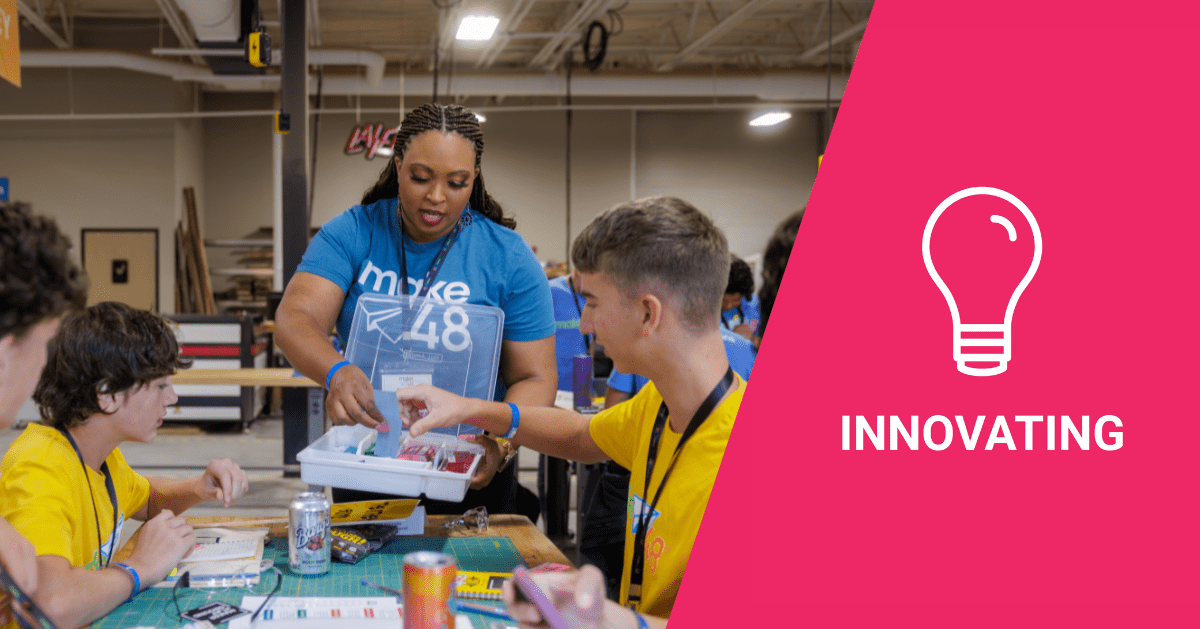
In the Make48 Innovation Experience, students are placed directly into this cycle. They’re given a real-world challenge, limited time, and the responsibility to collaborate, prototype, and pitch solutions. No step-by-step script. No answer key in the back.
At first, many students feel uncertain. That’s normal. But then something shifts. They begin to trust their thinking. They begin to experiment instead of waiting for permission. They begin to realize they are capable of more than they thought. That shift is the moment I lived for as a teacher.
Why Students Need This Now (Not Later)
For years, we told students: “Do well in school now so you’ll be ready for the real world later.”
But the world they’re walking into now demands adaptability, not just compliance. Employers aren’t only looking for content knowledge. They’re looking for people who can:
- Navigate ambiguity
- Solve problems without perfect instructions
- Collaborate across differences
- Adjust when plans fall apart
Those skills don’t magically appear at graduation. They develop in environments where students are allowed to wrestle with ideas, make mistakes, and iterate. When we intentionally build the Innovating Agility into learning experiences, we’re not just preparing students for a job. We’re equipping them for lifelong relevance.
From the Classroom to the Boardroom
Before my work with Make48 and The DeBruce Foundation, my career spanned architecture, engineering, K–12 education, higher education, curriculum design, and workforce strategy. Across every setting, the pattern stayed the same: The people who thrived weren’t always the ones with the highest test scores. They were the ones who knew how to adapt, rethink, and reimagine.
The Innovating Agility shows up when a teacher redesigns a lesson on the fly because students aren’t connecting. It shows up when a young professional navigates a role that didn’t exist five years ago. It shows up when a student who once doubted themselves stands confidently and pitches an original idea to industry professionals.
That’s not accidental growth. It’s intentional learning and development
Building It Early Changes Everything
When students learn to innovate, they begin to see themselves differently:
- Not just consumers of information, but creators
- Not just students completing assignments, but problem-solvers tackling real challenges
- Not just future professionals, but capable contributors right now
I’ve watched students who were once quiet take the lead on team decisions. I’ve seen students who struggled in traditional settings thrive when given autonomy and trust. I’ve heard educators say, “I’ve never seen my students this engaged before.” Those moments don’t come from motivational speeches. They come from experiences intentionally designed to stretch students in meaningful ways. That’s the heart of the Innovating Agility.
A Different Kind of Valentine
So yes, this month is about love. For me, it’s about loving the process of growth. Loving the uncomfortable middle of learning. Loving the moment a student realizes they don’t need permission to think boldly. And, it’s about believing, deeply, that every student deserves access to environments that invite them to innovate, not just comply.
When students build Innovating Agility early, they don’t just prepare for the future. They start shaping it.
Learn more about bringing the Agilities to your classroom, and learn about bringing the Make48 Innovation Experience to your classroom.