Link copied to clipboard
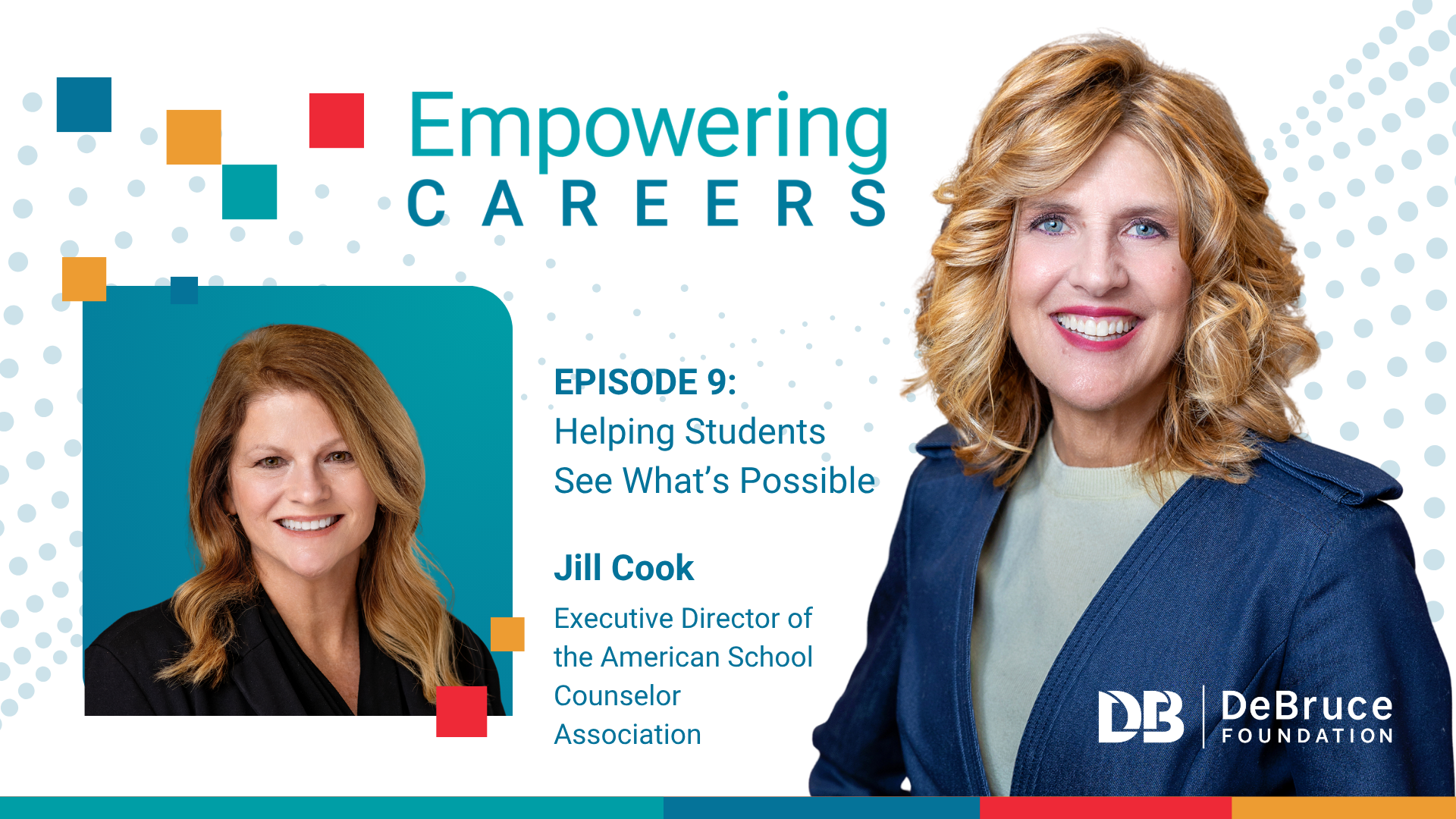
Episode 9 - Helping Students See What’s Possible


Takeaways
- Follow ASCA on Instagram
- Follow ASCA on Facebook
- Learn more about ASCA
- Follow Dr. Leigh Anne Taylor Knight
Transcript
Dr. Leigh Anne Taylor Knight
Welcome to the DeBruce Foundation’s Empowering Careers podcast, where we explore insights and strategies for building empowered careers. I’m Dr. Leigh Anne Taylor Knight, and I serve as the Executive Director and Chief Operating Officer of the DeBruce Foundation. And today I am thrilled to welcome Jill Cook. Jill Cook is the Executive Director of the American School Counselors Association. She has been a music teacher, a middle school counselor, and an assistant principal. And she joined the American School Counselors Association nearly 25 years ago and has served as the executive director since October of 2020. She brings a deep understanding of how our counselors support our students in schools and in their lives beyond and in thinking about their future pathways. So, Jill, I’m so thrilled to have you with us today.
Jill Cook
Oh, well, thank you so much, Leigh Anne. I’m thrilled to be here.
Dr. Leigh Anne Taylor Knight
So let’s just start with a little bit about your career journey. Tell us about where you started and how you got into this whole business of supporting and serving students.
Jill Cook
Sure. So I knew growing up I always wanted to go into education of some sort. My parents were both teachers, college professors. My cousins were teachers, aunts were teachers. I mean, it was very much in my DNA, and music was my love and my passion. So that just drew me into pursuing music education. And so my very first year, I was in a small rural district in North Carolina as an elementary school music teacher, and I had 3 schools, more than 1,000 kids, every week. And I didn’t like it very much because I didn’t feel it was impactful. And I spent a short stint doing high school choral music, and that was very enjoyable. But for me, it still wasn’t where I saw myself making a difference with students. So I got myself back to school and got my master’s degree in school counseling and landed in a middle school in North Carolina. And I was there for 7 years as a middle counselor, love middle school. And then—
Dr. Leigh Anne Taylor Knight
You should wear a halo. Love middle school? You should wear a halo.
Jill Cook
You either love it or you don’t. And it takes very special people, I think, to work in middle schools. But I love that age. They’re not grown, but they think they’re grown. I love middle school students. They’re so much fun. And then my superintendent—well, so a little backstory. So I had 3 children in 1 year, and they are not triplets. So I have an older son, and then I had a daughter, and 11 months later, 2 babies came along. So there was a time when my husband and I had all 4 children. We were at a Wendy’s in the small town where we lived, and we were getting dinner for the kids. And the superintendent—and my husband worked for the school district too at the time—the superintendent came through the parking lot, saw us in the Wendy’s, parked, came in, didn’t really say too much to us, but just kind of watched us with these 4 kids, 3 of whom were 2 and under.
And the next day I got a call and he’s like, hey, how would you like to be an assistant principal? And I was like, what? It wasn’t on my radar. We had a shortage at the time in our county and also in the state of administrators. So there were special provisions for emergency certification while you pursued the degree. And he was like, yeah, anybody who can handle that many children in a fast food restaurant can be an assistant principal. So that’s how I became an assistant principal. So my career journey wasn’t planned out from the time I was little, other than knowing I wanted to be in the education field. But some of it I just happened into, and it’s how I got the job where I am now. My husband’s job, he came to work for the National School Boards Association, and it brought us to Northern Virginia. And I had decided I’d look for a school counseling job, but there weren’t a lot of openings, and I was going to just stay home with the kids, but went to a picnic for my husband’s work, met one of his colleagues who said, hey, my neighbor is the Executive Director of the American School Counselor Association, and he’s looking for a school counselor to join the staff because they didn’t have any at the time. And here I am 25 years later.
Dr. Leigh Anne Taylor Knight
Oh my gosh, Jill, I love hearing that story. I think there will be a lot of our listeners who will relate to the fact that the career trajectories that we maybe think are gonna be linear actually get interrupted by things that happen in our life circumstances, by the people who see us or know us, and then these networks that we’re connected to, sometimes intentionally connected networks, sometimes not. I mean, we’re at a work picnic. My husband has a new job.
Jill Cook
Right.
Dr. Leigh Anne Taylor Knight
So your life trajectory and your career trajectory has been a part of understanding a little bit about yourself and maybe what you really cared most about, kind of going back to it’s about those students and doing that. And then also an organization that would say, hey, we need somebody who really is in the role of counselor or understands counselors if we’re trying to serve all of the counselors in America. What a beautiful story. And again, that network strength of being connected and going places. And sometimes what we say at the DeBruce Foundation is saying yes and showing up. You had to say yes to something that was a new and different risk and not something that you really had on your radar screen.
Jill Cook
That’s exactly right. And when people ask me for advice, that’s exactly it. It’s to say yes. One of my mantras I keep to heart all the time—one of my favorite singers and songwriters is Jason Isbell. He’s a prolific songwriter, and one of his songs is called “Be Afraid,” and the lyric is, “Be afraid, be very afraid, but do it anyway.” So that’s kind of—I’m okay with that.
Dr. Leigh Anne Taylor Knight
Yeah, well, that makes me think of the school counselors and the roles that they have in inspiring and guiding the opportunities of our youth. And I think maybe some of us think we know what a school counselor does because we had a school counselor. But even then, sometimes the ratios are like 1 to 200 or 1 to 400. And so do we really know what school counselors do beyond, is that the person who helped me get signed up for classes, maybe go to college if I want to go to college or explore that? But really, talk with us a little bit about how you would describe the impact that counselors are having on students, their academics, their careers, or their life trajectories, like what you were talking about.
Jill Cook
Yeah, thanks for that question, Leigh Anne, because the role is very different than it was 30 or 40 years ago, even from back in the day when I was a middle school counselor. Most of us may have had guidance counselors even. When I was in high school, that’s what I had, a guidance counselor who helped me select courses and helped with the college application, would sign off on that, and I only had one in high school. But in today’s world, we have school counselors at all levels: elementary, middle, and high school, and they support students around their academic development, career development, and social and emotional development. And what’s really different about the work today is that the work of the school counselor reaches each and every student in a school. It’s not just some students, the few students who want to go to college or who are in disciplinary trouble. It’s each and every student in a school, and that’s done through a comprehensive school counseling program that is grounded and guided by the school and student data. And that’s very different from the days of old. Even when I was a middle school counselor and it would be time to go do a classroom lesson and I’d just pull something out of the filing cabinet because I liked it.
It was not necessarily meeting the needs of the students, but it’s very intentional work looking at the data, attendance data, achievement data, discipline data, to see how then you can develop your school counseling program goals and then create a program for the course of the school year to help meet those goals and support those students. So if you’re familiar with multi-tiered systems of support, the triangle of interventions, school counselors do a good chunk of their work at Tier 1 level, and that’s delivering information and content to all students primarily through classroom instruction. School counselors at all levels go into classrooms, and these lessons that are being delivered are based on the need. It might be about study skills. It might be about resume building or friendship skills or learning more about yourself, but it’s delivered to all students in a school. And then at Tier 2, that’s when you do a little more targeted work based on the needs. You might do small groups. You might do one-on-one counseling with students. School counselors are not therapists. They don’t diagnose, don’t prescribe medication. They do short-term counseling, and if a student needed more than that, if they needed services at Tier 3, then referrals are made to get students and families that kind of support.
So for example, using the data, it might be something looking at grades. If you were in a middle school and you notice a pattern that the 7th grade boys, particularly in a section of math, their grades are very poor, and that’s not the case across the board. So what’s going on with this particular segment of students? So what the school counselor can do is help design interventions. It might be conducting a group on study skills or time management, connecting these students with tutors or getting them the additional support they need. But it’s not just about leaving it there. It’s then looking at the impact of that intervention. Did grades improve? Did we see improvements? And if not, then what else can we do? So again, it’s very different from the days of old where you might—in my image, it was the guidance counselor sitting around drinking coffee, just waiting on kiddos to drop by. That’s just not the role anymore.
Dr. Leigh Anne Taylor Knight
Right. I’m so glad that you’re helping our audience understand that. And really, that’s why they call it comprehensive, right?
Jill Cook
Right.
Dr. Leigh Anne Taylor Knight
It is. And it is comprehensive from earliest ages that we have students all the way through. And kind of leapfrogging from the elementary and the middle school, now in high school, so many of our students are facing this question like, okay, what am I going to do next? Right. And our counselors have a key role in that. So what are some effective ways to help students explore career options, and when does that exploration begin? Some of our research shows that you can’t start too early with kids starting to recognize that they can have competence and that they do certain work activities that someday someone will pay them to do, right?
Jill Cook
Right.
Dr. Leigh Anne Taylor Knight
But as they get into that, like, well, what do I want to be? What’s the school counselor’s role with that?
Jill Cook
Sure. And I think your point is an important one, that if we’re having this conversation not until high school, then it really is too late. It can’t be too early. It’s not even a K-12 conversation. It’s a lifespan conversation. Career development is developmental. It’s layered. It’s intentionally designed over time. In the early grades, it’s exposure and imagination. What are they seeing in the real world? What are they learning about? You talk about community helpers. You talk about how math shows up in architecture or writing can connect to media. Just really exploring their sense of what’s possible and helping them begin to notice some of their own interests and strengths. And then in middle school, it’s much more interactive and exploratory. They’re not just hearing about careers, they’re engaging with them. It might mean career speakers, project-based learning tied to real industries in your community. Interest inventories aren’t the end-all be-all, but they’re certainly a way to begin to learn more about yourself and as a point for deeper conversations. It’s not an endpoint, just more information along the way, learning about themselves, what they like, what surprises them.
But then in high school, it’s really about application and experience. It becomes tangible—job shadowing, internships, apprenticeships, dual enrollment, certifications—really the opportunities to test their interest in real settings and refine the direction based on those experiences. And so the school counselor is certainly—it’s not just the school counselor, it’s all the adults who interact with students—but certainly they’re integral to how this looks in a school and in a school district over the grade spans.
Dr. Leigh Anne Taylor Knight
Yeah. Hey, I’m ready to hire you to come work at the DeBruce Foundation right now because everything that you have said is key to what we call the Agility Advantage. And you mentioned doing surveys and helping students understand what they like to do and what they do well. We call those the agilities. And that’s where our foundation has free resources for students and for parents and for counselors and teachers and schools to be able to use that. You can actually talk about what those agilities are and then use them in classroom lessons or counseling lessons. But it’s really steeped in where you were also going into this idea that as they get a little bit older, the kinds of experiences that they need to have, those work-based learning experiences. In North Kansas City Schools where I worked, with the counselors there, we used to say it’s just as important that they learn what they don’t like to do as exactly what you like to do, right?
Jill Cook
Yes.
Dr. Leigh Anne Taylor Knight
And so that’s where we’ve kind of sat in that space as we’ve been developing. And our charitable mission is all around how do we get more resources out there, help people be informed career decision makers. And informed career decision making maybe looks a little bit differently now as we think about this workforce that continues to evolve. And so as you think about that and career preparation, it’s evolving right now too. So from your perspective, Jill, how do students need to prepare differently than they did even 5 to 10 years ago for this workforce that continues to evolve and really helping them even think about all of the different pathways that might be available to them?
Jill Cook
That’s such an important question because we know we’re preparing students for careers and jobs that may not exist right now. So what does that look like for our schools? So I think about it as not preparing students for a single job. We’re preparing them for a lifetime of change. My own journey wasn’t—I mean, when I was 10 years old, if you had said I was going to be an association executive, my 10-year-old self would have said, what’s that? So it’s helping them learn about adaptability, critical thinking, communication, and the ability to continuously learn. And that’s just as important as any one technical skill. They need to be comfortable navigating uncertainty, building skills that transfer across industries. At ASCA, we have student mindsets and behaviors, and these are what we say that students should know and be able to do when they leave us and how they think and how they apply their skills over time. So when school counselors do classroom instruction or lead small groups, they use these mindsets and behaviors, these student standards, as a guide, like a teacher does with a lesson plan.
They identify the mindset or behavior that they are going to address in a particular classroom lesson or small group and then construct the lesson around that. So mindsets like helping students believe in their ability to succeed, understanding that post-secondary education and lifelong learning are necessary for long-term success. So again, I think it’s really about continuous growth and not just a fixed endpoint.
Dr. Leigh Anne Taylor Knight
Oh my gosh, you’re right on track with how we look at things and even what the research shows us in this space. Individuals too who understand what they like to do and what they do well and how counselors are really helping them explore careers. That ability to learn how to explore is key. And having this growth mindset that like, I’m going to grow and develop with these different experiences, which means I may find things that I start to do even better, and I might find things that I like to do more, right?
Jill Cook
Right.
Dr. Leigh Anne Taylor Knight
And so being open then to helping students and even helping families think more broadly about career pathways. I’m so glad that you said this is about lifelong learning. This is about them constantly staying ready and also having that confidence that they’ll even consider careers. I mean, we’re talking about individuals who are probably going to have at least 6 different careers and probably 18 jobs. My 2 sons have already skirted into different sectors and had multiple jobs. And so even the school counselors helping families see, right? It’s not just a pick one or that their personality is going to stay the same. No, they’re going to grow and develop over time. And so even how do families kind of lean into that and help people do that too?
Jill Cook
And I think that’s important to keep in mind. We need to really shift the message as we talk about post-secondary opportunities. We have to actively normalize that there are multiple high-quality pathways. Absolutely, higher education and college is one of them, but it’s not the only option. There is career and technical education, apprenticeships, military, direct-to-work options, and we know that there is a need for skilled labor that pays well. So how can we help students and families understand all of these options, and how can we celebrate and validate all of these choices and options that young people make, and how can we destigmatize ones that may not have seemed as attractive as another one? Because we need them all.
Dr. Leigh Anne Taylor Knight
You have a really cool seat to be able to see what’s happening across the country. I mean, you have your own podcast, you talk to counselors and others across the country. So from that seat, are there really encouraging shifts that you’re seeing or innovative practices that really will help students be empowered for their future careers, Jill?
Jill Cook
Well, I do think the conversation is shifting. Again, it’s not certainly that college is not important, and we know all the statistics about what a college degree can mean, but I do think young people and families are beginning to understand that there are multiple pathways that are credible. It’s not a backup plan, but they’re intentional, respected choices. And school counselors certainly are part of the conversation. But I think as a society as a whole, as we’ve seen these needs, I think we’ve collectively shifted that conversation. And we’ve brought in voices and stories from people who’ve taken different paths. And school counselors are great about bringing speakers in, bringing in past students to share their journeys, to talk about how they landed where they landed. And so again, for students, it’s really seeing young people, seeing maybe students they knew who are older than them, bringing in speakers, making it seen, making it real. We can do our exploration online, and certainly in today’s technology, it’s fantastic. We can get so much information in real time about job opportunities and what your community data looks like in terms of the needs and what education requirements are and what salaries might be.
But helping them to see real people and do that exploration, bring in the voices and the stories, but also giving them the structured exploration and reflection. You said it earlier, it’s okay if it’s just as important that they learn what they don’t want to do as they do, and helping them be comfortable in that. That’s part of the journey in this exploration.
Dr. Leigh Anne Taylor Knight
Well, and it also kind of leads me to think about the school counselor has a role in this, but you’re talking about the community coming into the school. You’re really talking about opportunities being provided by others.
Jill Cook
Yes.
Dr. Leigh Anne Taylor Knight
And so I think that may be one of the biggest pieces that educators, but the entire community needs to embrace. These are all of our young people. And yeah, we have these opportunities even in our own hometown and in these industries and helping them be able to see it so that they can be it.
Jill Cook
Yes.
Dr. Leigh Anne Taylor Knight
Is something that maybe is on the shoulders of educators to help build those bridges, but it really takes this community collaborating. We’ve had some other guests on that have talked a lot about that and really do believe that. Do you think, Jill, what do you see out there that you think are maybe some of the biggest obstacles for us helping as communities, helping students explore careers and build their confidence and their skills for these future jobs that we don’t even know what they’re going to be? What are some of our biggest obstacles?
Jill Cook
Well, you sort of hit on it. I think sometimes this work and these conversations are done in silos. Even though I just said it, this is a community effort, but oftentimes education and school districts work in isolation, and then you have the community workforce, and sometimes they don’t talk to each other. And one of the biggest surprises as I’ve had these conversations about career development is being at tables where they say, no, we’re not talking to each other. The businesses are saying we want students to come out of high school with X, Y, or Z skill, but they’re not telling the education system what their needs are. So I think being vulnerable to having those conversations, because it makes you vulnerable when you open yourselves up from either end. So how can we continue to have those community conversations? That’s when change will happen.
Dr. Leigh Anne Taylor Knight
You know, the word vulnerable also brings to my mind something else that’s kind of in play. You’ve done some work in this area and thinking about this. Everybody’s talking about AI and do we have to—are we now going to be more vulnerable in the jobs or the certain jobs that are going away or how we’re going to work in our jobs because AI is going to be a part of that. From your lens, what we know about AI today—I know it’ll be different tomorrow—but what we know about it today, what are the kinds of conversations that you’re hearing happening within your community and the counselors and others around the nation regarding it and its impact?
Jill Cook
Yeah, so it’s scary for some. It’s new. There are some school counselors doing amazing things with that. School counselors using AI to help them design their lesson plans and helping take away some of that administrative work, putting in, this is the student standard I want to address in this lesson. Help me design a lesson for this. And in their work with students, it’s much more robust information about helping students match interests and strengths and values to career clusters, suggesting careers or pathways that students may not have considered, showing those multiple pathways and getting that information in real time: in-demand jobs in your area, the salary ranges, growth projections, required skills and credentials. And I don’t know that we know how it’s going to shift the workforce at this moment, but I think it goes back to what we were talking about. If we can be committed to lifelong learning and having those skills and abilities to navigate something that’s not just from point A to point B, that there are going to be lots of on-ramps and off-ramps, I think helping them realize that those skills are what will help set them up for success.
And with AI and school counseling in particular, I just want to throw this in that school counselors—it’s not about replacing school counselors. AI cannot provide therapy or delve into mental health concerns with a student. So I think as we learn to live in this new world, being very clear about what it can do and what it shouldn’t do.
Dr. Leigh Anne Taylor Knight
Yeah, well, and you mentioned earlier about the importance of counselors using data. Some of the things that you could use AI to do to just give you the snapshots of information of the data without you having to pour through so much of that. So some of the summaries of that, some of that administrative tedious pieces that could be done by AI so that you release the margin of the counselors to be the ones that have those human interactions.
Jill Cook
Exactly.
Dr. Leigh Anne Taylor Knight
I really think that it could set us up to address some of those administrative tasks, as you said, that have gotten more and more on the plates of counselors and educators and others who are in schools serving. At the same time, okay, where can AI actually help us be more efficient so that we release the margin of humans to have the relationships, the student rapport, the relationships with one another so that we’re actually talking about how we can be holistically serving the students and our community. So maybe that’ll be something that’ll come of it. Looking ahead, I mean, we’re talking about it right now, we’re already in the future. What really gives you optimism about this next generation of students and the careers that we know they’re going to create? It’s not only what’s going to be out there for them, but what are they going to create? What gives you optimism about this next generation?
Jill Cook
Well, I think students today are just incredibly adaptable. They’re socially aware, so purpose-driven. And I think they’re asking thoughtful questions about impact and meaning, not just income or title. And so I think that mindset is going to lead to innovations in ways that we just can’t foresee at this point. But that makes me very hopeful.
Dr. Leigh Anne Taylor Knight
And I bet you’ve got a hopeful story or two in your bag too that’s really reflecting on maybe a student’s life that’s been changed because of the role of a counselor or an educator. Could you inspire us maybe with a story like that, Jill?
Jill Cook
So what stands out isn’t necessarily one specific student, but really a theme I’ve heard repeatedly from school counselors across the country. School counselors describe students who come to them believing explicitly or implicitly, for example, that college is not for them. They’re disengaged, uncertain. Their experience and their sense is very narrow of what’s possible, and based on maybe their academics, what they’ve been told or heard from others. And so in those kinds of moments, a school counselor’s role is not just to immediately solve anything, but it really is to listen. And it’s that human relationship you talked about. Listen for what does spark interest. Is it hands-on work, problem-solving, creativity, helping others? And then school counselors can intentionally shift the conversation from a narrow identity question like, what do you want to be? And toward an exploration question. What do you feel capable of? What kinds of environments bring out your strengths? And so across these stories, school counselors describe what happens when students are introduced to pathways they just hadn’t previously considered—career and technical education programs, certifications, or other postsecondary options. Sometimes it might be a campus visit that sparks interest.
So when I was a middle school counselor, I worked with the 8th grade students, and one of the things I started is I made it my goal for every 8th grade student in my school to go to at least one college campus. We lived in a fairly rural area, but we lived in North Carolina, and there are a lot of colleges and universities in North Carolina. So we started a college day, and I got funding, so we would take the students. We would all go on the same day to two different universities. We had groups who would go to UNCG and Wake Forest. We’d go to UNC Chapel Hill and Duke and NC State and Marymount. And I remember distinctly a young 8th grade young man. So I went to school at UNC Chapel Hill, in full disclosure, and so that’s the trip I would always take with the students. And we were at UNC Chapel Hill on the campus. And this young man, he was looking around the football stadium. He was at Kenan Stadium, and he said, “I never thought I would step foot on a college campus, and this gives me hope. I would really like to see myself going to college someday.”
And that story has stayed with me. I remember the look on his face as we were standing there on a beautiful fall afternoon. So it’s things like that that make the role so rewarding. Anybody who goes into education, they do it because I hope that they really truly want to help students at whatever point they’re working in along this pathway and along this journey for students. And for me, school counseling gave me—when I couldn’t find that joy and that spark in the classroom as a classroom teacher—being a school counselor let me work with all students, but it also gave me the opportunity to work one-on-one and have, I think, a real impact on students’ lives.
Dr. Leigh Anne Taylor Knight
And I can tell that you are passionate about that and doing that, and how fantastic for counselors across the country to have you as a leader in the position you are, understanding really the important role that they have and helping all educators understand the important role that they have and how all working together for the well-being and the health and the futures of our students and really of our economy and our country. So that’s exciting. Okay, I’ve got a lightning round. All right. Three questions. I don’t know if we can answer them in one sentence or not, but here’s the first one. If every student could graduate high school with one mindset or ability, what would you choose?
Jill Cook
A strong sense of self, knowing their strengths and interests and how they learn best.
Dr. Leigh Anne Taylor Knight
I love that. Second one, what’s one question every student should ask themselves before making a career decision, Jill?
Jill Cook
Does this path or does this choice align with who I am and how I want to contribute?
Dr. Leigh Anne Taylor Knight
Excellent sound bites. All right. What’s one thing our audience can do to help students build brighter futures?
Jill Cook
Expand their exposure. Help them see the possibilities. Help them see more possibilities than they currently know exist.
Dr. Leigh Anne Taylor Knight
Thank you so much for being with us, Jill. And perfectly, your answers at the very end there perfectly aligned with—I was taking some notes to make sure. After I have heard Jill speak today, I want to challenge myself. And audience, I want to challenge you too. I want to challenge you guys to do the things that Jill has talked with us about today.
Number one, we need to actively normalize options. We need to make it the rhetoric and the normal thing for families and schools and others in our community to be talking with students about options. Lots of options. Yes. Secondly, students need to hear voices and stories. They need to be exposed to what these are, and that comes from voices and stories, and that takes all of us to share our voice and our story so that just like Jill and I, I would say the same thing. I didn’t expect to be doing what I’m doing today. Didn’t probably even know what this job was when I was 10 years old. Like Jill said, the same is probably true for you. So your voices, your stories, they’re key to helping our educators help our students see multiple pathways.
And third, introduce them to pathways not yet considered. Jill gave specific examples of how she had done that. We can all take responsibility in our families and in our educational settings and in our community settings. And I so admire the chambers that are getting behind this work, the businesses that are getting behind this work, all of the not-for-profits across the country that are saying this is important. We must now help students understand themselves, have confidence in themselves, what they like to do and what they do well, and be able to see what the options are that are out there. And so it’s going to be about all of us working together to do this.
So for everyone who tuned in today, if you enjoyed this conversation, we hope that you will follow us at DeBruce.org and on our media channels for more career-building resources. Jill, thank you so much for being here today.
Jill Cook
Oh, thank you so much for having me, Leigh Anne.
Dr. Leigh Anne Taylor Knight
Well, together, as Jill has taught us, we can build empowered careers. We hope to see you here next time. Thanks again for being with us!