Link copied to clipboard
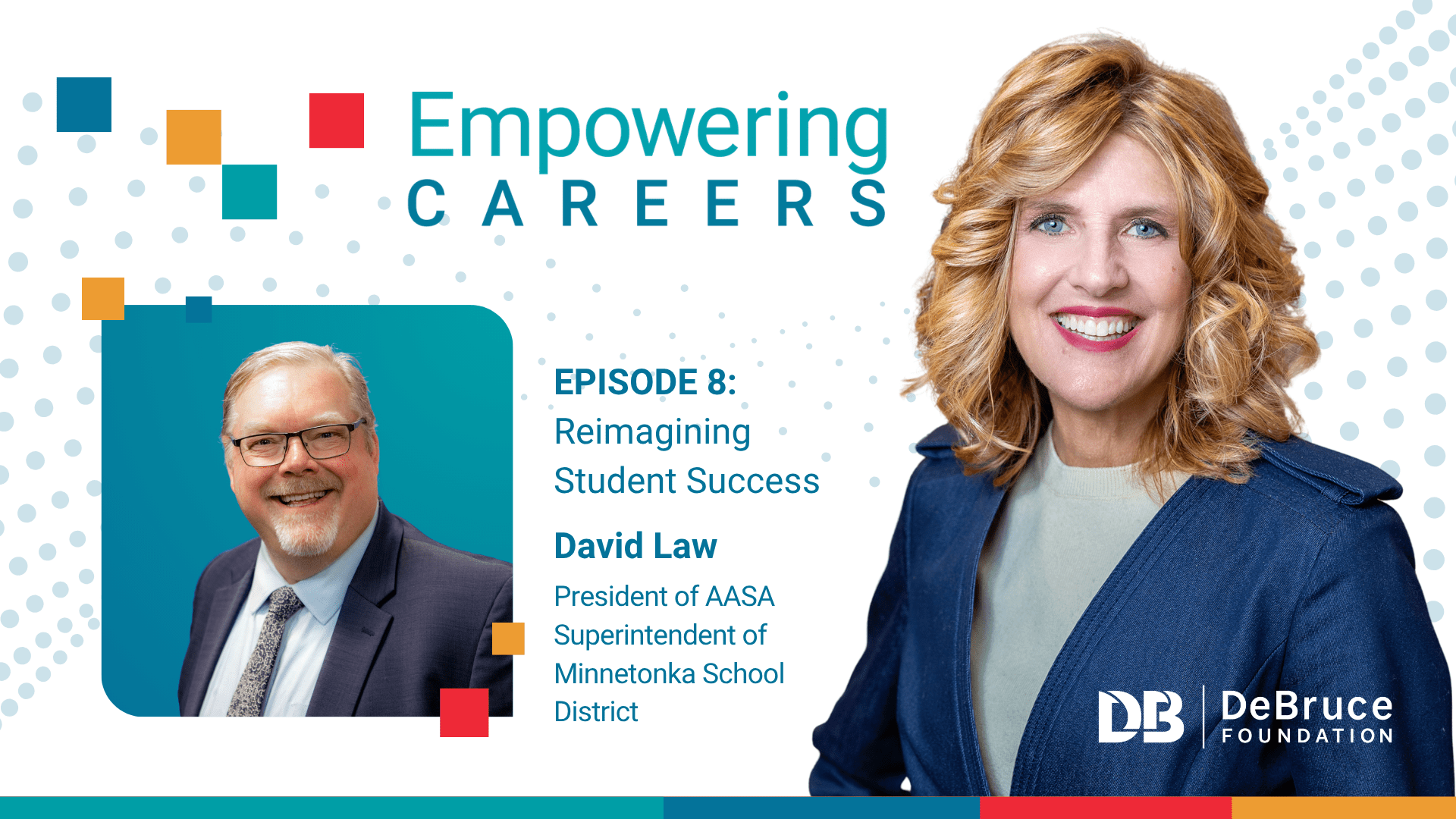
Episode 8 - Reimagining Student Success


Takeaways
- Follow David Law on X
- Follow David Law on Instagram
- Follow David Law on LinkedIn
- Learn more about AASA
- Follow Dr. Leigh Anne Taylor Knight
Transcript
Dr. Leigh Anne Taylor Knight
Welcome to the DeBruce Foundation’s Empowering Careers podcast, where we explore insights and strategies to build empowered careers. I’m Dr. Leigh Anne Taylor Knight, the Executive Director and Chief Operating Officer of the foundation. And today I’m thrilled to welcome David Law to our podcast. David is the Superintendent of Schools in Minnetonka Public Schools in Minnesota and currently serves as the President of AASA, the School Superintendents Association. He has spent more than 30 years in public education, from classroom to district leadership, and now he represents more than 13,000 school leaders across the country. David, welcome to our podcast.
David Law
Leigh Anne, great to see you this afternoon. Thanks for having me. This will be a fun conversation to have.
Dr. Leigh Anne Taylor Knight
It will. We’d like to start with learning a little bit more about your career journey, right, David? So we have people listening, who they’re trying to figure out their career journey or how to help other people navigate a career journey. So, talk with us a little bit. I know you started as a math teacher, then came up through the ranks, superintendent, and now a national leader of, of school superintendents. So, what are the kinds of experiences along your career journey that really impacted the way that you approach learning and leading in schools now, David?
David Law
Great question. Thank you. I think this is, you know, we are a people business and we’re a teacher business. And so when I look back over my career, and actually, if you go back to my first teaching experience, I’m 41 years in. I started while I was in high school as a swim teacher and coach. So My time teaching was about 15 years from that experience until I left the classroom. And I think we are forever teaching. In my job as superintendent, I am constantly educating people about things that they’re not— you know, as I’m informing, I’m thinking of how can I message something so that these people will appreciate either the complexity or the intention of what we’re talking about. So, and on top of that, as I talk with aspiring leaders within education uniquely, teachers like to know that the person leading them understands teaching. And while that job has significantly changed over 30 years, you know, the concept of prepping, of managing, of supervising, of multitasking all day long, the structure, When can I go to the bathroom? What 5 minutes do I have to make a phone call? How long is lunch?
David Law
All those things are unique to education, and, and I think that’s a good background. Educational leadership is about collaboration. I’ve had lots of conversations in the last week about, are these things that teachers think we’re doing to them or doing for them? And So that, that really came from— I spent 12 years as a middle school administrator, both as an assistant principal and principal, really walking the halls, supporting teachers. And then district-level leadership is balancing pressure on our system with implementation within our system. And now really over the last 12 years working with school boards to say, what does everything we know tell us we should be doing? And then as the implementer, how do I take the direction they have, make sure they’re competent with it, and work in our system to make positive change? All of those things are a progression over time, and nothing is a better teacher than experience.
Dr. Leigh Anne Taylor Knight
100%. And I love the way a lot of people talk about making data-driven decisions, but I love the way you framed that in the space of taking everything we know and then using it to inform what we’re going to do. Because sometimes we just put data in one lane, right, David? And it’s really about everything that we know, which all can be data points too, but then using that to inform what we do next.
David Law
Well, yeah, we are. I remind people we should blame ourselves for how people have viewed us because we’ve done things without being very clear about what we expect to change.
Dr. Leigh Anne Taylor Knight
Right.
David Law
And then when nothing changes and we do something different, whether it be our employees or our students or our community, you know, and we wonder, why don’t they buy in? Well, if we didn’t say, this is what this will look like if we’re successful, shame on us.
Dr. Leigh Anne Taylor Knight
Yeah.
David Law
But how do we know when we’re done? We’re done when we stop doing it, whether or not we accomplish what we set out to.
Dr. Leigh Anne Taylor Knight
That’s right. And even acknowledging, so taking ownership of that accountability and also acknowledging that, by the way, we’re going to try some things and they’re going to fail, and our job is going to be to learn from them, right? If we as educators can’t step out into that space and really be about failing forward and doing the best that we can all the time, but really being accountable to ourselves and others. Yeah, I appreciate your saying that. And I know a lot of people listening will also appreciate that where they sit, whether they sit in the seat of an educator or a parent, a community member, school board member, all of the businesses, right, who we partner with.
David Law
I mean, we have lots of similarities with businesses. We have some significant differences. Our output are humans, and humans have free will. So it’s different than making a thing because a thing is an object. We’re dealing with humans, and humans are in constant development. We are in development still. Yeah.
Dr. Leigh Anne Taylor Knight
Yeah. Well, let’s talk a little bit about the role that educators have played on your pathway. I want to share this quote with our audience. David shared about his success, quote, the love— what has shaped your success, quote, the love of your family and the commitment of public educators to see your potential. So you give family and educators some of that credit. Would you just talk with us a little bit more about the role those educators played and why that kind of a role matters for our students today still.
David Law
Well, I, first of all, I’m the youngest of 7 children and I’m going to give my siblings a shout out. I’ve learned many life lessons from them and I think life lessons, people always assume, oh, those must have been good lessons. Nope. You know what? Sometimes you can learn a lesson from someone because things didn’t work out for them or things did, right? And those are all valuable lessons. But at its core, between those two things, people who believe in you and expect you to be successful matters. And, you know, I was in a building earlier this morning and we were talking about students that aren’t meeting our expectations yet as a frustration. But on the flip side of that, it’s students who we see as capable of doing so much more. and it’s a belief in that student. And so public education at its best is when we can see potential and help kids reach that potential. And, you know, when people talk about what’s the magic bullet for all that ails education today, it starts with, I believe the people I’m working with can be successful. And for me, my family moved around a lot over the time I was in public education.
David Law
I went to 8 schools in 12 years. In Illinois and California and Minnesota, Illinois, and again in Minnesota, the common theme was I quickly would come across people who saw potential and invested in me. And if you can do that in 4 elementary schools and 2 different middle schools and 2 different high schools, and I’m not a statistic, I could be, that’s a positive backstory. It’s possible, right? And so I, I tell that story sometimes as we talk about people who are in transition or who are in crisis or who are homeless. We are the stability in public education, and when we provide that, we can disrupt whatever instability those kids have had.
Dr. Leigh Anne Taylor Knight
Yes. Yeah. Well, and I’m going to hearken back to something that you said early on about leadership, leadership being about collaboration. So the same applies to the adults. When you believe that the adults can do what we’re attempting to do, and together we move forward. That’s the same trip. So we need to believe in those students. We need to believe in our communities to be a part of that. And we as leaders in organizations really need to believe in those with whom we get to work every day and collaborate.
David Law
Absolutely.
Dr. Leigh Anne Taylor Knight
Yeah. You know, Minnetonka is known for innovation. And so what are some of the programs or approaches that you’re specifically excited about right now?
David Law
Well, I’ll take two different approaches to that question. One, you know, we have had the good fortune of stability in trajectory, and so we have some long-established programs that we’ve been tweaking that are really high quality. We have 40% of our students are either in K-12 Spanish immersion or Chinese immersion. And those programs are constantly innovating within themselves. But, you know, if you think of the concept of innovation as what’s new and different, those are programs that are established and successful, and they’re innovative in the fact that we’re tweaking within an established program that’s very successful in Chinese immersion programming or Spanish immersion programming, and they’re constantly coursework within those programs are constantly evolving, and that’s a source of innovation. On the other end of the spectrum are public education and this perception that we’ve been the same program that we were in, in the ’70s and ’80s. We are so different. I just presented at a local Rotary last week, and the most common thing I hear is, I wish that those things were around when I was in school.
Dr. Leigh Anne Taylor Knight
Oh, I hear that too.
David Law
Yes, yes, the experiential learning we provide for students that is problem-based, it’s real-world-based. Just a handful of examples. Some of our students are presenting at the Capitol on the importance of school safety. Now talk about relevance, school safety across the country. But those kids are learning about both the what of school safety and the political why and the barriers and everything from, you know, what’s the role of an educator to talk about gun violence or gun safety or gun protection or school hardening or safety practices. But those experiences for kids are relevant to a topic today, and they’re working with one-on-one. Their mentor reached out to our school board and invited to come hear them present. To a local community group about what they learned. So, um, collaboration, public presentations, working with a mentor, research, final product. A different spin on that in that experiential learning program, we had students do web-based improvements with community organizations, and one of our student groups worked with the local community group on recycling, and their video that they created on teaching the community about what it looks like to recycle in our community is still on that district’s web page.
David Law
So you talk about a, you know, a resume piece or something in a portfolio, they’re going to say, well, I’m just going to show you this link. Here’s a product that I created that still lives today serving a function. It’s not some random hypothetical product. This is a real thing we created that’s still being used in our community. That’s how education is evolving and innovating. It’s giving kids real opportunities that are relevant and practical.
Dr. Leigh Anne Taylor Knight
Yeah, and the students get turned on by that. I’m guessing too that your educators get turned on by that when they get to help students create and dream in those particular spaces. And put them, you know, the other thing that is happening for those students is they’re practicing being citizens in a democratic society, right? And they’re learning about policy and how to impact the things that they care about, which I think that’s one of the things that’s really hopeful about this generation that we have is they’re being realistic about their future. They’re also really hopeful that they can change it and make good things happen. But if we think about the adults who get to work with these students, talk with us, give some advice to superintendents and other leaders about how we can create cultures where educators can feel empowered to innovate like this, like these programs that you’re talking about. How do we create that, create that kind of culture?
David Law
Well, first of all, when it— when you walk in that building and you see, and, uh, there’s 12 different, uh, pathways for students, whether it be fashion design or international marketing or business analytics, but what you C is not as much teacher-led as it is student-involved. So here’s 4 students in a breakout room sitting together, maybe for 3 days straight. And if you’re a teacher who thinks, I’m teaching well when I can see everyone in my class and I’m guiding their work, it’s going to feel very different. So you really have to One of the things we do is we host a lot in Minnetonka. I’ll throw that out there. 3 or 4 times a year, people from across the country will come and look and say, well, we want to see this Vantage program or this Momentum program. And then they get in there and then they’re excited because they can’t imagine as a teacher how, how fun it would be when your kids are loving their work. Yeah, you’re like, you’re not keeping them on task. You’re trying to help them out as fast as you can because they’re so excited to move things forward.
David Law
Yeah, but it, it, it’s a paradigm shift. It is so different than what teachers experienced.
Dr. Leigh Anne Taylor Knight
Yeah, to being that guide on the side, that facilitator. It is different than how they experienced learning and how they have experienced teaching.
David Law
Right. And everyone thinks I went to school, therefore I’m an expert on what school must look like. And then this looks different. And even for their parents, I hear parents say, I was a skeptic, but every student should have an experience like this.
Dr. Leigh Anne Taylor Knight
So, yeah, let’s dial it up to your national perspective. I mean, you have the vantage point of working with superintendents across the country. What are some of the encouraging shifts? Like earlier you mentioned experiential learning, seeing more of those, those kinds of things. What are the new ideas that you’re seeing in education right now, David, as you go across the country?
David Law
So AASA, and I was very fortunate as I came into the presidency, they’re talking about, you know, where do public schools need to go over the next 10 years? We’re really looking at this narrative about a concern about are our schools meeting our needs? And that, you know, there’s some really competing things happening in the education space. On one hand, students have the ability through technology to get information faster than their parents ever could. Like, they can interact and find things, whether it be with AI or with databases and research. And so how we have students grow in that and how adults can comprehend, well, what do kids need to learn if they can get this information? You know, they’re really going to be managers and communicators of information rather than creators of information. I mean, there’s still some creation in that. Um, the best schools are helping students be flexibly navigating all of the tools we have available today, understanding, you know, we’re, we are interacting in a medium that didn’t exist in, in this fashion 10 years ago, right? Right.
Dr. Leigh Anne Taylor Knight
Yes.
David Law
Um, the also, so there’s this flexibility and real skills for real life. That’s a, that’s a piece of it. Another part of it is measure what matters. What are our future, our students’ future employers or educators wanting from our students, and how do we communicate that? You know, there’s this, you know, we’re having a really funny conversation in Minnesota, probably across the country, about the role of cursive instruction. And it’s interesting because what you get at the core of— I heard someone say to me, I want my children to be able to read my mom’s letters. That’s very romantic. It’s very practical. It plays a role. But there’s a disconnect because I’ve not had any employer say, you know, your children’s lack of ability to read and write in cursive is why we’re not employing them. So there’s this, yeah, hey, teach the stuff that you’ve always taught. But make sure kids are ready to do things they’ve never done.
Dr. Leigh Anne Taylor Knight
Yeah.
David Law
So we need to, we need to figure out what’s the stuff and then how do we measure and communicate that. We’re hearing this big shift in, in the skills, the essential skills that students need to have: communicate, collaborate, work with other people, self-direct, attend, engage. You know, we want people here when we expect them to be here, and we want them to be doing things we expect them to do, and really maybe improving, curiously improving the things that they’re working on. We do all those things at school, but boy, we don’t communicate them very well.
Dr. Leigh Anne Taylor Knight
Well, and it’s also about helping students process the process so they can communicate from the experiences that they have what have they learned, right? So it is both, it is both helping the adults be able to understand and communicate that as well as the students when they’re in the process. Talking about students, one of the things that we say here at the Diverse Foundation is that we often recognize talent is distributed equally, but opportunity is not. And from your national lens, like across the many communities and the districts that you get to work with, I bet you see differences in the resources and the access. In fact, you even kind of alluded to it in the, in the last, in the last question. From your perspective, David, what does it look like to close those opportunity gaps so that every student really has that chance to succeed and to, to help them build those kinds of essential skills that you’re talking about, those kinds of things that really are going to be a requirement for them to be upwardly mobile and having economic opportunities?
David Law
I love this question. I think, you know what, I could be at peace with education if we could acknowledge every student walks in with skills and that those skills all represent some value. What we, we take a lot of pride in the fact that we’ve identified what we think excellence looks like, and kids come to us with all sorts of excellence, and we say, well, that’s really great that you’re incredibly creative and tactile. And imaginative, you know, but, but how are you at being not imaginative and following a really direct prompt and giving the exact kind of answer? So I think the opportunity gap starts with acknowledging everyone comes with a skill set.
Dr. Leigh Anne Taylor Knight
Oh, I’m so glad you said that. Yes. Yes. Talk more about that.
David Law
That, you know, when we define what we say excellence is, we discount the amazing that kids bring to us.
Dr. Leigh Anne Taylor Knight
Yes.
David Law
And, and really, sometimes we work really hard to beat it out of them and say, yeah, that’s great that you’re talkative and a leader, but could you just be quiet and, and submissive? And, and really, that student becomes disengaged and says, what I’m good at isn’t valued here. And there’s that balance of, yes, we all need to hear direction and do work. Then the other part of that is A good friend of mine was the superintendent in Fargo, North Dakota, and when we were talking about the Public Education Promise, he said it’s not going to be a sales pitch in North Dakota if all we’re doing is educating kids for the purpose of leaving their communities. Right? We need to be educating students in their communities for the needs of their communities. That means constantly saying what’s the needs of our communities? And then aligning our education to meet that, that’s that opportunity piece. You know, our, our standards-based education system is intended to prepare every student for the choice for post-secondary. It doesn’t have to be a 4-year school. It’s the confidence that whatever your post-secondary option is, we want you to be prepared.
David Law
And so within that, that opportunity gap question is, have we exposed you to things that are interesting, that are career pathways, that are aligned to your skill sets, that make you feel confident to move on and be successful? And it isn’t, have we prepared you to take 6 AP classes and get a 5?
Dr. Leigh Anne Taylor Knight
Right.
David Law
And when we measure success based on, here’s some criteria, a very foundational part of my educational career was I spent several years working in a high school at-risk setting. And it, as a student who wasn’t a high school at-risk student working with about 170 9th through 12th graders who were in that setting, I had to readjust myself to realize that it wasn’t my place to tell these students what their dreams were. It was to help them make sure they had dreams and put them on their way and not have them limit themselves. And I work with some incredible educators who helped me frame that resource. But if you have someone say, I know what these kids need without listening to the kids, you’re missing the boat.
Dr. Leigh Anne Taylor Knight
Yeah.
David Law
Because none of us are, or none of the happiest of us are what someone told us we needed to be. Right.
Dr. Leigh Anne Taylor Knight
Well, I share that experience with you. That’s, I cut my teeth in an alternative school too. And we had the 7th through 12th graders who had been basically Oh, school didn’t work out for them in any of the other settings, right? And so when— and like you, I had not been a student who had struggled with, with this. And so really getting to understand how to meet students where they are. And I did pull a quote that I was like, oh, I think this quote is indicative of the conversation that we’re having right now. You have said, quote, I’m committed to help kids find their dreams and chase them. Our job in public education isn’t to tell students what it is to be great, it’s to help them find their strengths and run with them. And that, that fits so much inside of the work that we’ve done here at the DeBruce Foundation. And just even recognizing, we have a colleague here who has said, you know, building confidence in kids is no small thing. Even building confidence in adults right, is no small thing. So when we get back to even helping kids explore and develop these skills that we’re talking about, at the same time, as you mentioned, recognizing that they showed up on our doorstep with a lot of skills.
Dr. Leigh Anne Taylor Knight
Now, how do you— and I always love, I love middle school educators because I think they’re some of the best at like seeing kids and who they are, and then like going with that, like, okay, we are just gonna celebrate that and move on into that. And even as we think about as educators, we’re talking now so much about college and career readiness. I mean, we have for the whole time you and I have been in education, we’ve been talking about that. And yet we’re doing it in a time that the workforce is readily changing. I mean, these students aren’t going to have one job or one career. They’re going to have probably 6 different careers, maybe 18 different jobs, right? So, It’s moving so quickly that makes this development of skills all the more important, recognizing what they already bring to the table and then, you know, also capitalizing on that. So if you were to talk about what does true workforce or career readiness look like for you, David, or for the students that you get to serve, you know, what would, what would you say it is?
David Law
Well, my first pushback for post-secondary or careers is that the reason that those are unique places is because they play a role in developing people who get there. And so I’m always a little critical when someone says, well, they weren’t ready when they got here. First of all, those of us who work in K-12, We don’t get the luxury of telling anyone when they got to the doorstep, hey, you weren’t ready when you got here.
Dr. Leigh Anne Taylor Knight
Right, right.
David Law
We, we, we could waste a lot of wind complaining you weren’t what I would define as ready.
Dr. Leigh Anne Taylor Knight
Mhm.
David Law
On the other hand, all of those places are unique because they provide opportunities and training. So what we hope to deliver are people who show up are curious, can attend and adapt and learn, and that we want to be communicating a transcript, a resume, a story that says, look at how I’ve grown in this place that I’ve been as an indicator of how I will grow at this place that you’re inviting me. And I think that is college and career readiness. It’s exposure. Ideally, there’s some areas of interest, and, you know, students have unique skill sets. We have students who have a passion for technology or a passion for policy or a passion for creation or, you know, manufacturing or those pieces as a starting spot. But it’s not a culminating spot. It’s, I’ve been successful in this. I’m curious. I’d like to do this. And then I’m going to come to you and learn with you. I think of the wonderful— you know, we launched one of the— pardon my pun— one of the biggest growth areas we have in our system is around aviation because it’s such a wide open career pathway. And our students— and we went on a first flight.
David Law
We’ve got an alumnus who works at an aviation industry, and all of our students get a flight and they get on a plane and One sits next to the pilot and one sits in the back seat, and they go to do their flight. And then the, the trainer essentially, when they get off the ground, says, ‘Take the wheel.’ And that person sits back like driver’s ed, and our students are flying. And then one in the back seat, and they fly around. And, and I actually went on one of these flights with just a trainer and I, and I flew around a little bit. And, uh, uh, we were there as kids switched, and these two kids switched, and one got out and the other one got in. And the one student said, I am never going to be a pilot.
Dr. Leigh Anne Taylor Knight
Right, because it’s just as important that they learn what they don’t want to do as what they do want to do when they’re going through these experiences.
David Law
Right. However, that person understood, I love the aviation industry. This, you know, there’s a lot of operational sides of aviation I want to do. I don’t want to fly a plane. The other person now has her pilot’s license because she loves it. Okay. So those are incredible lessons to learn in the K-12 system about here’s something I thought I wanted to do.
Dr. Leigh Anne Taylor Knight
Yes.
David Law
That isn’t right there. Or here’s something I thought I wanted to do and now I really want to do it. We should be able to provide both those experiences.
Dr. Leigh Anne Taylor Knight
Yes. And maybe before I spent X amount of money for Y amount of years in doing this. So, you know, David, you’re so committed to student success. And you also operate from a belief system that like this has got to be created by community, right? So would you talk with us a little bit more about your Portrait of a Graduate? I mean, like this, this simulation, this example is perfect. Like you couldn’t do that as just the school. You had to, you get to involve the community in that. So tell us a little bit more about Portrait of a Graduate. I know some other school districts are doing it across the country, but there’s still a lot of people out there who don’t know or understand that and the community-driven shared vision for something like that.
David Law
You asked in an earlier question, what are school districts across the country doing that’s really innovative and new? And I’m going to come back to this topic of the Portrait of a Graduate.
Dr. Leigh Anne Taylor Knight
It’s okay.
David Law
What does our community think our graduates need to have in their tool belt? And that’s that Portrait of a Graduate. It’s students. We’ve identified some of these things. Students who can work together, students who complete tasks, students who engage, students who are present, students who are, who, you know, their academic competencies are there. You need to be able to communicate, read, write, speak, text, type, all those things. That’s all part of it. But in, in whether it be in a farming community in Montana or an urban setting in Chicago, your portrait of a graduate should reflect here’s the place our students are going to go and what that place says our students need. So in Minnetonka, our portrait of a graduate has this balance of experiences that students should have within our system that matches what they will likely need to do next. And it has to be community nuanced because our, our students are in different communities across the country. There are some generals across the entire country and Of course, but it has to be community nuanced. Our, our students don’t need to do as much in an agricultural setting, but there are people across the country that is where most of their graduates go.
David Law
So it should be reflective of your community. It should be community influenced. You should be annually, whether it be our aviation program or our automotive program, multiple times a year checking with those industries to say, are our experiences still meeting what you would expect coming out of our system? That’s part of that Portrait of a Graduate. It’s community involved, it’s relevant work, it’s opportunities to work together, it’s project-based. I will tell you, as much as I’m the superintendent, and that’s a singular title, everything I do is collaborative work with the team. You just can’t without.
Dr. Leigh Anne Taylor Knight
Right. I agree. And so Give us, as you look at this newest generation of students, David, what gives you the most optimism about their future?
David Law
Well, our students are amazing. I’m in a week or so, I’m presenting at the National School Boards Association with a young woman who is a senior in Minnetonka. Her name is Rory Shane and she’s fantastic. And she was part of a group of students in public policy that studied how great school districts include students. And they presented a model to our school board, and our school board adopted that model, and we are in our pilot year. And actually, like anything, we’ve learned what’s working and what’s not working. So I met with her because she’s traveling with us to the National School Boards Conference to present. And in that, we— I just gave her some questions. I said, here’s 7 things I want you to present on, take it away. I’m not going to tell you what to do because clearly you did some amazing work on your own. Our students, if we let them be amazing, they will blow us away. Oh, and so that, that is, you know, to answer your question, what are, what our students are capable of, what they’re doing, how they’re shining. That’s, that’s the job right now.
Dr. Leigh Anne Taylor Knight
Yes. Yes. And again, she will be the star of the show. You and I both know that. And, and again, there are so many ways that we can empower students, and we just need to let go of the reins just a little bit and get— because again, how else are they supposed to develop those skills that your community is talking about them needing and wanting? Okay, I have got a few, like, lightning round questions for us here. Okay, so here we go. If every student, David, could graduate high school with one mindset or ability that would serve them for a lifetime, what would you choose?
David Law
Keep learning.
Dr. Leigh Anne Taylor Knight
Oh, that’s a great one. Growth mindset. Keep learning.
David Law
You are never done.
Dr. Leigh Anne Taylor Knight
Never done. That’s right. What encouragement would you give to educators or anyone investing in young people today?
David Law
We’re never done. Don’t give up on kids. You know, every student has the right to have a good day and a bad day.
Dr. Leigh Anne Taylor Knight
Yeah.
David Law
Believe that you will find success.
Dr. Leigh Anne Taylor Knight
And let’s give our audience, David, one thing that they can do to help students build brighter futures.
David Law
Just continue to ask them where their, where their energy is. What are they excited about? Relationships take time. Two things: relationships take work every day, and they take time. And so you’ll have that moment where at one day, or even maybe not now but 10 years from now, a student will say, hey, Leanne, I never meant to think— I never remembered to thank you, but you said this thing this one day And today I’m telling you I’m doing it. And when you’ve been around a while, those have happened a lot.
Dr. Leigh Anne Taylor Knight
That’s right.
David Law
When you’re newer in the system, and I feel bad for educators that, you know, their first few years they haven’t felt it yet and they’re walking away. And I’m like, hey, you know what? For those of us that have seen thousands of kids tell those stories, it happens. And you know it when you connect with an educator and they see it, they’re like, That’s why. That’s the why.
Dr. Leigh Anne Taylor Knight
David, you are not supposed to be able to make me cry on my own podcast here. But 100%, like all of us who’ve had the opportunity to work with youth know and have those stories. And to your point, boy, give yourself a break. Give yourself some grace. Meet students where they are. They will not let you down. They will surprise you. Every single time. But truly, there’s some of the things that you don’t even know that you do just by being in their lives. And so I’m so glad that you gave us that encouragement today and are inspiring us to do so. We are so grateful, David, that you were able to be with us today. We covered all kinds of fantastic insights. We’re winding it right back around to the importance of relationships. You started about leadership and collaboration. You’ve talked about community and the power of that. And that’s really where the bright opportunities are, some of the most promising practices, right, with all of us working together to build these bright futures and also really involving the youth, getting into knowing what their strengths are, giving them opportunities to build those skill sets.
Dr. Leigh Anne Taylor Knight
So I’m so grateful for what you shared with our audience today. For everyone who tuned in, we hope that you’ve enjoyed this conversation and be sure to check out our website at DeBruce.org or follow us on our DeBruce Foundation social media where you can have access to more career-building resources. David, thank you for all that you do to build empowered careers, and I look forward to continuing to watch the chapters of your life unfold and your leadership. Thank you for all that you do.
David Law
Thank you, Leigh Anne. It’s been an honor to be here. I appreciate it. Thank you.
Dr. Leigh Anne Taylor Knight
And like David says, together we can build empowered careers. We’ll see you next time!