Link copied to clipboard
Episode 7 - Drawing Bold Futures


Takeaways
Transcript
Dr. Leigh Anne Taylor Knight
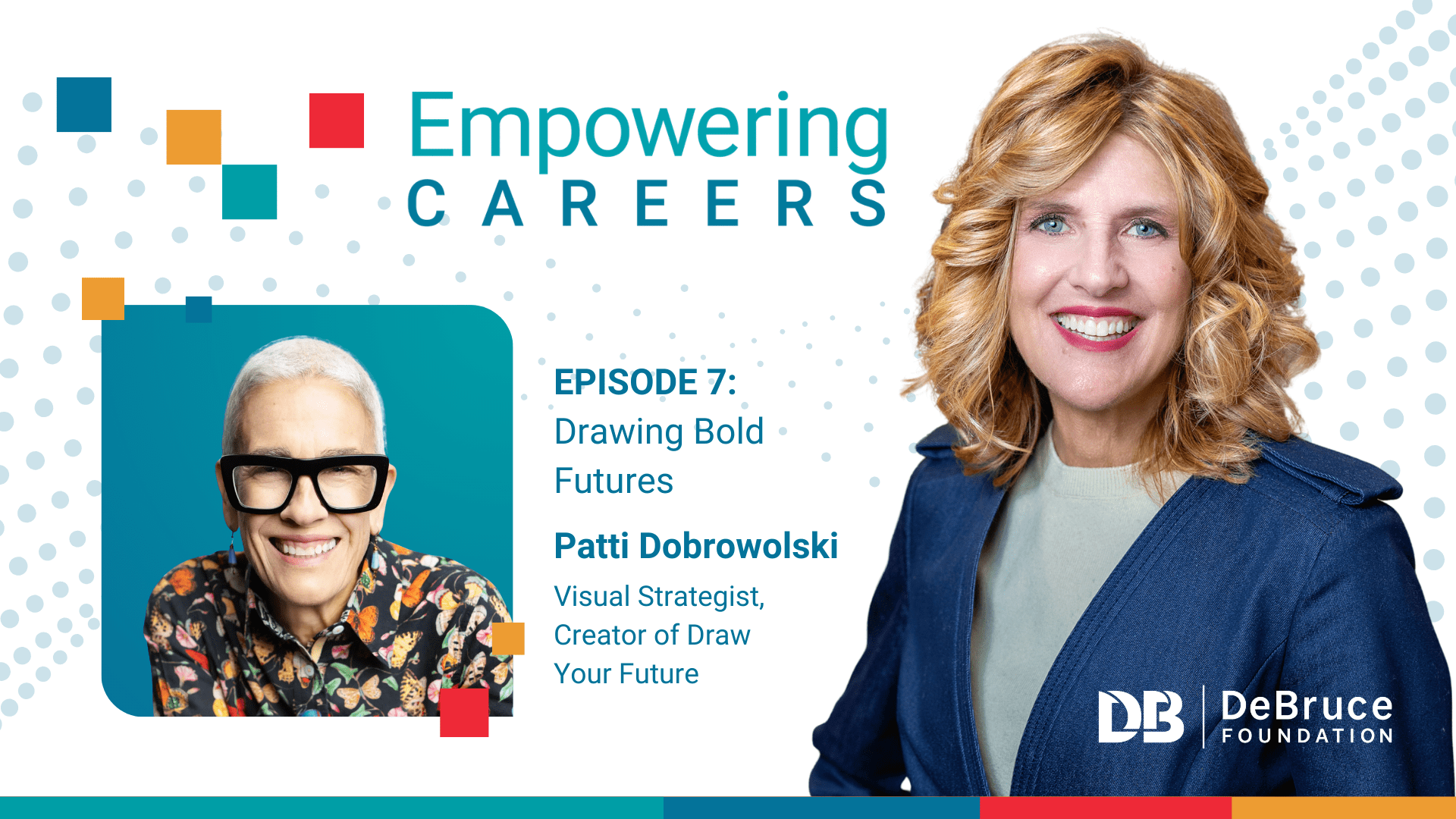
Welcome to the DeBruce Foundation’s Empowering Careers Podcast, where we explore insights and strategies into building empowered careers. I’m Dr. LeeAnn Taylor Knight, Chief Operating Officer and Executive Director of the foundation, and I am thrilled to welcome today Patti Dobrowolski to our podcast. Patti is one of the most fantastic people I know. She is a 4-time TEDx speaker, a graphic illustrator, a Broadway alum. She’s a changemaker, and she’s the founder of Up Your Creative Genius. She has helped hundreds of thousands of people draw, literally draw, their future. Welcome, Patty!
Patti Dobrowolski
Oh, Leanne, it’s so nice to be here with you. It’s just a pleasure. Thanks for having me.
Dr. Leigh Anne Taylor Knight
Well, you spent your career, Patty, helping people see the possibilities for themselves and their future. But let’s start with helping our audience know a little bit about your career journey and what set you on this path?
Patti Dobrowolski
Okay. Well, you know, I was an actor for many years and then I had kind of an artistic break where I knew I had to pivot and do something else. And so I thought, well, how am I going to do that? I want to make this change, but what is going to have, have it happen more quickly? So I began to experiment with drawing pictures of the future.. And I drew, I had drawn pictures of my career as an actor and had some amazing results ending up on Broadway. So I thought, well, how do I pivot my career into my next move? So I began by just putting this piece of paper up on the wall and putting up there all the dreams that I had. And then I watched as my world unfolded and those dreams became reality. And then I became obsessed with it. How did that happen? Was it my imagination creating that? Was it— were there some brain science pieces around it? And so I began to apply a particular process I developed called Draw Your Future. And I did it with these organizations I was working with because they were stuck in change or they had laid off a bunch of people and needed to go back to work.
Patti Dobrowolski
And I needed to give them something to hang their hope on, really, and to put their attention on rather than on how awful it was that that had happened to them. And so I found that if you put a picture up and you draw something of a future that you wanted, whether it’s for your own life or for, you know, your organization, everybody focuses on that picture and that attention and action creates this dramatic impact and changes and creates success. And so I’ve been doing that with, you know, organizations all around the world. And also then I came across the DeBruce Foundation, and we began to do it in the education space, which to me is really where my heart is. I started as a drama therapist, and I worked with adolescents. So to me, understanding and helping them to create a future that they want to step into is really pivotal. And it is for anybody that feels stuck and they want to make a change. And so that’s pretty much, you know, I became an illustrator.
Dr. Leigh Anne Taylor Knight
And you built your whole career on it. I mean, you’ve been this graphic illustrator, but you built your whole career. And I love that you have in the background right now, um, for those of you who are listening, she has in the background right now a Draw Your Future with Agilities map back there where it’s like, and, and we’re gonna talk a little bit more about that particular process so that, you know, our audience can get a feel for it. We know that they’re going to want to go do it after we talk about that.
Patti Dobrowolski
Exactly.
Dr. Leigh Anne Taylor Knight
I know, who doesn’t? But back up just a minute and would you talk a little bit more? You mentioned this piece about the imagination, and in one of your most recent articles, there’s a quote that I just love and I want to share it with our audience today and then maybe have you expand on it a little bit more because what you are doing, there’s a science behind this. And so your quote says, “Your imagination isn’t frivolous. It’s your brain’s most powerful predictive technology.” So your imagination isn’t frivolous. It’s your brain’s most powerful predictive technology. So you’re talking about imagination as a skill, and you’re talking about the research behind that. Could you give us just a little bit more meat on the bones with that one, Patti?
Patti Dobrowolski
Yes, for sure. Because, you know, for, for hundreds of years, really since the late 1800s, William Blake did a whole series of studies about your imagination, and people have been obsessed with it. Jung has a whole series about dreams and the imaginal field, and I’m obsessed with it because I, I feel like It’s your superpower as a human. We come into an experience and our, our imagination helps us get in and out of any kind of conundrum that we’ve created for ourselves, in and out of any situation that’s challenging. Well, how does it do that? Well, your imagination is actually a reflection of something called the imaginal field, which is a place supposedly where everything exists. And so if ever— and you know, people always say, well, there are no new, new ideas, that ideas already are formed and they live in this imaginal field. Well, I’m like, I want to make that real for me. How do I tap into that? So I found that if you draw a picture of that future that you want, something you want, anything, What it does is it taps into your reticular activating system in your brain, which is the part of your brain that will help you to remain focused.
Patti Dobrowolski
It’s part of your executive functioning. And so it keeps you focused on that thing that you want, and it begins to draw to you things that you can do or more images of that things that you want so that you can understand it better. And then take action on it. And if you take action on a picture that you’ve drawn, you increase your chance of success by 42% of your ability to achieve that. And that to me was a statistic that, you know, Hal Hershfield did a bunch of studies from the UCLA and from the UCLA, you know, from UCLA, right? And he, I met him and I thought, wow, this is so fantastic. Because he was interested in how can we help people save better for the future. And for me, I think this is key. Like, how do you save better for the future? Well, if you understand and create a strong connection to your future self, you will save better in the here and now, meaning you’ll make better decisions here and now. And that fascinates me. And your imagination has everything to do with creating that future you.
Dr. Leigh Anne Taylor Knight
Well, and that’s really a nice segue into what is the Draw Your Future experience? Like, how do you take people from where they are today to then using their imagination to think about what that reality could be? And if you started kind of thinking about it in financial terms, I mean, one of the ways that we partner together, you said you wanted to help people be better informed decision makers. Right, about their finances. And what we’ve been able to do with Draw Your Future with Agilities is to help people be better informed career decision makers, right? So talk, take us through a little bit of like what someone would experience with you, um, or alongside of you in the Draw Your Future with Agilities experience.
Patti Dobrowolski
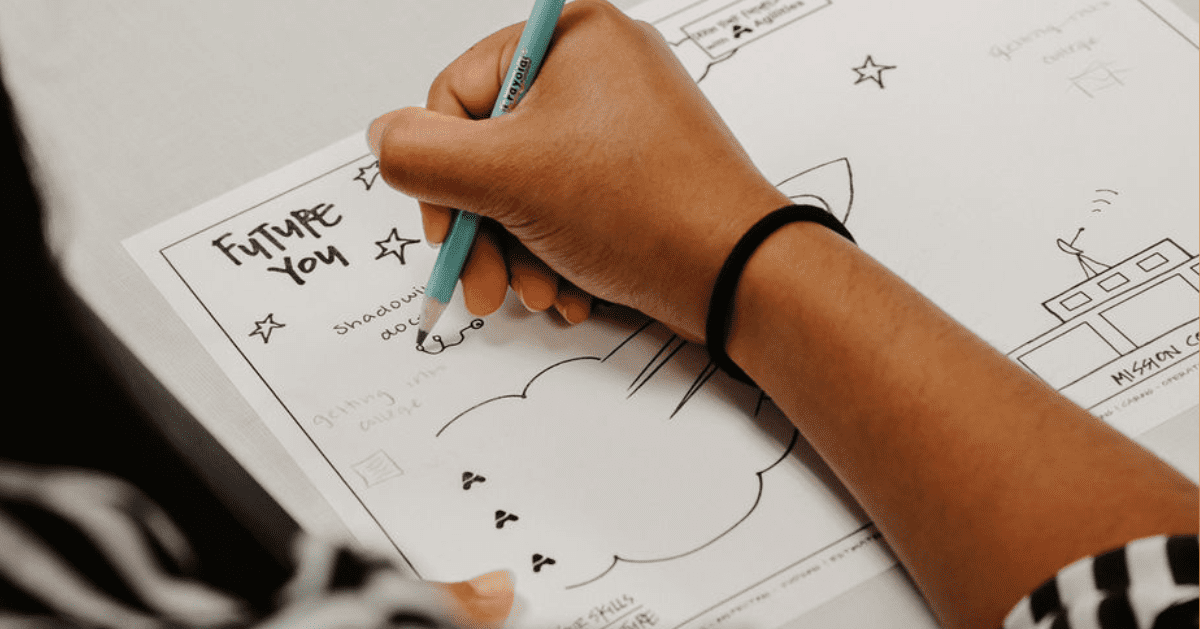
Okay, so, um, first I want to just talk about why we partnered together. Oh sure. The Agilities process helps you know what you’re good at and also what you’re passionate about. And those 10 skills are found in every job. Okay. So if I know those 3 top Agilities that are mine, I’m going to feel a sense of agency about my world and myself. And then if you draw a picture of the future, then you create this sort of expansive dopamine-filled experience where you believe that you can actually do that. So in, in the, the combined process, what we do is have people take their Agility Profiler so they know their top 3 Agilities. Then we have them look at where they are right now, their current reality in words and pictures. Now we show people how to draw because everybody thinks that their drawing skills are terrible. And, and mine were too, honestly, when I started drawing. So I can relate. So we show them how to draw some basic shapes and then we have them put up here, you know, what’s going well in your world in the best case scenario, you know, like what, what is all the things that are just you’re powering through and doing well at and also what’s challenging for you?
Patti Dobrowolski
What are you up against? What’s heavy on you and what are you trying to process? And then we ask them, you know, like, what, what Agility are you currently using to help yourself with these challenges? So they understand, oh, how am I applying those Agilities right now? Then we have them drop all that and move into the future and envision in the best case scenario, what would a year from today or 6 months from today or 3 months from today, what does it feel like to be you? Like, what will you be doing or hearing or seeing or feeling in this new world? And then we built this out into more specifics, like maybe you, if you’re a high school student, you want to graduate, you know, with a 4.0, or maybe you want to, you know, have, be accepted at multiple colleges. Or if you’re shifting your career, you might say, you know, like, well, I want to have more freedom in the kind of work I do, or I want to have a better environment, more collaboration. So we capture all these in words and pictures, and then we just close the gap.
Patti Dobrowolski
And this is really for your brain, the gap closing, so that the amygdala, that part of your brain that gets all amped up and wants to flee, it says, oh, we got a plan. So we create these 3 bold steps that will help you to get there. And then we can break that down into smaller steps if we want to and if we have time. But we always ask, like, what Agility will you use that could, that could you apply to help you achieve this bold step? And this not might not be an Agility that you already have, but you can grow that Agility. That’s the thing. They’re not set. They change over time. And so that’s the beauty of this whole process. And so now I got a roadmap for my future. I understand what I’m good at and what I, what I’m, and I know what I’m passionate about. So now I’ve got this roadmap and I’m gonna go and take action on it.
Dr. Leigh Anne Taylor Knight
That’s the best.
Patti Dobrowolski
Yeah.
Dr. Leigh Anne Taylor Knight
So if we recap that, it’s like you first acknowledge, like, where you are, what’s your current reality, the good but also the ugly and the bad. And then you use that imagination to jump into, well, what do you want your desired reality to be? And then you come back through, and to close that gap, you think about what are the bold steps that you could do to move from current reality to desired reality and which Agilities could you use or grow or develop to actually help you do that? So I think that process sounds great. What are the kinds of things that get in the way of people believing that they can change? And how do we help them overcome that, Patty?
Patti Dobrowolski
Yeah, Leanne, that’s a great question because I think this is the hardest thing. Like when I gave the TED Talk, Draw Your Future, and then Like I got thousands of comments, you know, like some people are like all in. Yes, I did this and it helped me. Other people are like, this is crazy. You know, I can’t make things happen. You know, you make it sound easy. It’s not that easy. And that’s true. If you’re not in alignment with the things that you want, sometimes there are limiting beliefs that you’ve got that are interfering. Like you don’t believe that you can do it, or you don’t think you’re smart enough to do it, or you don’t, or somebody said something. When you were like 8 and you’ve stuck it and it’s married in your hippocampus, that part of your brain that just draws that stuff up. So when your executive functioning tries to envision and go there and do things, that hippocampus, that memory just slips right in there and it stops you. Well, you can shift those. Those, you know, people say, oh, you can write affirmations. And then they’d be like, oh, affirmations, they don’t work.
Patti Dobrowolski
Not true. Affirmations is a way of programming your brain, and your brain is flexible, it’s malleable, it’s plastic. And so I say to people, look at your limiting beliefs that you currently have in this current reality, and then, and really understand them and know when they start to happen, and then create a positive belief for yourself, a new affirmation that’s going to help pull you through. And when you see that limiting belief happen, you have to interrupt it. So you have to be like a detective in your own life and look around for where that happens and then interrupt it. Have you ever had that happen to you where you have a limiting belief get in your way, Leigh Anne? I mean, you’re pretty, you’re pretty, you know, you get stuff done. But I wonder, has that ever happened to you?
Dr. Leigh Anne Taylor Knight
Yeah, sure. I mean, I think that when we’re really honest with ourselves, we can all think about limiting beliefs. I mean, In fact, I spoke with a group of leaders last night and asked the question, hey, has anybody ever felt imposter syndrome? Has anybody ever felt like I got into a position and there’s no way I should be in this particular position? I don’t know enough about the business to lead this. I don’t know enough about how to manage people in order to supervise all of these individuals or to lead them and to guide them. And so I definitely think that those limiting beliefs, and boy, they can suck you down, right? That can just continue. So what do you have to do? And I, I do your strategy of just recognizing it and naming it. So I’m in a job now that I really don’t know anything about this sector. Okay, that could be crippling to me. That could stop me from being able to make progress. I can also flip over to the other side and then write like, what are all the things that I do know about this sector and this industry?
Dr. Leigh Anne Taylor Knight
And what are all the things that I can learn? And who are the resources or where are the resources where I’m going to be able to do that? Now I’ve flipped myself into the things that I can have control over and do have control over. At the same time, recognizing that that limited belief could really spiral into, into a place—
Patti Dobrowolski
send you down the slippery slope. Exactly. You know, I think for me, you know, think about it. I work in every sector, so I don’t know a whole ton about, you know, you know, solar power energy. I don’t know a lot about that. That’s not my expertise. So I always say at the beginning of the session, I’m not the expert in this. I’m just here as a facilitator. And I think, too, allowing yourself to acknowledge what is true and then allow yourself to stretch into it. It’s not like I didn’t do a ton of research and figure out what those pictures were going to look like and be prepared. But also, too, I’m going to push my limiting belief away for the time being because I’m not expecting myself to be anything but what I am. And I think that’s the other part is that we have these high expectations from people around us and, and we say these things to ourselves. And those things are the things you want to unravel so that you can actually be present. Because when you’re present in the moment, that’s when your creative genius really works. That’s when the imagination will feed you information about what to do next.
Patti Dobrowolski
And if you are open to it and believe in your own intuition or listening or whatever you want to call it, you will fly and you, your dreams will really take shape in a way you never expected.
Dr. Leigh Anne Taylor Knight
One of the things that, uh, I, again, we live by it here at the DeBruce Foundation is, um, we’re gonna fail. We just need to learn from, you know, or we’re gonna make mistakes. We’re gonna fail. We just need to learn from those situations. And, um, I heard last night one of the leaders say it’s just really important to give yourself grace in those particular situations. And so in this situation where you’re not actually sure or these limiting beliefs come up, give yourself a little bit of grace that, okay, some mistakes are going to be made. What are you going to learn along the way? How are you going to be really authentic with that? Truth works so that you can move through that process.
Patti Dobrowolski
And I think hold on to yourself, too. Yeah. You really have to calm yourself down in the moment. I can’t tell you how many sessions I’ve been in where things have gone awry. In the room and I think, uh-oh. And then I think, that’s okay, this is great. We’re— I don’t know what we’re doing right now. And so I’m going to tell that, I’m going to say that, I’m going to be transparent about it because they’re the genius in the room. And I think that’s the thing, you know, we don’t give ourselves enough credit for the fact that we have all these, uh, mentors and we have people in our lives that we can call and get information about and and expand ourselves through, through all of the touchpoints that we have.
Dr. Leigh Anne Taylor Knight
Most certainly. Well, in your work, let’s talk a little bit about— you have been in so many rooms, you’ve helped so many people. Do you have any favorite stories of, as we think about empowered careers and this audience who might be helping people navigate career decisions or might themselves be trying to navigate a career decision right now? Do you have just any favorite stories of someone whose career trajectory, like, changed after drawing their future.
Patti Dobrowolski
Okay. So, um, I got this email day before yesterday. And so this happens to me all the time. Somebody will write me a little story. Sometimes they’re around how I got out of bad relationships, sometimes how I found my own career path and stopped doing what my mom wanted me to do, etc. But this woman, um, Charlotte, she was in an HR position in healthcare and her job totally drained her. 12 years ago, this was her. And she was like, I don’t know, what am I going to do? I can’t do this. This is killing me. And so her health was declining. And so she watched the TED Talk Draw Your Future, and then she did the process. And here’s what she wrote to me. She said, I believed it was possible. In my desired new reality, people weren’t stuck in boxes and alone anymore. Nobody was yelling at me. There was laughter, collaboration, coffee. And connection and joy. Not long after that, I noticed a for lease sign at a beautiful heritage building. I always admired it. After visiting a coworking space in Toronto and feeling inspired, I decided to stop my car and call the landlord.
Patti Dobrowolski
And she opened the Village Hive there, and this was her 12-year anniversary that she wrote this. So she opened this coworking space.
Dr. Leigh Anne Taylor Knight
I have goosebumps. That is the neatest.
Patti Dobrowolski
I know it. It happened. And it’s just like unbelievable. And so she was just writing this in LinkedIn and she had tagged me and I was like, oh my God, can I tell that story? Because this is, you know, we think that we’re stuck in this role or we’re, we have this, like we’ve done this one career path, but I changed my career 4 different times. And I’m sure I’ll change it again because you want to be changing and growing and you want to do what you love. In a mapping session yesterday I was doing with an individual, you know, we got to the future state and it’s got all this pretty stuff over here and it looks really great and there’s all these ways I will feel. And then out of the blue she says, you know, I have this dream and I’ve had it for a long time. And I go, that’s it. That’s what’s going to happen. That’s the dream. We’re going to write it now.
Dr. Leigh Anne Taylor Knight
And now did she put it on her map?
Patti Dobrowolski
She put her on her map. I’m like, okay, game over.
Dr. Leigh Anne Taylor Knight
Game over. Game over. Just a couple of 3 weeks ago, I was at a book launch for a good friend, and it was in a venue that had just opened here in Kansas City. Both the book is something that the, the woman who wrote the the gals who wrote the book, it was from something that had been written on a map of their desired reality to write a book. And the business that we were standing in was from a, a group of, a couple of women who had again thought about their current reality, thought about what they wanted their new desired reality to be. And so we were standing there with a book launch because of, you know, that had been on a map. And then also in a business that had been on a map. So there is, there’s there’s immense power. Again, kind of going back to your imagination is not frivolous. It will absolutely tell you what this can be and then give you that gas behind like, okay, this is how we’re going to get this done. So a lot of our listeners, Patty, they’re educators, they’re workforce leaders. What do you want them to know as they serve young people and job seekers who are building their careers?
Dr. Leigh Anne Taylor Knight
What do you think it’s really important for them to know?
Patti Dobrowolski
Well, first, I just want to say thank you for doing that. That’s, that’s my first, because, um, you know, I was sitting next to a third grade teacher on the plane coming home, and I was— I just asked her all these questions about what it was like to be a third grade teacher now, right? And, and what were her students like? And I think for educators or people that are helping people to— other people to shift, just know that there are tools out there And that you will know what to do and which tools are right for your students if you begin to tune up your imagination and start to tune into the channel, because you can dial that imagination to any channel you want, right? In that ladder of imagination, you can make something really creative and sort of out there, or you can have it be very basic.. And if you understand the levels of imagination and how to use it, and you draw a picture of it, whatever it is that you’re trying to communicate, people will understand better and they’ll be able to get more ideas because they’re accessing the whole of their brain.
Patti Dobrowolski
So if you can, and you don’t have to be good at drawing, bad pictures are even better because studies show they’re remembered better. Bad handwriting remembered better. So remember that you’re in the lead of presenting new information to them and that you can do this. You can lead them into a future where they can stand on their own two feet, be responsible as an adult or in their new career, and really enjoy what they’re doing.
Dr. Leigh Anne Taylor Knight
Yeah, thank you for that. I think that’s important. The other thing is, Patty, even as you were speaking, I had in front of me one of The books, the most recent book, Patty’s an author, but the most recent book, you all, that she has released is called Drawing Your Future: Solve Problems, Explain Ideas, Sell Anything. And sometimes even as you were talking about the educators and the workforce leaders, you know, they’re trying to solve the problems and help individuals, right, with what their next steps will be with their career. But you also dove into when you’re drawing these pictures, it actually helps in the explaining the ideas of what you’re thinking about. It makes your brain actually have to work through pieces and parts of it. And the sell anything, my gosh, a lot of times we’re just trying to sell our own future to ourselves, right? To help us believe that we can do this, we’ve got this, and that we, you know, it’s not too, it’s not too much to go ahead and say that’s what you want it to be. And here are the first steps that I can take towards that.
Dr. Leigh Anne Taylor Knight
I think the other thing that you remind people to do is to put— I have my— I have a draw your future map right up here in front of me right now at my desk that I look at every day, right? And by drawing it and by looking at it, it also prompts me to think, okay, Leanne, what are you doing in your head today to get to that desired reality? Any other, any other tips on when you do a map like this of Draw Your Future, like, what am I supposed to do with it? How do I, you know, and I know people, I’ve done multiple ones, right? Like, so I’ve done it when I’ve had to solve a problem. I’ve done it when I’ve had to make a change. That’s also evergreen. Like, the Agilities are evergreen. This process is evergreen.
Patti Dobrowolski
Could you talk about that? Yeah, anytime. I mean, it will help you. So you might do a big one on how you want your future to be or your next year to be like that. But I always drill down on when I take one aspect, if I wanted to write that book, right? I did a whole map about the book, like where was it now in my idea span and where did I want it to be? And like, what, what did I want to have happen? You know, and though all those things happen on that right side, right? But one of the things that you said is put it somewhere you can see it every day. And I do this other thing, which is I take pieces of it. And I double-click on them with my imagination, and I take them into meditation, contemplation, prayer, whatever you do, or your walk out in the, you know, down, getting your steps. Take that one aspect and like play it out. Like play out all the possible great futures that you want to have happen. Because just know your imagination, it will take you down that slippery slope.
Patti Dobrowolski
So you want to corral your imagination and put it to work on the things that you do want. And that is one of the most important things, is catch yourself and, no, no, no, we’re going to focus on this because this is my new reality. It doesn’t— your brain doesn’t know the difference between where you are now and where the future is. It believes it’s all in the now, right? It doesn’t have a separation of time. So utilize that and leverage that and then bring yourself into more alignment with it. By taking small actions and celebrating every time you do something good or bad.
Dr. Leigh Anne Taylor Knight
You know, exactly. We need to celebrate those failures where we— because you learn something in those, like to not be afraid to, to celebrate those too.
Patti Dobrowolski
Absolutely. And then, and then just, you know, whenever you feel stuck, that’s my thing. It’s like, you know, action ceases panic. This is my through line for my whole life. Action ceases panic. If you feel scared and that free-floating anxiety in your life when you wake up, get up and do something. You do something. One tiny little thing will change it all. Yeah.
Dr. Leigh Anne Taylor Knight
Yeah. Well, I want to do a little lightning round, one-sentence answers with you, Patty. So I’ve got like 3 questions here that our audience is probably— I know our audience is probably dying to know these about you. So, okay, Patty, what is the best career advice you’ve ever received?
Patti Dobrowolski
Do what you love and ask, ask for the right amount of money.
Dr. Leigh Anne Taylor Knight
Don’t undersell yourself. Don’t undersell yourself. Know your value. Do what you love. I love that. Secondly, what gives you hope for the future, Patty?
Patti Dobrowolski
I think any time I do a session with young people, it gives me hope for my future because those kids are so smart and they’re so in tune with what’s happening and they know where things need to change and grow.
Dr. Leigh Anne Taylor Knight
They do. They do. And trusting them with their future is really, really important, isn’t it? Yeah.
Patti Dobrowolski
Yes. And lastly, the agency to, to do something like let them lead.
Dr. Leigh Anne Taylor Knight
Yes. Yes. And third, what is one thing our audience can do today to build their career or to help others build a career?
Patti Dobrowolski
First, I would say go take your Agilities Profiler. I mean, I’m just gonna say it because you’ll get those 3 things and you’ll know, okay, I got these things. And you may have done some other process before, but this is just something that you can find in every single job. And then allow yourself to take the time to imagine a positive future. No matter what circumstance you’re in now, there is something better on the other side. And sometimes it’s just your fear that gets in the way. So remember, on the coin, fear is on one side, but love is on the other. So act in service to yourself and life. Serve it with love, yourself with love, and things will always turn out fantastic.
Dr. Leigh Anne Taylor Knight
Patty, in In every way, you exude some of the, really, some of the Agilities in the work that you do every day. You are innovating every single day. You are developing others. And just even with that last piece there, I hear serving and caring just being rained down on people and all who you serve. So thank you just so very much for joining us today. But more importantly, thank you for the work that you do every single day to instill confidence in people and help them think about Here’s my current reality, but here’s the desired reality. And giving them these tangible steps of ways to use their imagination, leverage drawing into solving those challenges and making more informed decisions and really putting them on a pathway to expand their career pathways or expand anything that, that they wanna do in life. So it’s such a joy to know you, my friend, and to get to have you here with us today.
Patti Dobrowolski
It was my pleasure, Leanne. It’s always just such an incredible conversation between us about these things that we’re both committed to. So thank you for everything that the DeBruce Foundation is doing and you particularly are helping to enable.
Dr. Leigh Anne Taylor Knight
Thank you. Thank you, Patty. And for everyone who tuned in today, if you enjoyed this conversation, be sure to check out our website at DeBruce.org and follow the DeBruce Foundation on our social media channels for more career-building resources. Together, we can all build empowered careers. We’ll see you next time.