Link copied to clipboard
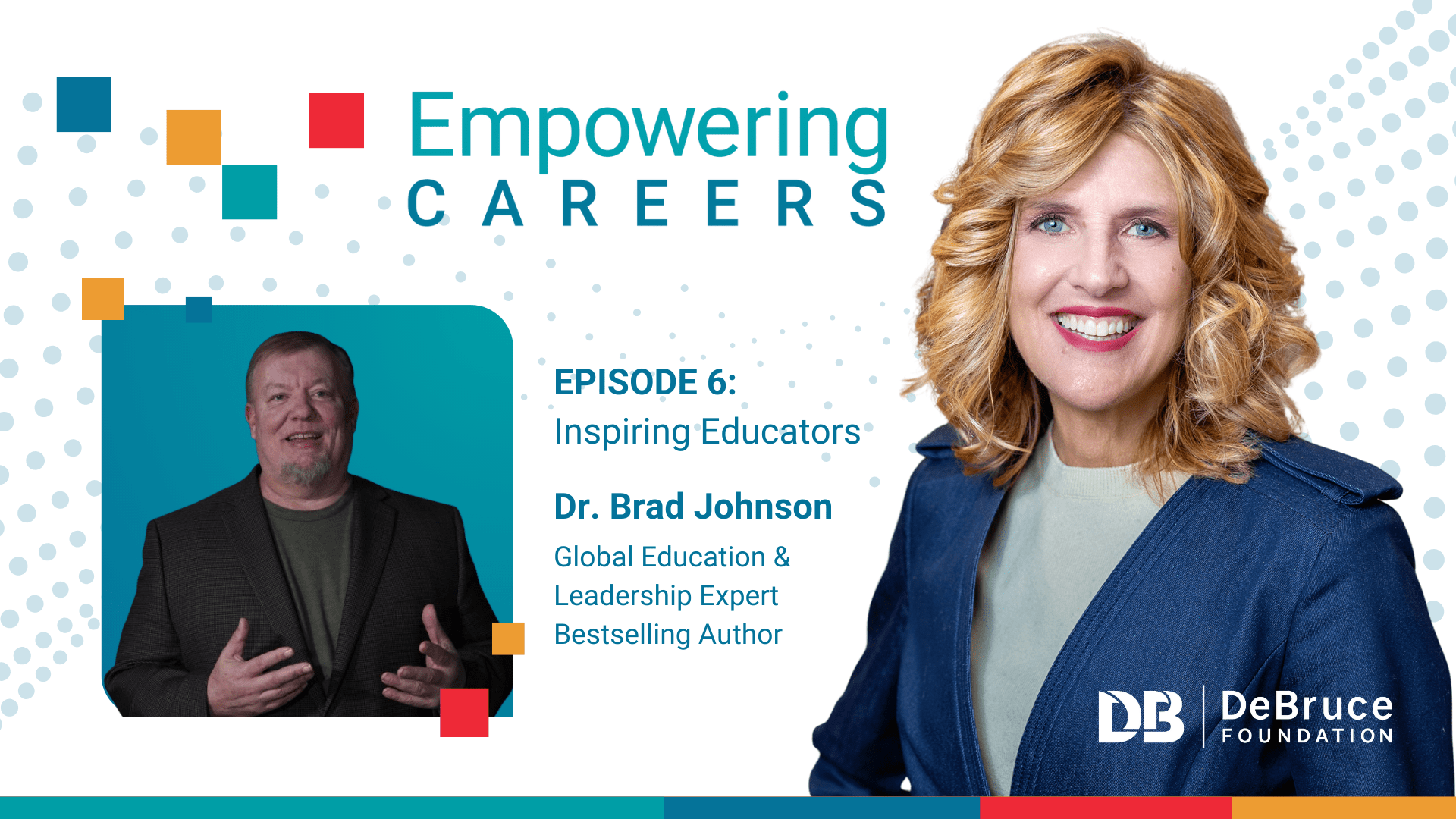
Episode 6 - Inspiring Educators


Takeaways
- Learn more about Dr. Brad Johnson
- Follow Dr. Brad Johnson on LinkedIn
- Follow Dr. Brad Johnson on X
- Follow Dr. Brad Johnson on Instagram
- Follow Dr. Leigh Anne Taylor Knight
Transcript
Dr. Leigh Anne Taylor Knight:
Welcome to the DeBruce Foundation’s Empowering Careers podcast, where we explore insights and strategies for building empowered careers. Today, I’m thrilled to welcome Dr. Brad Johnson. Dr. Brad Johnson is a best-selling author and internationally recognized education expert who works with educators around the world to strengthen teaching and learning and leadership practices. Through his research, his writing, and his global speaking engagements, Dr. Brad helps schools and systems create more effective, inclusive, and future-ready learning environments. He is all about grounding that work in relationships, in collaboration and in communication. And in his most recent book, Room 212, which we’re going to get to talk about today, Dr. Brad blends heartfelt storytelling with professional inspiration, following a new teacher’s journey to discover a small intentional shift in the presence and the connection that can transform a classroom and the lives in it and the school around it. Welcome, Dr. Brad. I’m so happy to have you here today.
Dr. Brad Johnson:
Oh, I’m so excited to be here, and it’s so good to see you again. I know we were together in November, I think. Might have been October. I can’t remember now. And Happy New Year.
Dr. Leigh Anne Taylor Knight:
And to you, too. And to all of our guests, a Happy New Year and exciting as we get things started in 2026 here. We want to talk a little bit, just actually harkening back to our being together for the Employment Empowerment Event. It was my pleasure to get to discover that one of your top agilities is developing others, Brett. So talk with us a little bit about, has that always been a top agility for you, or is that something that you think you developed over time?
Dr. Brad Johnson:
Maybe developed a little over time, but I think it’s something that was there all along. I think early in our career, we’re so focused on self and being successful ourselves and climbing the ladder that sometimes along the way we forget other people or to bring people with us. But I think it was already there. And I think at each level, when you do make it like… I remember as a teacher, one of the things I would take time out a day or two during the semester, and I would actually have students reflect on what are my strengths, theirs, not mine as the teacher But even back then, although I taught science, I thought that was very important for them to understand what do I do well, what do I like doing, what are my passions, but what are my strengths, what are my talents, something that I can develop that will help me be more successful. So I remember even taking time, and this was long before there was even strength finders and all of those and the questionnaires that you guys have, which are incredible. We’re so helpful for people to be able to identify what do I do well, what is some things that I can take with me and be successful.
Dr. Brad Johnson:
But I just think all along that’s been there. At each stage, I was able to, whether it was students or as an administrator or even as a college professor, with my older students that were moving into administration is helping them develop to be their best That’s really as I travel around, I’m all about inspiring and affirming teachers and administrators of their work. But the big thing is how can… Because it really should be about them. It’s not about me. I always tell people I’m just the messenger. I have a story to share, but it really is about helping you rethink, reprogram, rewire, is the word I use, to be your best.
Dr. Leigh Anne Taylor Knight:
I love that. And again, that it’s been a part of your entire career journey. It’s just been foundational to who you are and what you do. People listen to this because we’re trying to empower folks along their career path and expanding those career pathways. So a lot of times people want to hear about your career journey. So could you tell us a little bit more about how you came to be an educator and then really that trajectory of then leading you into now this education expert and developing leaders and others that you’re doing today? Just a little bit about that career journey.
Dr. Brad Johnson:
Well, I can tell you about the career journey. Being like one of the global gurus and stuff, I think is just pure luck. I don’t know if I have a plan laid out that I could share on how that happened. But yeah, I began as a teacher. I taught life science. I loved it. I often share when I speak that one of the teachers that greatly influenced me was my seventh-grade life science teacher. I loved her class. I love how she taught. I love the games that she played, and it really impacted me. At the time, I didn’t think, Oh, you’re impacting my life. I think I’ll be a life science teacher, too. But as I look back on it in the course, the trajectory that I went in becoming one, I did look back and go, You know what? She really did have an impact. I think we all have a teacher or two that impacted our life. Whether you’re in education or not, I think we have teachers that connected with us and influenced us regardless of what the path is. But then as a teacher, like I shared, I love teaching science, I love science, but I still was all about the people, even the students, helping them figure out how to help them be successful, not just to learn about science.
Dr. Brad Johnson:
Then I was like, each stage I always felt like, and I love teaching and I taught teaching for many years, I wasn’t one that did three years and jumped into administration, although I don’t necessarily think there’s anything wrong with that. I know a lot of people think you should teach 10 or 20 years, but I really think it’s what talents that you bring and what strengths you bring determine the length and the places that you go. But After that, I moved into administration and enjoyed it because my thought was, I can reach a lot of students, but as an administrator, I can help a lot of teachers reach even more students. So That’s how I looked at it. If I would have stayed in the classroom, I would have loved it, but I really feel like I want and have tapped into my potential, I guess. Then from administration, I moved to the collegiate level to help train new principals, people that are moving into leadership because I felt like, Well, I could help some teachers help a lot of students, or now at this point, I can help equip a lot of leaders to help even more teachers help even more.
Dr. Brad Johnson:
While the personal interaction narrowed, the overall umbrella really began to grow. At one point, I decided, hey, when I was working on my doctoral dissertation, I’m like, If I can write this, then I believe I can probably write a book, and it probably doesn’t need to be as boring as my dissertation. I wrote a book, and then I wrote another book and I had people start contacting me, Hey, I read your book. Would you mind coming to speak? People can probably tell by now with my accent, I’m from the South. That was one of the things that I was always I’m tripled about was the public speaking. But apparently, people have found it charming. That worried part of it went away fast. But I’ve I’ve been to probably, I think, 12 or 14 different countries, spoken all around the world and all over the US and just love it, feel very fortunate. At this point, I feel like now I’m reaching even more educators, even more administrators that are impacting more people and more students and hopefully having a global impact because at the end of the day, to me, and why I like that each step has have occurred the way it is, and you asked how to get to this point, and I really have no idea how I got to the top point of being fortunate to travel all around the world, but just very blessed, I think, is the only way that I can describe how that happened.
Dr. Brad Johnson:
It’s sure wanting a long term plan or really, I think, my skill set necessarily. But I love to tell stories which I think is important and connect with people. But I think it is really just about being relationship focused. To me, that’s everything. One of my sayings is that education is relationship-centered, leadership is relationship-centered. Everything that we do really evolves and revolves around relationships. It’s so important to understand that, to understand how to relate to people, how to listen, how to communicate. Again, and I know we’ll talk in a minute about my book, but that was what brought it on was understanding that stories is really how we communicate stories or how we relate. Stories are what we remember, and stories really are what helped transform us. Yeah.
Dr. Leigh Anne Taylor Knight:
And I think you’re a beautiful model of authenticity, Brad, and being who you are. And I think no matter what someone’s career is, when you can really operate in that space of authenticity all the time, those relationships, they come They come naturally. People know that you’re genuinely interested in listening. You’re genuinely interested in understanding the challenges that they’re facing in any particular environment. And I am so admirable of the ability that you have had to really compound your own learnings into other opportunities and learnings for others, which it is. It’s the perfect conversation to really lead us into Room 212, because you were already a best-selling author, and then you do Room 12, 212, when you and I were talking about it, you talked about how it really marks a shift in how you’re sharing your ideas. So could you tell our audience just a little bit about what inspired the story itself, and why was the narrative format the right way to tell it? You have… Talk about an interesting story. Interesting stories related to that. So let our audience know a little bit about this room 212 and how it’s come to you.
Dr. Brad Johnson:
Yeah, absolutely. And so the term 212 is not new, and it’s something that’s been used. But being a science teacher We remember that at 212, that water boils. And when it boils, it creates steam, which creates power. And with power, you can do things, you can move things. And that’s where that one degree shift that talk about in the book comes from. The stories in it itself really are most of them I experience as a teacher or as an administrator with other teachers. There’s a couple of wild stories in there, but they really happen. Kind of the same thing, I wrote a sequel to this, not a sequel to this, but a book for leaders themselves called Coffee with the Custodian that will be out soon. But it’s my experiences with people I work with. There really was a Tammy. There was actually two Tammy’s that I taught with and that were in my life that I talk about in the book. But it really is about a story of a new teacher coming in and the experiences that they had, the mentor that they had, and just the process of becoming a better teacher.
Dr. Brad Johnson:
So often with PD and even my other books, the ones that sold best tend to be ones that were more… They weren’t narrative-driven. Driven, but they were anecdotal. I would share some stories. But so often, and I get this feedback a lot, because if you think about it, I don’t know if you read a lot of PD books like I have over the years, but most are just boring as can be. It’s a lot of strategies, it’s a lot of bullets and a lot of points, and it’s basically trying to tell you what to do. I’m like, Well, we’re working with adults, not children. We We don’t need to be talking at them. We need to be speaking to them and speaking to their heart and their experiences and their own life and speaking into it. And so that’s where it came from. Like I said, when I speak, anytime I speak, I share a ton of stories. That’s just how I grew up in the South. We’re story tellers, and some are true, some are not.
Dr. Leigh Anne Taylor Knight:
Stretch that truth just a little bit to make it interesting.
Dr. Brad Johnson:
That’s what makes great stories. That’s exactly right.
Dr. Leigh Anne Taylor Knight:
Yeah.
Dr. Brad Johnson:
The teacher in you also finds a way to make it really user-friendly to take away just a nugget of information, a phrase, or I have mine Post-it noted, and those kinds of things.
Dr. Leigh Anne Taylor Knight:
Because even thinking about small intentional shifts, that’s What’s the point behind this? But as an educator, you’ve also made it really easy for me as a reader to just grab some of those kernels and know, Oh, right. I’m really supposed to be paying attention to that. When that’s italicized, that’s a phrase, that’s something that I might want to put into my repertoire as I’m developing as a teacher or as a leader. And as we think about coffee with the custodian, I’m sure it’ll be much like that, too.
Dr. Brad Johnson:
Absolutely.
Dr. Leigh Anne Taylor Knight:
Is there one change that you think consistently makes the biggest difference for educators, Dr. Brad?
Dr. Brad Johnson:
I think we are so used to having programs and new initiatives and all this stuff dumped in our plates and we’ve got to change things. It’s the little shifts. That’s why I emphasize that so much and really played with that one degree, because often it’s just the little differences that are made in the course of a day, in the course of interacting with a student, a student that just continually gets on your nerves, changing that one degree shift and how you respond to them, and they notice that, Oh, you didn’t respond the way you usually do. You took time out to see what’s going on or whatever that it is. The big changes are little things that we do. It’s those little shifts. To me, I think that’s what I hope people take away is that in education, we’re probably the worst field that’s known for it, but we’re always looking for that magic formula, that magic pill that fixes everything, and, Oh, this new curriculum is going to do it, and it’s really not. One of the things that I say is it’s not technology and it’s not curriculum. It’s the teacher in the classroom that has the greatest impact on student learning.
Dr. Brad Johnson:
It’s not just about the teacher being in the classroom being important, but it’s about them learning how to make those little shifts and differences to reach each child. Child’s different. Some are very outgoing, outspoken, and you know they’re there. There’s some that are so quiet, you don’t even remember that they’re there sometimes, but they still have needs and need for you to be able to relate and connect to them as well. And that was one of the stories in there was the quiet girl. And just those little one-degrees shifts that we can do, take time out to ask, What are your interests? To notice them drawing something and make a positive remark about it. Those little things are what make the biggest difference.
Dr. Leigh Anne Taylor Knight:
And that leads right back to, I think, for me, the theme of the whole book, which is about creating those meaningful connections. And you’re like, it’s just that one little degree shift that unlocks or that builds that bridge to that connection that is so very needed. And when we think about schools today and fostering connection, not only in classrooms, but the entire building or the entire system, do you have any good advice around that in addition to these one-degrees shifts? I think you can apply some of those one-degrees shifts and those perspective-seeking pieces to working with parents, working with other partners that are engaged with the schools. But-But how can entire school systems or entire organizations beyond schools really foster those connections, Brad?
Dr. Brad Johnson:
It goes back to, like I said, just the word relationship. I wrote a thing the other day. In the past, we always thought of relational intelligence as soft skills, but I’m reframing it. It’s not a soft skill, it’s the software. It’s the software that drives drives everything in the system. Because think about it, you can have the best computer, the best hard drive, the fastest processor, but if there’s no software, what do you do? You just have a very expensive machine sitting It’s paperweight, I guess you could say. It’s the software, and the software drives everything. The relationship drives everything. It’s hard for teachers to build those great connections with students. If administration doesn’t make those connections with the teachers. It’s hard to get parent buy-in if you aren’t making those connections with them. It seems simple. I think the reason we don’t for or focus on it more is because It’s not something we can just buy and implement. It’s something that actually does take time, which is the one thing that cost us nothing, but it really is the most valuable thing that we have. It’s about building those relationships at each level.
Dr. Brad Johnson:
I always encourage superintendents, know what’s going on in your schools. Be in your schools. You should not be someone that’s not known when you walk into a school. Who is that? They should know who you are. And the leaders, they should be in the hallways. They should lead from the hallways, not their office. Just building those connections all the way down in the students, see that and know that I’m important as as a person, not just a student here.
Dr. Leigh Anne Taylor Knight:
Yeah. Thank you for giving that leadership tip. I was going to ask you that question about what is a common leadership mistake that you’ve seen in education and how can it be corrected. So that’s a good one from the superintendent’s perspective is be seen, be there, be a part of it, even if what it means is on Mondays, you say to the folks in your office, On Mondays, I’m going to be out and about in schools. I can have meetings all day long, but they always have to be in the schools, not in my office, even if it’s something as practical as that. Are there other common leadership mistakes, Brad, that you’ve seen that you can give ideas for how to correct?
Dr. Brad Johnson:
Yeah, but before I do, I want to give one shout out to my brother. My brother is a sheriff here in Georgia. And he was actually awarded by the Georgia Association of Elementary School Principals, one of their awards. But one of the things he tries to do at least once a month, but as often as he can, is he will actually go to schools in the morning and walk the kindergarten and first-graders to their class. The Sheriff of a county walks the kids. So you talk about building relationships, about them seeing it in a positive light, and it makes a big difference. So that is a key part of Now, I already forgot what you asked because I’m getting older.
Dr. Leigh Anne Taylor Knight:
No, that’s okay. You know what? We’re going to take a little… So your brother is a good example of community members and leaders outside of the education system, accepting responsibility that together we’re expanding career pathways. Together we’re expanding the opportunities for these young people. And it’s never too early for them to get to see community leaders leaders in their schools, interacting with them and saying, Hey, we care about you, and you’re a valuable part of our community. So I think that builds confidence in young people. It also starts to expose them to other opportunities and other ways to to me, because the vast majority of students who go through our schools are not going to go on to be educators, but they are going to go on to have other roles in the community. And so I have believed for years, my background in education, I have always just thought, we could have never done it without the community partners and the parent volunteers. I could have never done my job as a teacher, as a coach, as a principal, as a leader in a district without that community engaged aging and embracing that. And so kudos to your brother for that.
Dr. Leigh Anne Taylor Knight:
And I’m so glad you did share it. Yeah, I was just asking about, are there other common mistakes that you see with leaders or really just good common practical leader tips for others, and whether it’s community or inside the school or outside of the school?
Dr. Brad Johnson:
Well, you just hit on a big one right there with talking and engaging the community, not just parents, but the businesses. And I think, and I actually wrote an article on this one time about, I think it’s so important for principals, but especially at the district level, for them to learn how to speak the language of business. Because when they go and approach the business as, Hey, we need this or help with that, or we would love to collaborate, if all you’re doing is speaking that education needs that we speak, they don’t know what you’re talking about. That really doesn’t fit It’s a lot of their time and energy to put into it. One of the things that I think is so important, especially for district levels and for school administration, is learn to speak the language of business. Think like a CEO. If I’m going to approach them, how am I going to speak? How am I going to present it? If I need them to help fund something, you have to do it in a different way than your thinking and how that you usually operate in just the school environment. To me, that can be a game changer for districts.
Dr. Leigh Anne Taylor Knight:
It can be. It’s really about thinking it through the lens of what’s the value proposition for that group of stakeholders?
Dr. Brad Johnson:
What is For their return on investment?
Dr. Leigh Anne Taylor Knight:
For the students, for the businesses, right. For what’s their return on investment in that? When we think about what is future-ready education, what does it really look like in practice in our communities across this country or across this world? What is it going to take? I think you’re giving us a glimpse into that’s what future ready education has to look like and sound like.
Dr. Brad Johnson:
Absolutely. Because think about it, we tend to be so disconnected. We do CTE, and we do some types of training. Sweden, I think it’s Sweden, it might be Switzerland that is really big into the apprenticeships now. I think it’s Switzerland.
Dr. Leigh Anne Taylor Knight:
Switzerland. Yes, Switzerland has a lot. And we have some parts and some states in our country, Indiana being one of the leaders.
Dr. Brad Johnson:
Some are starting, right?
Dr. Leigh Anne Taylor Knight:
Yeah. They’re really looking at those apprenticeships opportunities. Yeah. Talk a little bit more about that, Dr. Brown. Yeah.
Dr. Brad Johnson:
And it really fits with your model and what you all are trying to do. But think about this for a minute. If you’ve got a high school student that has high absenteeism, low engagement, doesn’t really want to be there, what are the odds of them going to college? Probably zero. And I’m not saying they can’t or they can change things or turn things around. But what if that student really enjoys doing something that we can can partner with a business on an apprenticeship? Because then you have a student going to work while they’re still learning school, they’re getting paid, instant motivator, they’re doing something they enjoy. So absentee is almost… And that’s the feedback I get from them. I’ve actually talked to people in Switzerland that do this. And a couple of the states, like in Washington, that are doing this, like you said, here in the US. And their big things are the student. We don’t have to worry about absenteeism because they’re going to a job, they’re getting paid, and it’s something they enjoy, and it’s something they’re learning. So we don’t have to worry about that. We don’t have to worry about behavior anymore because, again, it’s something they want to do.
Dr. Brad Johnson:
It’s something they’re getting paid for. It’s something they’re going to be preparing for the future as well. But then when they leave school, you talk about being future ready and a job ready. They just had a year, two years of experience in it. So they’re really ahead of students that don’t have that, or maybe they even go to college because they have that actual lived experience in that field.
Dr. Leigh Anne Taylor Knight:
Yeah. And what is the value proposition, too, for the community getting involved in that. As we’re looking at sectors, this is one of the things that definitely Richard and Fairbanks Foundation, Strata, they’ve been looking at this for a decade and actually engaging businesses and actually helping the businesses are defining what the value proposition is, right, too? Because they need that workforce. At the end of the day, whether the students go on to college or do not go on to college, Most likely, most of us are going to be working someplace, right? So we’re still choosing careers, and we’re going to be changing careers and growing and developing across our lifetime. So kudos to those that are already investing in that and I’m looking at that. And I know that for sure in Indiana and in some other places, they’ve got businesses engaged and involved. And I do think that is key to that future of education and actually helping each individual child find the way to expand their career pathways and just recognizing the traject for these can all be upward. The pathway to it can just look a little bit different and sound a little bit differently.
Dr. Brad Johnson:
Absolutely. And then, let’s say you have a student that goes and does this and gets a good paying job, they may decide to go back to college later. And you know what? They’re going to have money. They’re not going to be in debt, and they’re going to have good income, so it’s going to change. We have so many students that come out of college now that can’t get a job and that are burdened down with so much debt that they feel like they’re never going to dig out of it.
Dr. Leigh Anne Taylor Knight:
And that Switzerland And model does allow for experience to count as the building blocks, stackable credentials right on into opportunities at the most secondary level.
Dr. Brad Johnson:
And just certifications or whatever. Absolutely.
Dr. Leigh Anne Taylor Knight:
Yeah, that’s right. So that’s one of the things that actually gives me hope about the future of education right now. Are there other things, Dr. Brad, that give you hope about the future of education right now?
Dr. Brad Johnson:
I mean, there’s a little bit of a bleak outlook, only because I say we still haven’t figured out that we need to take care of teachers. That is just that That is my sounding board. That’s the advocate for teachers is something I’ll never stop doing. The irony of it, like I said, I’ve been fortunate to travel around the world. That’s probably the one consistent CSC around the world is that teachers aren’t paid enough and treated like professionals, which is sad, but that’s one thing that unites all of us is how bad that we take for granted our teachers. That is the one thing I wish that we would realize. I think when it comes to that, it’s like, and I don’t mean this arrogantly or whatever, but when people ask me about speaking, I’m like, Well, don’t think of it as an expense. Think of it as an investment. I think we have to see it that way with teachers as well. They’re not an expense. They’re actually an investment. The thing is with AI, with technology, the skills that people need more than ever are those people skills, those relational skills? Because we don’t have that assembly line that people can work on anymore.
Dr. Brad Johnson
It’s gone. That’s the one thing, though, that technology and AI can’t help is It helps students learn how to be more empathetic, how to have better communication skills, how to build trust and lead and to put people first. And so that’s why I think education, we talk about the bright spot. That’s why I think it’s more important than ever because it’s helping develop those skills that most students don’t have that they lack and that they sorely need.
Dr. Leigh Anne Taylor Knight:
Well, and so that, even as we think about what will be the role of educators, how that will will continue to evolve over the next decade, I think you’re starting to give us a glimpse into what that is or what it is already right now that we are seeing is the importance of human beings modeling those relationships and building on that skillset to interact, connect, communicate, and engage with other human beings, meeting them where they are, being mindful of the situation You are so mindful of teachers and where they sit and the importance of them. You remind me of, I used to say when I was an assistant principal and then on into some other leadership positions, when I was a teacher in the classroom, if I was absent, there was always a substitute for me. And each step that I took, there were no more substitutes. So let’s stop and think about who are the most important people in those schools every day. Well, the people that we get substitutes. We get substitutes for those folks. And at the same time, there is no substitute for the work that teachers do with students in the classrooms and outside of the classrooms, even in their extracurricular activities and those roles as they continue to evolve over time.
Dr. Leigh Anne Taylor Knight:
I know that you’re going to be there to serve and support teachers. So would you give us any insight into what’s next for you? Is there another book? Is there a new research? Or there’s going to be coffee with a custodian. Anything else that you see coming on what’s next for you?
Dr. Brad Johnson:
Yeah, coffee with a custodian will be the next one out. I’m really excited about it. Again, it’s one of those where, and just to give a little tease about it, but it’s an assistant principal that moves into her first principal role. But the first person that she meets and engages with is the custodian that’s been there for 36 years. But it just winds up with them having coffee in the morning and talking. She begins to see things through his lens. The reason I use custodian is custodian actually means gatekeeper. If you look it up in the original, I guess, Greek, maybe Latin, but I think it’s Greek, but it means gatekeeper. My thing is always the custodian is the person that sees more but that’s never seen. You don’t really think about the custodian in the school till you need them, but they see and hear everything because they are basically invisible to most people. So they really know what goes on, what people think, how they feel, what they do. And the reason that she trusts him to make it realistic is he reminds her of her grandfather and the wisdom that he has and shared throughout life.
Dr. Brad Johnson:
So it’s a great story, but it has a lot. It’s the same thing with Room 212. I’m not giving you those 10 key principles of effective teaching, but you’re seeing them played out or lived out in the story. That helps people visualize it better so that they can take it back and implement it. I think that’s one of the struggles people have, especially in new roles, is you can tell them 10 things do, but that doesn’t mean they know where to even begin with those. But if you show it lived out, then they can be like, Okay, that makes sense. I see that. That gives them at least a blueprint or a road map to help them. The next few books will be that style. I call it EduFable, and they’re just stories that are for educators and for leaders. Then just back hitting the road and speaking and traveling all over and just Like I said, I have the best job in the world because I get to spend my day speaking with administrators and with teachers all around the world. I always leave more inspired than probably what I leave inspired in them, I’m the one that takes away the most and benefits from it the most.
Dr. Brad Johnson:
I just very fortunate and love every second of it. Even the travel people like, Does it get old? I’m like, Absolutely. But when you get to see those teachers and those administrators and see the difference that they make and the energy that they bring, you can’t help but just love it, love every minute of it.
Dr. Leigh Anne Taylor Knight:
Well, Dr. Brad Johnson, thank you so much for being with us today. Thank you for also inspiring us with the EduFables, and we get to look forward to more of those coming out. And again, it’s been so good to cover with you the importance of educators, the way that communities can also inspire and help develop our youth and be a part of an overall education system that really creates future-ready individuals who is an important part for all of us to accept within our community and the roles that we play. So for everyone who tuned in with us today, if you enjoyed this conversation, be sure to check out our website at DeBruce.Org and follow the DeBruce Foundation on social media for more career-building resources. Also, be sure to check out Dr. Brad Johnson’s most recent book, Room 212, and coming up soon, Coffee with the Custodian. You can find more information at doctorbradjohnson.com. Again, that’s doctorbradjohnson.com. Together, we can build empowered careers, and we look forward to seeing all of you next time. Thanks for being here, you so much for having me.
Dr. Brad Johnson:
Hope you have a great year. You, too.