Link copied to clipboard
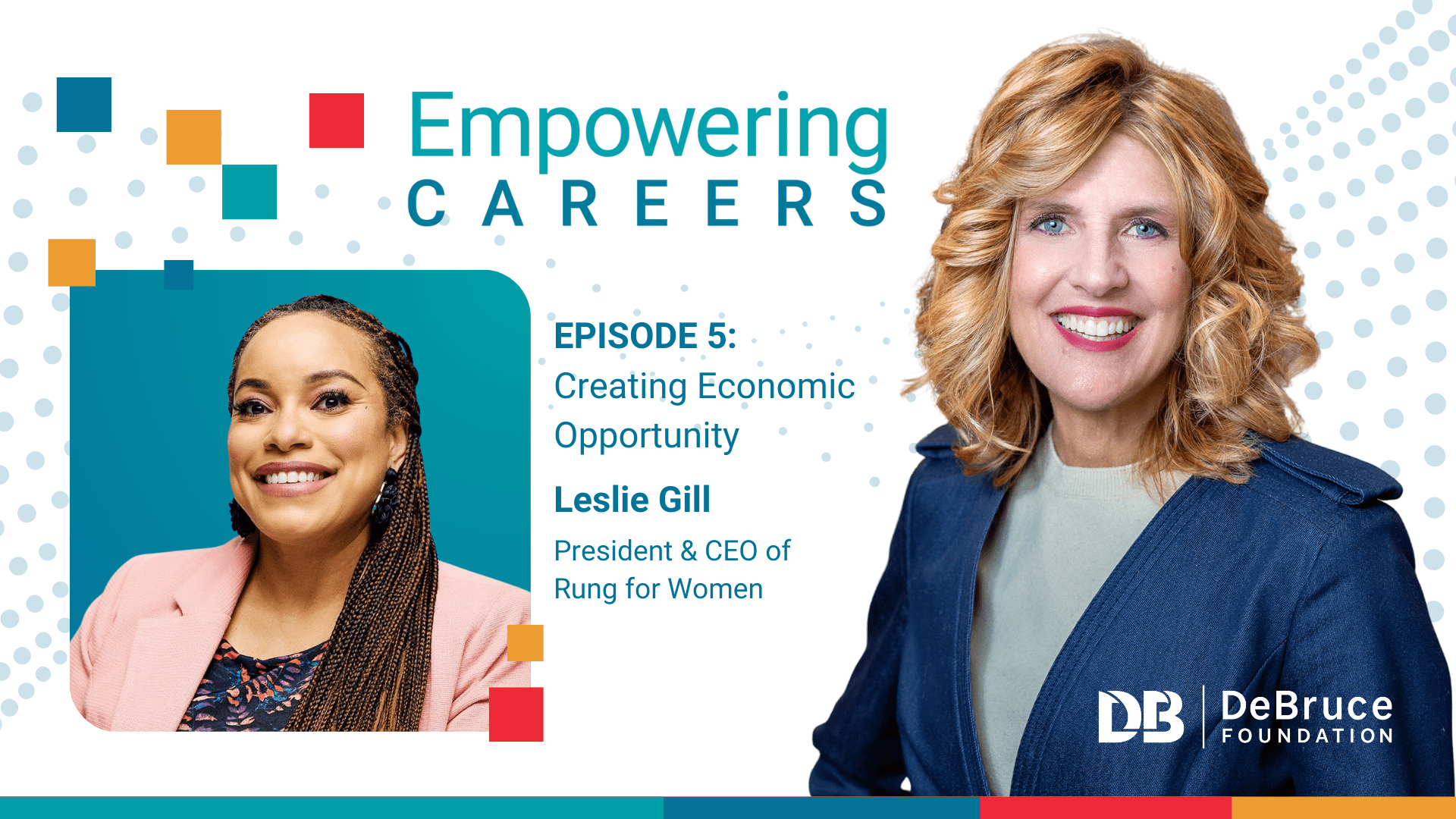
Episode 5 - Creating Economic Opportunity


Takeaways
- Learn more about Rung for Women
- Follow Leslie Gill on LinkedIn
- Follow Rung for Women on LinkedIn
- Follow Rung for Women on Instagram
- Follow Dr. Leigh Anne Taylor Knight
Transcript
Dr. Leigh Anne Taylor Knight: Welcome to the DeBruce Foundation’s Empowering Careers podcast, where we explore insights and strategies for building empowered careers. Today, we are thrilled to welcome Leslie Gill. Leslie is the President and CEO of Rung for Women, a nonprofit located in St. Louis, where they are committed to training and coaching and support services for women as they move through their careers. Since joining Rung for Women in 2017, Leslie and her team have touched hundreds of lives of women advancing their opportunities economically, professionally, and personally. I’m so happy to have Leslie with us. She has been recognized as a leader in equity and in economic mobility for many, many years now. And it’s just such a pleasure to have you on the podcast today, Leslie. So welcome.
Leslie Gill: Thank you. Thank you. Thank you. So happy to be here and excited for this conversation.
Dr. Leigh Anne Taylor Knight: Well, you’ve dedicated your career, right, to really empowering women in the workforce. So let’s learn a little bit about your own career, Leslie. Tell us a little bit about your journey and what you’ve learned along the way with that and why it would bring you to this point.
Leslie Gill: You know, Leanne, I did not know what my career path would be. I always, growing I thought I would be a lawyer. Don’t know why. And specifically, I wanted to be a sports agent because I had a love for sports. And I wanted to work in the field but didn’t know about all of the variety of career pathways in sports, aside from being an agent. So I was on this law pathway and went to college and then got to college and realized, I don’t want to read this much. I want to be with people doing things. I don’t want to read. I don’t want to go to law school. So after college, I ended up, I landed in Washington, DC, and started working for the mayor of Washington, DC, and really had this interest in public service in ways that I didn’t even know that was a career path. But the nice thing about municipal government that I learned is that you can do a lot in a little bit of time. You can learn a little bit about a lot in municipal government. And so that is really what sparked my interest in public service and people and serving others.
Leslie Gill: And I spent 10 years working in municipal government in Washington, DC, for the mayor. And then he decided he wasn’t going to run for re-election. So I’m like, well, shoot, what do I want to be when I grow up? At this point, I had started my career and learned lots of interesting things about government and government operations. But I was like, I don’t know where I go next. I really took some time to do some self-reflection and discovered there were two organizations that were incredibly formative for me in my younger years. That was Girl Scouts and the Boys and Girls Club. I had been a lifetime Girl Scout. My mother was my troop leader, and I just had such fun memories of Girl Scouting. And then I was a latchkey kid. And so the YMCA after school was part of my upbringing. And so as I was on this journey to figure out what next, I was like, okay, I want to go work for one of those two organizations. I had no idea what that meant other than, based on my experience, I knew there were people that worked there, but I don’t know what jobs they had.
Leslie Gill: I started my search and ended up being the Chief Operating Officer of Girl Scouts of Eastern Missouri here in St. Louis, left Washington, DC, came back. That is really what started my nonprofit career journey. Again, I think a great blending of municipal government. In the nonprofit sector, you have know a little bit about a lot and be able to do all the things from leading people to management to accounting and finance, program operations, how to not cause harm to people. It was just such a good alignment with my time in municipal government. Here I am, man, 20 years later, It’s crazy. And I still love it. I care deeply about our mission. And I’m proud to be doing this work every day.
Dr. Leigh Anne Taylor Knight: Yeah. I mean, so many people are blessed by the work that you do, Leslie, and the passion that you bring to it. And I love how your career journey reminds us that we really start early in life, figuring out what we like to do, what we do well, where our passion is. And thank you for calling out those two youth organizations. I mean, those are the kinds of organizations that are pouring into our youth, and they’re already starting to have experiences, right? To find out, hey, what do they like to do and what do they do well? And I mean, leadership and serving others requires an ever evolving set of skills. And I love the way that you talk about the fact that when I’m in this a role, then I have to do a little bit of everything.
Leslie Gill: Yeah. It’s so It’s interesting that you point that out because I go back to my time in Girl Scouting, and the Girl Scout patch program, learning a skill and earning the patch was genius. So Juliette Gordon Low, who started Girl Scouts in the 1900s, and had this concept of teach a skill and get some recognition for that skill. But then that skill is actually embedded in you, and you use that skill in other parts of life. I really did not realize how impactful that journey was until I got to various stages in my career. Way to go Girl Scouts, way to go, way to go, Juliette Gordon Low.
Dr. Leigh Anne Taylor Knight: I love it. I love that shout out. And so will many of our listeners, they will love that shout out as it relates to that. And it does call to mind, too, those skills that you’re learning at the Bruce Foundation And we have something called Agilities. And they’re work activities, and they’re the skills that you really do well and that you like to do the most. So I hear even in your career journey that one of your agilities, it might be serving and caring. When you said, I cared more about the people that we could serve rather than doing a bunch of reading of what I might be doing in law school. What What are your other agilities?
Leslie Gill: I feel like serving and caring definitely resonates with me. Innovation. I love change. I love tinkering with things. I love trying to do things better. Now in this climate and economy, how do we leverage technology to serve more people and to help people grow in life? I would say Serving and caring. I don’t think you can be in this nonprofit space in this sector without having or being a servant leader and caring deeply about people. I mean, we’re not making widgets.
Dr. Leigh Anne Taylor Knight: That’s right. Tell us a little bit more about Rung for Women, Leslie. Tell us, help our listeners hear and understand what it feels like to walk through the doors of Rung for Women. What a success What Rung for Women looks like for the women you’re serving, for you, for your team. Just talk with us a little bit about that.
Leslie Gill: Rung for Women started as a bold experiment. We spent the better part of 18 months building and designing and talking to women across the region about, If we build this thing, will you come? The thing at the time was we started as a resale clothing boutique, and our founder came from a family of several generations of women. One thing they had an abundance of was clothes. Allie Hogan, our founder, was like, You know what? I’m going to start a resale clothing boutique. It was a beautiful space, well-merchandised. You could go in and shop for the clothes you needed for your next interview or to go into the workforce. She spent several years working with women who were either in transition mission or homeless, getting them ready for the jobs that they wanted. Her biggest discovery is that women needed more than clothes. In 2016, she decided to pivot away from that resell clothing boutique mission And really think about what does it take to invest in women, both professionally and personally. Because as you know, Leanne, for women, especially, when one area of life is out of whack, everything is out of whack, right? I know.
Dr. Leigh Anne Taylor Knight: And when I’m in your I see there are healthy opportunities for people to eat. There are ways for us to work on our physical health when you’re there. We’re thinking about what is needed in terms of our families and the care and the quality of education that is needed for our youth. I mean, all those things, actually, women hold all that in their margin, and a lot of men do, too. But women in particular hold that. And so you have to stress that wholeness. I mean, that’s brilliant for Allie there.
Leslie Gill: What we found is, like women caregiving and caretaking. And so often, they invest in everyone else before they invest in themselves, me included. You two as well, I’m sure. And so what we decided to do was build a program that would help women grow in their careers, either reskill, upskill. If they’re stuck, help them get unstuck. Then all of the other of wrap-around services, mental health, physical health, food, wellness, all of those other things had to undergird this career program, primarily because we know that But again, all of those things contribute to professional growth and development. The way I like to explain Rung For Women is we’re a career accelerator. Career and training and development and growth and helping women think the jobs of the future is really the engine, but everything else around the engine is really also what helps the car move. We’re doing both and. Our members come to our facility, our camp, is located in the heart of the city of St. Louis. Minimum age of participation is 25. We’re not necessarily a program for young women. Or women who are just fresh out of college or trying to figure it out.
Leslie Gill: Our average age is 37. So these are women who’ve gotten to a stage in life where they’re like, okay, they’re having aha moments. I want to grow in my career. I want a new job. I need to be able to take care of my family. And so we’re helping them achieve their goals in ways that I could have never imagined, moving into new careers, building new skills, helping them move into leadership roles, but also buying their first homes, reducing debt, losing weight, managing chronic illnesses, all of the things that typically get in the way of professional success. We We’re investing in the entire woman. And so they come here. The program is about a year. It’s a one-year commitment, 10 to 15 hours a week, where they’re taking on new learning, new technical skills. So manufacturing, moving into sectors like manufacturing, technology, geospatial, and moving into careers that are going to give them flexibility, allow them to plan for retirement, send a kid to college, or just take a vacation. So many of the women that we have been serving were working like gigs or multiple part-time jobs. And so once they make this investment, themselves.
Leslie Gill: They get to pivot from those types of experiences into one full-time job that pays benefits, that allows them to plan for retirement, and gives them what they need to change the trajectory of their lives for themselves and their families.
Dr. Leigh Anne Taylor Knight: So Leslie, you mentioned jobs of the future, and you mentioned about what’s next for them. And really, there’s a whole range of opportunities that are out there. But if you’re stuck, like you said, and you can’t see that range, could you talk with us a little bit? I know that we hold this very similar as organizations. Why is exposure and exploration so vital to career empowerment? I mean, you’re talking about the track that these women are getting on. Why is that exposure and that exploration so important, Leslie?
Leslie Gill: You don’t know what you don’t know, right? And so I think about when we were growing up, there was women’s work and there was men’s work, right? And so as women, you were maybe exposed to nursing or teaching or caring professions or service professions. And as men, you were maybe exposed to engineering and science and manufacturing. Now, in this digital age, in this current climate and economy, so much of that what used to be known as men’s work, because it’s labor-intensive, is driven by technology. Anyone can do it. You don’t have to be a big burley guy to work in manufacturing anymore. What we’re trying to do is help women see themselves in those industries. We go visit plants, we go visit employers, we want them to see themselves in those roles. We bring in female executives from companies that are nontraditional for women so that they have access to have the conversation with those women about what’s a day in a life like? How do you manage maybe being the first or the only in a certain industry? We’re having those conversations so that when they choose to move into those fields, they’re prepared.
Dr. Leigh Anne Taylor Knight: And your model, you’re helping the individuals, but your model, as you say here, also goes in to help those businesses, right? Absolutely. You feel that responsibility of creating a safe and secure and productive landing place for the women who, like you said, they may be some of the first women who are going into some of these careers or into this place. Leslie, if you… And so that’s another A really cool thing. Those businesses out there who are looking to think about how do we bring more women, Rung For Women is a great partner for you all, right? Because they will help you come in and look at this and assess this and understand why would a woman want to work here or not want to work here. And that’s important. I mean, Leslie, if you could tell employers just one thing about the women who you are serving every day, what would it be? What do you think those employers need to hear or know about those women?
Leslie Gill: I would say that employers need to, A, first and foremost, create conditions where everyone can be successful, regardless of gender. But B, know that depending on the industry, for our members in particular, you’re going to get likely an experienced employee, you’re going to get a mature employee, you’re going to get someone who has a to learn and grow. They’re reliable. I think, especially in the industries that we’re talking about, employers that I talk to say, If you can show up and use an iPad, you can do this job. And so women are a good match. They’re dependable because we’re caregiving and caretaking, and we know that taking care of family is priority. So that is our motivator often. So we’re showing up on time. We’re doing what’s required. We’re willing to learn new skills. But also you get this blend of head and heart. Not that men don’t have it, but I do think that women show up in the workplace in a more nurturing way often and will be good leaders, will model good behavior. That is what you’re going to get when you get a Rung for — Rung for Women member, but also, I think, just women in general.
Leslie Gill: I think that creating the conditions so people can be successful is most important. Then what we’re doing is exposing our participants to these industries where maybe they had no previous knowledge of.
Dr. Leigh Anne Taylor Knight: Well, and on that note earlier, you did mention, too, the, if you can’t see it, you can’t be it. So talk a little bit, Leslie, maybe about what role does mentorship, what role do networks play in helping women not just get jobs, but actually build these lasting careers? Because you’re not only committed to them at the time that they’re there, you’re thinking about what are some of those next steps. For sure. What’s happening in terms of mentoring and networks? Talk about the importance of that.
Leslie Gill: Well, of course, I think for all of us, I got to this seat because I knew the importance of having my own personal board of directors and a group of people who would hold me accountable. I showed up for the networking event or I went to have coffee with the person that I aspired to be. So networking, sponsorship, mentorship, all really important facets of career growth. I would say in our model, one thing that is really unique is When members are going through technical training, we do learning labs, which are a fancy name for study groups, where we bring in women who are working in the industry and they lead those study groups. So that member who is in that learning lab, they automatically connect with someone who looks like them and works in the industry that they’re aspiring to. If you’ve never actually learned to network, it doesn’t necessarily come naturally. We help our members build that skill. They get to practice it in real-time, and then they get to build their own social network. Not different from social media, but that social network is really important as you think about career growth and career Agility.
Leslie Gill: The skills that you learn today might not be the skills that you need tomorrow. And it’s all a compounding effect, stackable Agilities, I would say. And so, so much of learning those Agilities and learning those skills come from being in community with women who already have the things that you want. And so I think that’s the real importance. I don’t know that you get to really grow in career or advance in career if you don’t at least You might not master networking, but at least understand the value of networking and the value of seeking out mentors and the value of being a little uncomfortable when you have to approach someone to say, Hey, can I have a conversation? Or, I want to learn from you. Those are all really valuable skills that only help propel you forward.
Dr. Leigh Anne Taylor Knight: I promise I did not I do not give you our research team’s notes. Yeah. No, you didn’t. You just gave the definition of employment empowerment because employment empowerment is both this career literacy. So being exposed to seeing careers and those opportunities and understanding what you do well, what you like to do. That’s a Career Literacy piece. And the other piece is this network strength. And you said you don’t have to like to network, but you’re probably going to need that network. And what we see over and over again is that career literacy, network strength. Network strength is what accelerates one’s ability in the career marketplace, right? Because we have a network of individuals who are even come from different life experiences, different education levels, different sector experiences than we do. And we have them in our network. They will sometimes see opportunities that exist for us that others do not. And Leslie, I’m so glad of the work that you all do, because what we know today, our research tells us that adults between the ages of 18 and 65, across all demographics, we see that only four out of 10 are employment empowered.
Leslie Gill: Wow.
Dr. Leigh Anne Taylor Knight: And so six out of 10 are either low on that Career Literacy or low on that network strength. And there’s a whole quadrant of people that have career literacy. They know what they like to do. They will apply for different kinds of jobs. They’ll after those things, but they don’t have the network strength that gives them that rocket fuel, right? To be employment empowered.
Leslie Gill: I love this notion of employment empowered. That’s a concept I really want to learn more about. So thank you for sharing that. I see the women that thrive in our program are definitely employment empowered, right? The women that thrive in our program know the value of having their social network and networking, right? And they might not always want to do it, but they do it because they know the value of it.
Dr. Leigh Anne Taylor Knight: That’s right. They know the value of it. Actually, too, we build confidence, right? As we do it, we do a little bit more. We build our confidence in that.
Leslie Gill: Here’s a little secret, Leanne. I don’t like networking.
Dr. Leigh Anne Taylor Knight: You don’t. I don’t. Do you have to budget it into your life in a certain way, Leslie?
Leslie Gill: I do. I have to also really build the emotional capacity to do it. Because I’m an ambivert, and so I’m not driven by people energy, and I definitely need… I’ll do it. I can flex when I need to. I definitely know the value of it, but it is not… My energy comes from solitude. I really, really use myself as an example, often with our members who are like, Oh, I don’t like networking. I’m like, You know what? I don’t either. You’re not alone. But here’s the value of it. Here is how it’s helped And so I think in our roles, people just assume, Oh, you love to do all the things. You love to be out every night at every chicken dinner and talking to all the people. It’s draining. It is straining.
Dr. Leigh Anne Taylor Knight: Thank you so much for being authentic and sharing that as a barrier for you also recognizing… And if it’s a barrier for you and for your audience, for those you’re serving, it’s also a barrier for other people who are on our audience. So So would you even give us a couple of Leslie tips for how do you overcome that barrier? Leslie, because you’re saying, I’d say to them, it’s valuable, you need to do it. So how do you push yourself over that barrier? Any tips for success?
Leslie Gill: Yeah, I would say I often, and we’ve talked about this, Leanne, I don’t seek balance, I seek harmony. And I think the notion that I am not naturally a networker, fits very nicely into this harmony philosophy. For me, I want every aspect of my life to work together. That means when I know that I have a week of evening commitments, I really try to find time during the day to reset. I carve out the time. I’m diligent about it. I’m disciplined about it because I want show up as my best self. If I am burning the candle on both ends, eventually, they’re going to meet, and then it just becomes a firestorm. I really work hard at harmony and making sure that I’m planning, I am intentional about looking at how I spend my time. Also, I think one thing, especially as women, not living in guilt. Because so often we find that we’re in spaces where we’re trying to do it all and it’s just not humanly possible. And then you feel so guilty about it, I have released that guilt. That’s just one tool for me, I would say just making sure that I take the time to reset.
Leslie Gill: If I know that I’m going to be giving a lot of emotional capital because I have to speak or I have to be present for a lot of networking time, I try to offset that someplace else in my day.
Dr. Leigh Anne Taylor Knight: That actually gives me hope, Leslie. It helps to hear that. It helps to be reminded of the importance of balance. Yes.
Leslie Gill: And- Harmony. Because- Harmony I think the balance is what also ignites guilt, right? Yeah.
Dr. Leigh Anne Taylor Knight: If you’re trying it versus it’s integration, it’s harmony. Yes. Put that balance word aside. It’s integration, it’s harmony. Yeah, I think that does. Because we do. We strive to seek that balance.
Leslie Gill: And then there’s really. And then you feel bad when the scale never balances, right? Yeah. I always think about the legal field and the scales of justice, right? And in every commercial that uses that image, it never stops equally, right? I mean, it’s like life is not about equal parts in any way, whether it’s career, family, or friendships. There’s going to be give and take, and someone’s going to give more at times, and then someone else will give more at times. But It’s never completely equal.
Dr. Leigh Anne Taylor Knight: Yeah. Looking ahead, Leslie, what gives you the most hope for the future of women’s economic empowerment?
Leslie Gill: Yeah. Man, that’s a heavy question in this climate, if I’m being really honest. But I think for the first time in maybe in our lifetime, we have more women in leadership. We have more women, female entrepreneurs. We have women who are leading major institutions. So that gives me hope, but we need more of it. We need more women who are leading who are able and empowered to lead in their own ways. I also think that we still have to talk about pay equity. And so I’m really hopeful that our future state allows us to not talk about pay equity in the terms that we are now, that companies especially will pay everyone for the job that they’re doing versus asking, Well, what was your previous salary? Well, why does that matter? And that actually happens to women more often than it does to men.
Dr. Leigh Anne Taylor Knight: Interesting.
Leslie Gill: I’m also really hopeful that women will just go for it. So often we see a new opportunity and we look at the glass as half empty. I can’t do that. I haven’t done that. Men, on the other hand, will be like, I can do that. I haven’t done it, but I know I can do it. And So how do we shift that mindset of women to just go for it? Even if the answer is ultimately no, you learn so much by taking the risk. You learn so much by going for it. Our counterparts go for it all the time, and we talk ourselves out of it. So I am hopeful that the world ahead of us will have more women leading in more meaningful ways and more women going for whatever the thing is. Just go for it. Yeah.
Dr. Leigh Anne Taylor Knight: Leslie, we’re so thankful for you joining us today, Leslie. And I mean, we’ve covered so many topics, but on that note of like, just go for it and really believing in people, that people can do this. I’m reflecting. I think a lot of us are probably going to Hold those words of caregiving and caretaking and what it means to get in harmony with that caregiving and that caretaking. And I also hope that our listeners today will really reflect on what are some of their early life experiences that have led them to where they are, what they like to do, what they do well, and not be afraid, like you, to follow that example and to pivot when you’re like, I really need to serve and care, which means I need to be developing others, and my leadership role needs to be in a place where I can do that with people. For any of those listeners.
Leslie Gill: I want to just put a pen in that really quickly because the work that you’re doing at DeBruce around agilities is so powerful. I think when people, but women especially, know what you’re good at and what you like and finding the intersection of the two, that is really what changes your life. I’ll just leave with a quick story of a member, Betty. Betty came to Rung. I’m not sure how old Betty is, but Betty is a little more mature. And she came to us saying, I’ve never finished anything, but I know that I like to work with my hands. I know I like to tinker with things. And I’ve been spending my entire career sitting at a desk. And so when Betty went through our program and discovered the manufacturing sector, her world just opened. She said, You know what? My husband calls me when the HVAC needs to get fixed.
Dr. Leigh Anne Taylor Knight: Okay.
Leslie Gill: Yeah, right? And she was like, And I go right to YouTube and Google, and I get to tinkering. And she was like, That is when I’m my happiest, right? So Betty discovered her agility later in life. But I’m so grateful that we were able to help her figure out the intersection between what she’s good at and what she loves. I think that’s just such a powerful tool that I wish we can all leverage.
Dr. Leigh Anne Taylor Knight: Thank you. You’re welcome. And thank you to that compliment, too, and our team that does the work around the Agilities and really sharing those resources. I mean, for all of you who have tuned in today, if you enjoyed this conversation, those resources that Leslie is talking about, they are free at DeBruce.org So follow us there. Follow us on our social media for more of those career building resources. And together, we can build those empowered careers because we’re going to build that Career Literacy. We’re going to build the network strengths of which Leslie talked about today. And we’ll see you the next time.