Link copied to clipboard
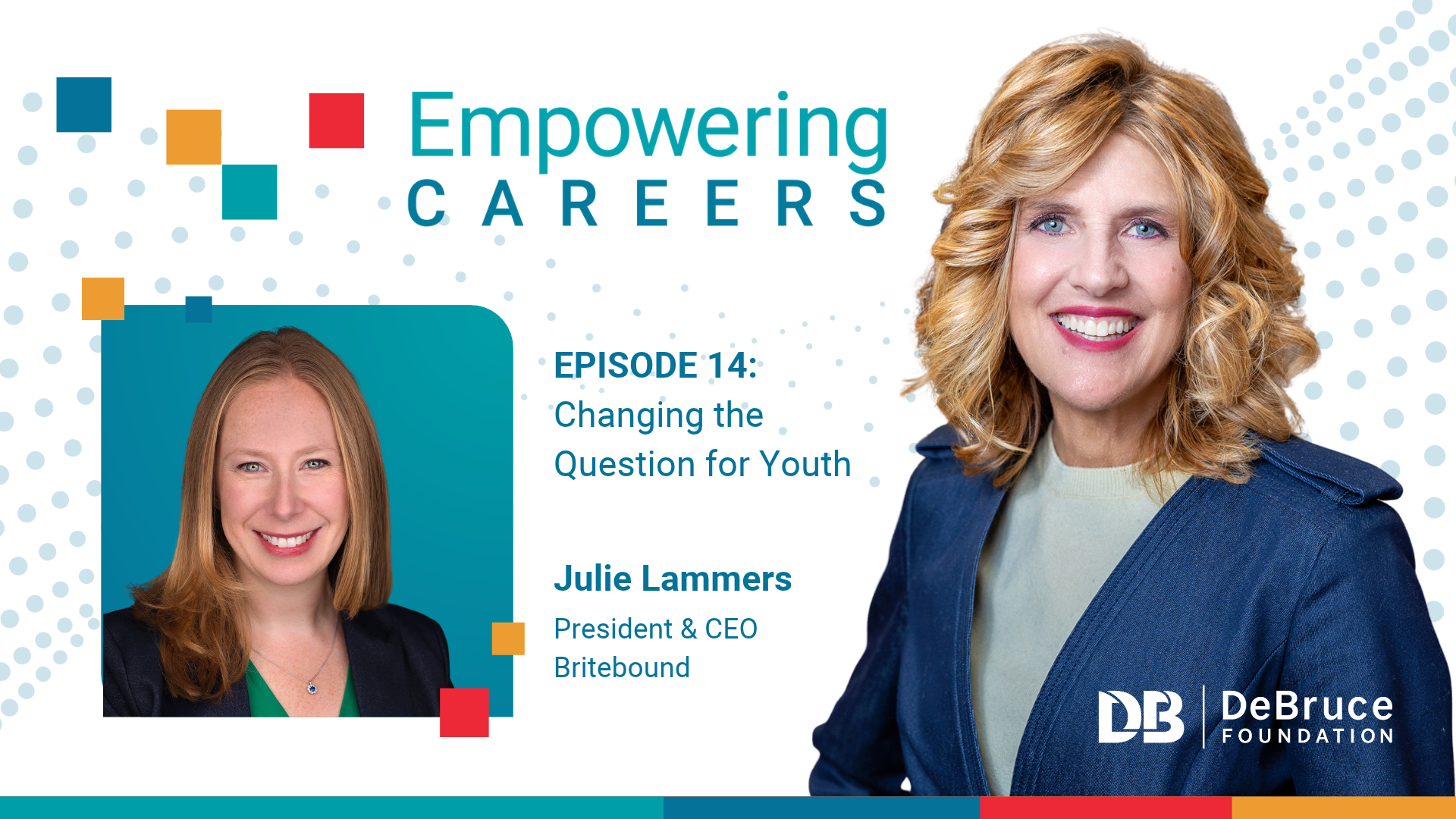
Episode 14 - Changing the Question for Youth


Takeaways
Change the Question this November in the classroom or at home: https://debruce.org/november
Learn more about Britebound: https://www.britebound.org/
Transcript
Dr. Leigh Anne Taylor Knight
Welcome to the DeBruce Foundation’s Empowering Careers podcast, where we explore insights and strategies for building empowered careers. Hello everyone. My name is Leigh Anne Taylor Knight, and I serve as the Executive Director and Chief Operating Officer of the DeBruce Foundation. November is National Career Development Month, so it’s one of our favorite times of year at the DeBruce Foundation, where we get to celebrate people choosing and changing careers and finding inspiring ways to walk into the future. That’s why it’s my special pleasure to welcome Julie Lammers, CEO and President of Britebound, a national organization that’s also committed to young people, helping them explore their potential, have different kinds of work opportunities, and find a pathway to a meaningful and rewarding life. Our organizations actually share this commitment to young people bringing their voices to the table, as well as providing different kinds of experiences experiences for them and supporting organizations all across the United States who do just that. I’m sure many of you are listening today, and that’s why Julie and I are very excited to share with you what youth are saying about the future of work, about AI, and about all things related to their career exploration and their journeys.
Dr. Leigh Anne Taylor Knight
Welcome, Julie, to National Career Development Month.
Julie Lammers
Thank you so much. It’s so— I’m so excited to be here to celebrate with you.
Dr. Leigh Anne Taylor Knight
So Julie, let’s start out. While our organizations have some things in common, it may be helpful for our audience to hear a little bit about Britebound and what you all do and, you know, what brought you to this work.
Julie Lammers
Great, thank you so much, and I’m so thrilled to be with you. We love the work that the DeBruce Foundation does, and we are very much aligned in our vision of making sure that young people have the tools and resources they need to be successful long-term. So at Britebound, we are a national nonprofit focused really on changing the way young people learn about careers and then navigate post-secondary education and career success. And for us, that means that there are many things that need to change and many supports that need to be sort of infused into the ecosystem in order to make real impact on young people. So we focus on a few key areas. We focus on middle school career exploration as an opportunity for young people to really understand themselves and their long-term career goals. We think it’s critically important that we start these conversations much earlier so the kids have a longer runway to think about who they are, what they want, and take advantage of the many programs that are now developing and have developed over the last few years to expose young people to career. I think historically we have not given kids that opportunity to really think about who they are and what they want at an early— an early enough age for them to act on.
Julie Lammers
And so we focus a lot on middle school As a key opportunity, make sure kids are not foreclosing opportunities for themselves too soon. In high school, we really focus on what are the hands-on learning experiences that we can be giving to young people, whether it’s an entrepreneurship experience or a full-scale internship, a career, a job shadow opportunity, perhaps career-connected learning project in some way that allows them to actually build the skills and expose them to an actual job in a way that helps them build a career identity, eliminate the things that they hate, hone in on the things that they like, and be able to make a much more intentional choice about the types of post-secondary education and training that will lead them to long-term success. And then the third pillar of our work is really how are we supporting kids in that navigation from high school into what comes next for them after high school, whether that is directly into the workforce or into an education or training program. So those are the 3 verticals that we are trying to really change, the opportunities we’re trying to change for kids. And we do this through direct digital programs that we create and provide directly free to kids.
Julie Lammers
We have a whole suite of programs that are free for young people. We do this through philanthropy and really investing in a lot of the tools and community-based organizations that are having a direct impact on a daily basis on the lives of young people. And we also do a lot of research and policy and advocacy work to really ensure that we are changing the systems that young people are, are operating in every day. We can’t do great work with an after-school program or a nonprofit if we’re not also thinking about how young people are, are experiencing school and this type of activity in their daily lives, the 6 to 8 hours that they’re, they’re in a structured program. So we need to do all of these things, and we try to tackle that activity in multiple, multiple ways. And so that’s generally what Britebound is trying to do. We do work nationally specifically on these issues of career readiness for middle and high school-aged youth.
Dr. Leigh Anne Taylor Knight
So, Julie, those are big things to be doing, especially in today’s workforce context, right? So when we think about preparing young people for careers, Especially in this world of work that’s changing so quickly. What does that, what does that really mean? What does our audience need to know and understand about that today, Julie?
Julie Lammers
Yeah, so I think there’s different conversations we should be having at different ages. In the middle school, we really think about how are we helping young people understand who they are, what they want, what they are good at, what the world needs, and what they can get paid for. And really trying to help them understand their own sort of personal point of view on what career should be. I think we, we believe that young people are just not exposed enough to opportunities around them. They might only see what their family members or community members participate in. And so young people are actually foreclosing a lot of opportunities for themselves because they’re not aware of the possibilities. And so we really want to make sure that the younger age students are just not closing off things too soon. How are we helping young people take advantage of the high-quality pathway programs that might be existing or might be built in their schools, or thinking about how we’re just exposing them to something new? As you know, the old saying, like, you can’t be what you can’t see. Too many people are not seeing what the possibilities are for themselves.
Julie Lammers
And so really, really think at that younger age, that’s the conversation we should be having. What is— what’s possible? In high school, I think it’s a little bit more tactical, right? It then it gets into the how are you actually trying something? What are the hands-on experiences we can be giving you to help hone some of that, what you might have developed in high school?
Dr. Leigh Anne Taylor Knight
Yeah, I’m really glad that the audience got to hear you talk about that through the different age groups, because sometimes they think, oh, it’s probably too early to start exposing them to careers, but it’s really not. It is, it is about exposure. And then I loved how you leaned into also building the confidence in what they like to do, what they do well. I mean, that’s where we’ve gotten to partner some too with the agilities and being in EvolveMe and some of those efforts. Because when we talk with people and we talk with young people about exploring, it’s really hard to even know what you want to explore if you don’t get some of that exposure too that you’re talking about.
Julie Lammers
Absolutely. And I don’t think it is really ever too young. And in particular, middle school, middle school youth are beginning to build a sense of who they are and sort of struggling to, at times, to figure out where they fit in the world. And part of that comes into sort of long-term views of themselves, what’s possible for them. And we want to make sure that they are, they are expanding those opportunities at that critical time of change in their lives, not limiting themselves. And so the more exposure we can give them, the more we can talk about what is possible for their future, and we think we’ll be in a better, better place long term.
Dr. Leigh Anne Taylor Knight
Do you think that adults sometimes make assumptions, Julie, about what young people want in their careers or in these experiences?
Julie Lammers
I think they do. I think in general we significantly underestimate the capacity of our young people. I think we see this time and time again, particularly when we’re talking about high school experiences. I think one of the reasons employers are often very reluctant to engage with high school work-based learning programs in particular is because they don’t think young people are capable of the work that they need to have done. And time and time again, we see that that’s simply not the case. Employers are often surprised that when they’re given sort of a challenge, young people very often step up and figure out a way to solve the problems. that employers are looking to solve. So I think we significantly underestimate the capabilities of our young people, and we need to think differently about how we’re empowering them to do more.
Dr. Leigh Anne Taylor Knight
I agree. I’ll never forget the day that a very large entity came to us. I was at that point in time an assistant superintendent, and they came and they said, you know, we think that your high schoolers who’ve been doing some playing around, flirting with some internships with us, could actually do as good a job as some of our college interns. And that’s how we started, you know, a work-based learning or career-connected learning experience for those individuals. And it is— your word, underestimation, which we should not ever underestimate. And we should also not ever miss the opportunity to hear their youth voice, right? Absolutely. And you guys at Britebound just have done a big survey with 7th through 12th graders. I think the name of the report is Teens in the AI Future, right? Maybe?
Julie Lammers
Yeah, correct.
Dr. Leigh Anne Taylor Knight
Yeah. So what did you find when you interviewed or surveyed those individuals? What stood out to you that’s really important for our audience to hear about today, Julie?
Julie Lammers
Yeah, so I think we, we started this work with a real question about the concerns we were hearing from young people about nervousness around AI. And we wanted to understand where that was coming to, coming from to a degree, because the reality is AI is here to stay. I don’t think we’re going to see it leave us anytime soon. And so we need to figure out how to help young people adapt in a world of AI. And being fearful of it does not help that. And so really trying to understand sort of the rationale as to where young people were coming from was the basis of this survey. So I think what we were seeing was a lot of confirmation of what we, we already knew to some degree. We were seeing that about 4 out of 5 young people were saying that they were using AI on a regular basis.
Dr. Leigh Anne Taylor Knight
Yeah.
Julie Lammers
And in their, in their daily activities at school, whether it was sanctioned by school or not, which was an interesting finding. But even the fact that, despite the fact that they were using it on a regular basis, 36% of young people said they had never had any The only 36% of young people had had any education around AI, how to use it properly, training of any type on it. And so, you know, this is largely self-taught, and that could lead to what some of these concerns are. I’m being— I’m using a tool that I don’t know a lot about, and I’m hearing that it’s gonna take away my job in the future, right? That’s sort of the—
Dr. Leigh Anne Taylor Knight
Yes.
Julie Lammers
And yet I’m not getting the type of training and support that I need in order to be successful.
Dr. Leigh Anne Taylor Knight
Yes.
Julie Lammers
I think the report also highlighted some really concerning disparities that we’re seeing in how AI is being taught and where. The types of schools that are really embracing AI tend to be private schools that, you know, you’re paying for your kid to go to school. They are the ones that are embracing AI, teaching AI, and then adapting their learning and teaching methods to teach different types of— teach education a different way, really facilitative conversations, but with the support of AI. That’s not happening across the board. And so these disparities, which we think— I think we knew were going to be significant in equity issues, are already arising in our schools. And so that’s a real concern. I think where the conversations we need to be having with young people are around the fact that AI is a tool that will help enable you to be more efficient in both school and eventually in work. And yes, the nature of work will change, but, you know, people talk about it’s taking my job. Well, you don’t have a job right now, right? You’re, you’re probably 10 years away from having a job, and the vision that you have for your job may change because of AI, yes.
Julie Lammers
But I believe that the kids that thrive in the future of work are the ones that not only know how to use AI effectively, but have the human durable skills to really stand out in a world of AI. And so what we can do to help prepare kids is really make sure through high-quality career-connected learning experiences, they’re building the type of human durable skills that employers say they really need— communication, teamwork, critical thinking. discernment of information. All of those things that are not easily replaced by AI are the types of things that we really need to make sure we are helping young people build the muscle for now so that they can be successful long term.
Dr. Leigh Anne Taylor Knight
Yeah, we, in our national survey on this, we had a slightly older age group. We had 14 to 24, but much the same results. 3 out of 4 wanted to use AI in their job search and their career exploration. 2 out of 3 said they were, and only Only 1 out of 3, just like your 36%, said that they felt confident that they were using it correctly. So that is, that’s definitely something for us to pay attention to. And also like, and what are they thinking about? Will it take our jobs? We may talk about that a little bit more, but— Yeah. That is, thank you for sharing that because I think the gaps that you’re pointing out and the places that we already see the disparity We can, you know, the sooner we recognize those, the sooner we can close those. Right?
Julie Lammers
Absolutely. And, you know, we’re seeing— it’s not surprising that we’re seeing the results that we are, right? Because teachers are not trained to teach about AI. They also need to build a skill set that’s completely different in a world of AI, in how they communicate about AI, how they help kids build these skills. And it is not something that is universally trained in teacher settings. And so, you know, we have to make sure that everyone is up to speed on how to use these tools correctly.
Dr. Leigh Anne Taylor Knight
Yes, definitely. So, well, our research also talked a little bit about confidence that students have, Julie, in attaining their career goals. So we see that like 85% of kids are confident in attaining their career goals, and yet only 44% of them actually have a plan, like have any idea. And also, we see that like 1 out of 4 kiddos don’t even want to talk about career education or what it might be, you know, for them. So is there anything— I mean, I feel like, gosh, that’s what you guys at Britebound are trying to— Yeah. You’re trying to make it cool and enticing for everybody to, you know, get on that track and to, and to talk about and to think about some of your next steps in the career journey. So is that, is that the case? Or—
Julie Lammers
Yeah, I mean, I think we definitely see that being the case. And I think it goes back to why it’s so important to have these conversations much earlier. We did a study a few years ago asking similar questions around confidence in future careers to middle school students and high school students. The reality is, the closer you get to having to make that decision, 11th and 12th grade years, the anxiety over those choices becomes much higher. And so, yes, kids don’t want to talk about it. I’ve got too much to think about. It’s too paralyzing to make a decision right now. And yes, and so that anxiety around future is really, really high. Middle school students tend to be much more optimistic. They tend to think everything is still possible. And they’re— because they are farther from the decision, they are much more open to a variety of possibilities. And so having a conversation with young people at a time when that anxiety about making a mistake is much lower is, in our mind, one of the key reasons why middle school is such a key point. to start these conversations, because the risk of trying and failing at that moment is significantly less.
Julie Lammers
And so if you can front-load some of these opportunities to try something, figure out you like it or you don’t like it, and then pivot to— you have enough time to pivot to something else. That anxiety about career decreases over time, so that when young people get to 11th grade and they’re asked by a school counselor, what’s next for you, they’ve had time to think about all of those opportunities. They’ve had time to experience something real. And the possibilities are then focused on the narrower set of options that aligns with their long-term interests and goals. If you haven’t had that preplanning time, obviously, what do you want to do next is going to be an unbelievably paralyzing conversation because you just don’t know what the possibilities are. Right. Right. And so really trying to front-load those conversations, we think, is critically important.
Dr. Leigh Anne Taylor Knight
And I think that’s even— it’s even more complicated today when we layer on these messages that are in the media about AI and AI is going to take these jobs. So just what adults are hearing, I mean, young people are also hearing those messages. Our research showed that like 60% of these 14 to 24-year-olds across this national sample, 60% thought that their job opportunities would be less because of AI, and only 36% thought that they would have more opportunities. So, you know, they’re internalizing hearing some of those messages. Julie, did General’s research reveal anything about how teens are making sense of messages around AI and the future of work?
Julie Lammers
Not really. I mean, I think there’s a lot of competing information, really. And, and They’re unsure really who to listen to and what— I mean, we don’t, as adults, we don’t know these answers. And so I think it’s a reframing really, right? It’s a reframing of this idea that AI is going to take our job versus how are we ensuring young people have skills to be AI ready in a job market that is still going to need many, many things. that will be different than they are today. It’s not necessarily a one-for-one trade-off. Right. It is— there’s a— there’ll be a whole new field of opportunities that is created from AI. And yes, it will likely look very different than what you envisioned today. But the reality is that’s always been the case, that every, every 10 years, things look very different than they did a decade ago in the job market and what the world needs. And so I think really trying to help young people think about it from that perspective of it is a constantly changing job market. We don’t have the same jobs today that we did 100 years ago, and that is probably for the best in many cases.
Julie Lammers
And what we have done over time is if we can help young, young people develop a love of learning and constant reskilling and upskilling, they will be successful in whatever job comes. It’s not about picking one thing now.
Dr. Leigh Anne Taylor Knight
Right.
Julie Lammers
It is about building a certain set of skills to be ready for any career possibility that’s in front of you. And so, you know, I think there is a bit of back and forth that we, I guess, nuance that we need to thread around some of the pathway work and helping young people build, you know, specific skills. So specific skills in healthcare. or specific skills around IT. And the idea of building these programs is less about the technical training that you’re learning and more about learning how to work, how to think about skill building, how to make sure that you are ready for a career. And that career might evolve over time, but what you are building are the skills necessary to be career ready long term.
Dr. Leigh Anne Taylor Knight
Yes, and I think that the plural of pathways is so important. I have heard that most most recently at Human Potential, most recently, um, at University of Wisconsin-Madison’s healthcare system, where they’re like, it’s not pathway, it’s about pathways. It’s broadening what individuals will consider. And the growth mindset piece of that is really important too. So you’ve given some good nuggets to the career navigators and the parents out there who, you know, might have a kid who says, Will AI take the job that I want? Possibly. But in our relationship, what we’re trying to do with you is to make sure that it’s not just one place to which you are going, but that you see this as the smorgasbord of opportunities and that we’re building that confidence, like you said, in the things that you do well and the durable skills that you’re going to be able to transport with you wherever you go. Yeah. So I think those are really important. The other thing that that does, our research actually found, Julie, that the students who already have a higher career literacy and a higher network strength, some of these pieces that you’re talking about, those are the youth who are less pessimistic about AI taking their jobs, right?
Dr. Leigh Anne Taylor Knight
Interesting. So everything that we can do to build career literacy, students having a vision for their careers, being able to articulate what they do well and to see the that whole career marketplace like you were talking about in the exposure piece, building that career literacy, plus building their network strength so that they can— they, they have individuals in their corner who will, you know, help them see those opportunities. That, that is— those are the students who feel less anxiety right now about this, where these doom and gloom kind of messages come.
Julie Lammers
And I think it’s really interesting, this, this The, all these doom and gloom messages about AI taking jobs, and yet we see employers who are desperately seeking talent and desperately concerned about long-term pipeline issues to employment that they don’t think over time they will have enough people to fill the jobs that we need. And so that reframing for young people that it is not about filling a job that is available today, it is preparing you for a job that is available tomorrow. I think it’s a really important conversation to be having because, as I say, jobs are constantly disappearing, but they’re evolving. There’s something new that replaces it. And so how do you help young people be adaptable enough to see the possibility in future career opportunities for themselves?
Dr. Leigh Anne Taylor Knight
And like you said, we’ll never be able to predict all of these. And I don’t even know— I mean, like, that’s not what young people need is for us to predict that change. They need for us to have those relationships, those resources, and that guidance. of how to navigate through that. That’s our— one of the things that we produced was how to talk with youth about careers in the age of AI. So just some of those tips that you said, those are— they’re just some really practical things that we can do right now with, with young people. And so I’m, I’m thrilled that you, you’ve shared that today and have helped our audience recognize and, and see we can do this, you guys. And we don’t have to have the crystal ball and predict the future. That’s not
Julie Lammers
No.
Dr. Leigh Anne Taylor Knight
That’s not what this is about. So speaking of those conversations, both you and I have been in social media channels and on stages, and we’ve kind of both said that age-old question of what do you want to be when you grow up might not be the best question for today when we’re looking at young people and even adults having 6 careers and 18 different jobs. And that back to your growth mindset, right? This whole idea of what do you want to be when you grow up, that sends us into a space of pick one thing, that’s what it’s going to be, this is what we need you to do. And that creates some of that anxiety, right? Absolutely. To which you referred. So what is it, you know, if it’s not that, from your perspective, what might we be missing when we’re focusing on this single future of a Job or a career, and, and how do we need to flip that on its head, Julie?
Julie Lammers
Yeah, so it goes back to the conversation I think we had at the beginning around middle school and, and what, what the conversations we should be having with them. I agree that asking someone what they want to be when they grow up is extremely limiting. It can be anxiety-inducing. producing if you don’t know what your possibilities are. And so you get a lot of, you know, default answers of, I want to be a doctor or a teacher or whatever my parents are, whatever my neighbor is.
Dr. Leigh Anne Taylor Knight
Just what they could see.
Julie Lammers
The 8 or 10 things that they might be able to see in their community. And that’s fine. And often that is something that drives a young person’s passion of what their parents have exposed them to, or a caring adult in their life has exposed them to. And, but the reality is, you know, that’s not the only possibilities for young people. And so really trying to hone in on what are the things that you love? Yes. What do you think you’re good at? Are conversations that we should be having with young people on a regular basis, and then helping them. And I think I agree that, you know, the adults in the, in our young person’s life need more resources around this. But what does the world need is the ongoing question of how is the world of work changing and what can you get paid for? Because yes, everyone would love to be an online gamer, I’m sure, but there’s only so much capacity in the world for someone to get paid for that. So what are the other things that the world needs in order to hone in on the things that you like, you love, and that you’re good at?
Julie Lammers
And in the center of those sort of 4 things are the types of activities we should be helping young people explore and really think about giving them hands-on experiences to decide whether or not I was right and I do actually love this, or I actually hate this. Yeah. And before the risk of trying and failing is too high. So really trying to help young people think about the things that they love and that they’re good at, rather than saying this is the one career you need to pick.
Dr. Leigh Anne Taylor Knight
Julie, I’m so glad you even started to mention other questions that we can ask kids at this point in time instead of what do you want to be when you grow up? That’s the very reason that in November, National Career Development Month, we at the DeBruce Foundation launched the Change the Question campaign. So we’re encouraging classroom teachers or organizations who work with youth to do just one activity. And we’ve got examples out there. Again, all of our resources, like the Britebound resources, are at no cost. They’re completely free for individuals to be able to use. But, you know, what can I be doing with elementary school? What can I be doing with middle-level students? What can I be doing with those high school-level students? And we, we really can Change the Question when we’re in those organizational and classroom settings. At the same time, a lot of us in November find ourselves sitting around the Thanksgiving table, right? So another part of our Change the Question campaign is actually something that you can do at the Thanksgiving dinner table. And you mentioned some good questions we actually have online that you can download and print or that you can do it from your phone.
Dr. Leigh Anne Taylor Knight
Questions that adults can ask youth at the table and questions that youth can ask adults. So like you said, hey, what are you really good at? Another good question, what do you want to learn next? Another, who could help you learn more about something that interests you? So those kinds of questions going to our youth around our family tables, but also opening up again something that Britebound cares so much about. finding that youth voice, there are questions for them to ask us, right? Because this is, as you have attested to, the only way that this works is for them to be curious and for us to invite them into that curiosity and say, even if we have to say, I don’t know the answer to that, but I bet we can find somebody who knows the answer to that.
Julie Lammers
Right. Yeah. I mean, it is, it’s all about trying to empower them. to have a little bit more say in what their future is. Right. And, and really drive, drive them to ask questions that matter. And we just need to facilitate those conversations in a different way.
Dr. Leigh Anne Taylor Knight
We do. And we just— and it’s really going to happen through practice. Right. It’s like yoga posing. Hey, the more I practice that yoga pose, the better I get at it. So we as adults— not always. Well, that’s true. Okay. You’ve been to the yoga classes where I’ve been seen. Yes. Okay. Before we, before we wrap up, Julie, I have some lightning round questions. So these are just like quick answers for you. For the young person listening who feels like everyone expects them to already know what they’re going to do in their life, what do you want them to hear, Julie?
Julie Lammers
That you don’t have to have it all figured out. Life is a journey, and all you need to do as a young person is ask good questions. and think about what you love, what you could be good at. And, you know, the possibilities are endless after that.
Dr. Leigh Anne Taylor Knight
Thank you. Could you give us one word to describe the future of work?
Julie Lammers
One word? Possible.
Dr. Leigh Anne Taylor Knight
Possible. I like that. The possibilities abound. Anything is possible, especially when we work together to expand those career pathways. That, that’s the ideal to this. And you’re Last lightning round question. What encouragement would you offer educators who are helping young people prepare for this future?
Julie Lammers
So I think educators have not historically seen themselves universally in this work, right? I am a math teacher. I am an English teacher. I teach civics. I think career readiness is everyone’s responsibility, and so any opportunity that a teacher has to connect what they’re doing in the classroom to the real world helps in this process. Whether it is when you’re talking about civics, what are all the public service careers that go into, you know, Election Day next week or this week, or if you’re hearing it later in November, that has just passed. Right. You know, the possibilities are endless for teachers and educators to help relate a subject matter to what a career possibility is. It’s just not something they have historically done or really been trained to do. So I would encourage employer educators to figure out one way of increasing conversation about career and the types of careers that are applicable to your subject on a more regular basis.
Dr. Leigh Anne Taylor Knight
Excellent. And I’m going to go back to that possible question when you, you answered what’s possible for this final question. Julie, let’s turn it back to youth because I believe all things are possible with youth. What gives you hope about the futures that our young people are building?
Julie Lammers
I am so inspired every time I have a conversation with young people. that are really thinking about their career opportunities and experiencing something new when it comes to career. You know, I was at a school recently that has a very strong career academy model. Yes. It’s one of the NAF academies. And these young people were so excited about their futures. Not— they had not all figured it out. But the fact that they were exposed to different types of careers and different types of experiences that allowed them to build leadership skills or to think differently about their career trajectory was so inspiring. And they were really owning the fact that this is my journey to take, and I’m going to do my part in exploring different opportunities, thinking about what questions I need to ask the adults in my life. And that this is not going to necessarily be handed to me. I need to work for it, but I am open to that possibility. And it was— it’s so inspiring to see young people that are really driven to think about what comes next for themselves and that anything is possible. But we need to give young people the structure and the supports to help them see those possibilities.
Dr. Leigh Anne Taylor Knight
And to your earlier point, not underestimate them. in that process. When we give them those resources, trust them and do not underestimate them. Do not— we do not hold them back. So I love that. Julie, thank you so much for joining us. And really, thank you for the work that Britebound does every day, regardless of the month that it is. It doesn’t have to be National Career Development Month for Britebound to be providing great resources and great connections for our young people and those who are serving them as we journey into this future of work. For our audience, we hope that this conversation sparks you to maybe ask a new question, to maybe engage some curiosity out of young people in your life, and also to support the other adults around you who are helping people who are choosing and changing careers. Hey everybody, happy Career Development Month from Julie and me. Thanks for being with us. Thanks for tuning in to Empowering Careers for the DeBruce Foundation. Be sure to visit DeBruce.org for more career building resources and subscribe to the podcast so you never miss a conversation. Together we can build empowered careers. See you next time.