Link copied to clipboard
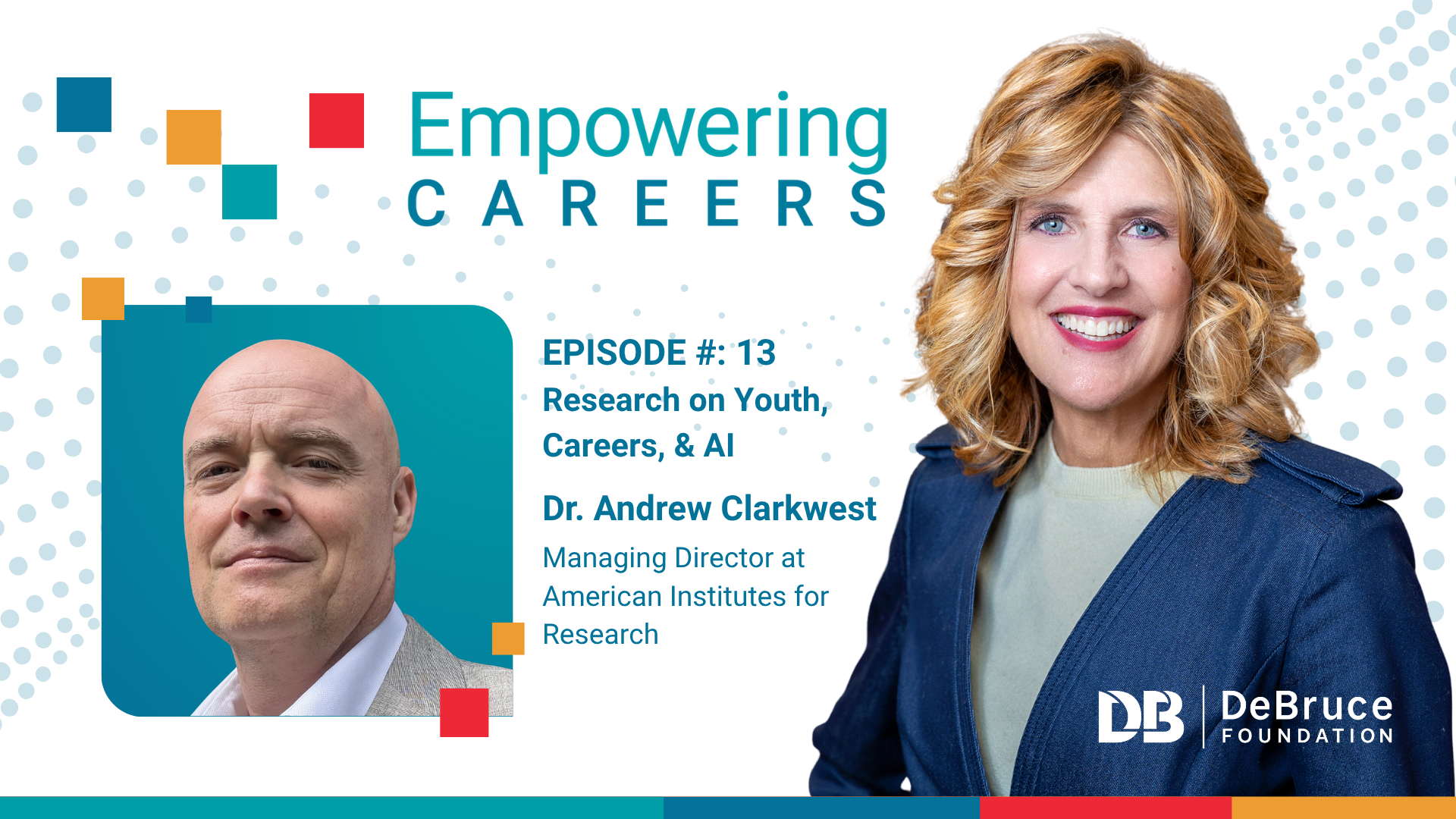
Episode 13 - Youth, Careers, and AI


Takeaways
Read the latest research on youth & careers from The DeBruce Foundation:
How to Talk with Youth About Careers in the Age of AI
Learn more about American Institutes for Research
Transcript
Dr. Leigh Anne Taylor Knight
Welcome to the DeBruce Foundation’s Empowering Careers podcast, where we explore insights and strategies for building empowered careers. Hello, my name is Dr. Leigh Anne Taylor Knight, Executive Director and Chief Operating Officer of the DeBruce Foundation. Today, young people are preparing for careers amidst rapid change. They’re hearing that artificial intelligence, or AI, will transform the workplace, completely change entire industries, eliminate some opportunities, and create others that we may not even be able to imagine yet. So what does all of that uncertainty actually mean for the way people are thinking about their futures and for the way adults might be talking with youth about their careers? New research commissioned by the DeBruce Foundation explores these questions. The report, How to Talk with Youth About Careers in the Age of AI finds that young people are largely hopeful about achieving their career goals, but many of them are unclear about how to get prepared. It also reveals widespread anxiety about AI, like a lot of other reports out there today. However, this report is different in that it presents important insights and practical steps about what can help young people feel better prepared and more empowered for their careers.
Dr. Leigh Anne Taylor Knight
So in today’s episode, we’re gonna explore these findings from two different perspectives. I’m very excited to bring to you our lead researcher, Dr. Andrew Clarkwest, to tell us about the research and what it means for helping young people prepare for their future. And then we’ll be joined by two of our DeBruce Foundation interns, Tyra McNeil and Ava Potter. They’re actually living this experience now, so they’ll share what’s resonating with them and how they’re preparing for their careers. First up, I’m thrilled to welcome Dr. Andrew Clark West, Managing Director in Workforce Strategy and Labor Market Research at American Institutes for Research. It’s been my privilege to know Andrew for more than a decade and to see his work up close and personal. He is the lead researcher on how to talk with youth about careers in the age of AI. Welcome, Andrew.
Dr. Andrew Clarkwest
Hi, Leigh Anne. Thanks so much. It’s really great to be here.
Dr. Leigh Anne Taylor Knight
So on this podcast, before we dive into the report, something we like to do is to just hear about the individual’s career journey who’s joining us. So would you tell us about what brought you to this work that you do today, and why you’re so passionate about workforce research?
Dr. Andrew Clarkwest
I have to admit, it was not a, you know, a clear strategic, okay, I know that’s what I want to do, and I’m going to do it. I think for myself personally, I didn’t really know anything much about careers, different careers growing up. I mean, I knew terms like engineer or HVAC technician or professor, but not really what those entailed. I didn’t even know that my job existed. I mean, I think most people don’t know that my job exists per se. I did feel like other people had sort of secret knowledge of how things worked, but that I didn’t have access to, and it sort of found my way along. I went to school and I was like, okay, I kind of, I mean, I knew that I took this class in high school and liked it. And so I’ll do a little bit more of that in college. And then in college, graduated, really got almost to the end before I knew that anything in sort of public policy-related research existed and just learned about it then and was like, okay, managed, found a job in state government related to labor. And then just gradually move forward.
Dr. Andrew Clarkwest
But it was definitely a, you know, some combination of just luck and searching.
Dr. Leigh Anne Taylor Knight
But it sounds like you’ve always had a growth mindset, been opening to— open to trying new things and, and, and maybe a few guides along the way or seeing examples of something that you could do.
Dr. Andrew Clarkwest
Yeah, for sure. I mean, that’s one thing. I grew up in the military, so we moved around a lot and just got used to different places, different people. Curious about how people live their lives in different places. Got to see up close to some degree, you know, some people who are in very different circumstances. And one thing that I think really was a big factor in me getting into this work was having exposure to people who are in much less advantaged environments and just knowing I’m going to interact with, with young people who clearly had a lot of talent, were very smart, but many of whom just weren’t going to have ways to develop that talent or actualize it. And that, that was something that stuck with me for a long time, just the passion of trying to make sure that everyone has more opportunity to become what they would like to become.
Dr. Leigh Anne Taylor Knight
Oh, that, that’s a beautiful segue into this research that we’ve done with youth across the nation, right? So let’s talk a little bit about the overview of this study. Who participated? What were you hoping to find? And how was the research conducted, Andrew?
Dr. Andrew Clarkwest
So this builds on some research that the DeBruce Foundation had done previously, or at least the DeBruce Foundation has done, I mean, a lot of great work in generating insights into economic opportunity. That included 3 prior waves of a survey of youth. So this is a 4th wave of that survey. It had responses from 702 young people from across the country aged 16 to 24. These youth were from a wide range of backgrounds, including being nationally representative in race, sex, and whether they are from urban or rural areas. So we have, I mean, youth who are all over the place. I mean, some are in high school, some are in college, some are in the workforce, some are, you know, they are in various different living circumstances, very different economic circumstances they were coming from. So a, a wide swath. And having Oh, go ahead.
Dr. Andrew Clarkwest
I was gonna— I mean, having worked with the Foundation previously in my career, as you mentioned, we know each other for over 10 years now. So I was excited to have the opportunity to dig into what you thought and feelings are in this particular moment that obviously is an unusually uncertain moment about what the future of careers and jobs are gonna look like that has And obviously youth having, like, particular feelings about that. And we know that youth are generally nervous about AI and how it might impact their futures. But I mean, I was very interested in getting a better sense for how those perceptions vary among youth and to what extent it differs depending on their backgrounds or where they are in their career journeys. And also whether there are more nuanced pictures in how youth see both opportunities and risks that that may be present in the future.
Dr. Leigh Anne Taylor Knight
So when you look at the findings, like, from the whole viewpoint, is there something that really jumped out at you as distinct or that stood out the most, Andrew?
Dr. Andrew Clarkwest
I mean, there are a lot of things as you dig into it, but it’s one thing really upfront that stood out when you’re looking at it is the relationship between just how youth are feeling depending on sort of how much they have heard about how AI may affect their futures. There was a really dramatic finding that youth who have heard more about how AI may affect their futures are more nervous. And this is just something that caught my attention since it does suggest that, I mean, number one, there’s some youth who— there’s quite a few youth who say they haven’t heard very much. It was about half of youth said that they had heard a lot and half said they’d heard maybe just a little or none. And obviously youth are going to be hearing more and more, and if it’s making them more nervous, then this adds additional dangers going on of youth potentially becoming disengaged, disheartened, and maybe not being prepared because of that.
Dr. Leigh Anne Taylor Knight
We’ll dive into that just a little bit more, I think, as we continue through this conversation. So I’m glad that you, that you brought it to the surface now. Another interesting finding for me that has been consistent across the 4 different ways that we’ve done is that 85% of young people report that they’re at least somewhat confident about achieving their career goals. And yet it’s only 11%. That’s only 1 out of 10 young people who feel like they have what they need to know to prepare for those careers. So again, that’s been consistent across 8 years of research. What do you make of that gap between confidence and destination and clarity about the path, Andrew?
Dr. Andrew Clarkwest
I mean, I do relate to it. As I mentioned, I was sort of the same. Like, I didn’t really know in any detail about even where I wanted to go or what the places, you know, were beyond like their basic names. I didn’t know what, what the job looked like, let alone how to get there. I think I figured, I don’t know, I’m pretty smart, I can work it out. And in part I did work it out, but then in part it also just worked out. And I think the, you know, the results that you describe signal some good things about young people’s confidence in themselves.
Dr. Leigh Anne Taylor Knight
Yes.
Dr. Andrew Clarkwest
That’s a really important foundation to have, to have the sense of self-efficacy that you can, you know, that you can make happen what you want to have happen. But at the same time, it indicates that we, and I guess I’ll use the royal we here, could be doing a lot more to give youth information about options, about clearer maps of how to get to those options, as well as more resources just for traveling, for successfully making it down those paths to where they might want to go.
Dr. Leigh Anne Taylor Knight
Right.
Dr. Leigh Anne Taylor Knight
Yeah, more resources for them. Let’s, let’s think about that. The research also points to the fact that 1 in 4 of these young people spend very little to no time thinking about possible careers. So there’s a whole group of them What might adults misunderstand about that disengagement, Andrew? What, you know, what might we misunderstand and what might we need to do to turn that into a productive conversation with a young person who doesn’t want to engage?
Dr. Andrew Clarkwest
Yeah, I do think it’s easy to look at youth and they can be very like, you know, standoffish or like, I’m not interested in this. And I think it’s easy to interpret disengagement as not caring. Whereas I think it is unlikely that there are many youth who really do not care about what they are going to be doing in the future, and particularly what they are going to be doing for a living in the future. But there are definitely youth who just do not see much opportunity, particularly if, you know, very few of the people around them have been able to access ways of making a living that really do anything beyond just paying the bills. They may know that careers exist out there, but those careers aren’t for them, or there’s no real pathway to get there. So there’s no point in thinking too much about it just because it doesn’t seem like a real possibility. At the same time, there are youth who just may not want to think too much about the future because it causes anxiety. I mean, this is something again that relates to what we’re seeing in the survey.
Dr. Andrew Clarkwest
So not thinking about it right now may be something that is self-protective. But it’s self-protective in the near term, whereas in the longer term it could be detrimental to, to their futures and achieving both, you know, getting to a career that they are going to enjoy as well as something that’s going to be good for their own economic opportunity and stability.
Dr. Leigh Anne Taylor Knight
Very much so. And that brings up one of my favorite quotes from the research, especially as we talk about how AI is shaping how young people think about their futures. The quote is, quote, fear of closing doors drives anxiety. Hope for opening doors drives engagement, unquote. And you write that in reflection to the fact that 58% of the youth are saying that it makes them nervous about their career prospects. AI makes them nervous about their career prospects. So the fact that this report offers a powerful way of understanding this. And this is where you were kind of leading into: fear of closing doors drives anxiety; hope for opening doors drives engagement. Can you just unpack that a little bit more for us, Andrew, and talk a little bit more about that nuance that you mentioned at the beginning of the cast?
Dr. Andrew Clarkwest
Yeah, this is something that I think in retrospect makes sense, but hadn’t really thought about too much beforehand. But one thing we did when we were gauging youth perceptions about AI’s likely impacts is we did ask them whether they expected that AI would shrink or close career opportunities of interest and whether they expected it to open opportunities of interest, since it could obviously do both. You know, youth fell in all combinations of these. The largest percentage felt like AI would only close opportunities, but there were also those that felt like AI would both close and open open opportunities, and others felt like it would only open opportunities. This was a smaller percentage, but non-trivial. And then there were some that didn’t think that AI would do either. So those are probably youth who have been less engaged in the news cycle. But when we looked then at how nervousness related to these expectations for opening and closing opportunities, we found that it didn’t matter very much whether youth expected AI to open opportunities How nervous they felt was pretty much the same regardless of whether they expected that AI would open opportunities. It was about roughly 25% that expected that AI, or that felt, that strongly agreed that they were nervous about AI’s impact on their future.
Dr. Andrew Clarkwest
That was roughly the same regardless of whether they expected AI to open new opportunities or not. Where we saw a big difference is whether they expected AI to close opportunities that would be of interest to them. There, when we look at that, among youth who don’t think AI will close opportunities of interest, only 7% strongly agreed that they were nervous about the future. So mostly, if you didn’t think it was going to close opportunities, very few were very nervous. Whereas among youth who expected AI to close opportunities of interest, 40% of them, so 6 times as many, said they strongly agreed that they were nervous about AI’s impact on their futures. So this nervousness clearly is about, okay, is AI going to close things that I want to get to? But we saw a very different picture when you get at how active youth are in exploring new opportunities. So for example, we asked about whether youth were interested in using AI-enabled tools to explore new career opportunities of interest. And there, when we asked them whether they expected AI to close opportunities, or we disaggregated it by whether they expected AI to close opportunities, And there, 76%, regardless of whether they expected AI to close or not close opportunities, both of those, it was the same.
Dr. Andrew Clarkwest
But basically 3 out of 4 said that they were still interested in using AI tools to explore new career opportunities. But 93% of youth who expected AI to open new opportunities were interested in using these tools to explore new opportunities. compared to only 67% of those who did not expect AI to open new opportunities. So I know that’s a mouthful, but basically in this case, we see something that makes intuitive sense. We know from behavioral science that we’re emotionally affected more by possible losses than by possible gains. And so this nervousness comes like, oh, are we— do we think that AI is going to close things I’m interested in? That’s nervousness-inducing. You think that path is there now, but maybe it won’t be in the future. But when you’re thinking about, okay, am I going to get engaged in exploring new opportunities? What matters there is, do I think there are new things that are going to open up that I can find and maybe access? So it’s the expectations for new opportunities opening that’s more consequential for action. At least it seems like it from the data in the— we’re hearing from youth.
Dr. Leigh Anne Taylor Knight
Thank you for working to unpack that. There is a There is a lot there. A couple of things maybe that we could pull out that could be helpful for our audiences. 3/4 of the youth say they are using AI in their career search, job search, career exploration. But there was a really small, much smaller amount. I think it was like 1/3 felt like they were competent in being able to use AI. in doing that job search and that career exploration. So that seems like an opportunity of a place that youth could, that youth could be guided by adults in how to successfully maybe use AI in career exploration and job searching. Do you think?
Dr. Andrew Clarkwest
Right. I mean, it’s true. We think about youth as being AI native, AI experts. They’re using it all the time. They know how to do it, and they may know how to do it for some things. But for career exploration, there’s clearly most youth say that they’re interested. But only about a third, as you say, think that they can actually do it well. So there’s a large segment of youth who, like, say, I would like to be able to do more, but I need guidance in how to do it, which also puts some onus on us as adults to figure out, okay, do we know how, or do we know how to plug in youth to resources to help, to help build their skills?
Dr. Leigh Anne Taylor Knight
Right. The other thing that I thought was interesting is that the research does identify career literacy and network strength as a solution. So talk with us a little bit about— I mean, those, those youth who had a higher level of career literacy, a higher level of network strength, it was in a way, it, it buffered their pessimism about AI and the fact that their opportunities would be limited. So maybe you could talk with us a little bit about how career literacy and network strength might be helpful in students navigating career journeys, particularly when they— there may be this pessimism and all of these messages being sent to them about AI and how the world is changing.
Dr. Andrew Clarkwest
Yeah, because it’s true, because the messages— I mean, you hear, you hear what’s in the news, and it’s not necessarily wrong, but it is not necessarily comprehensive either. Obviously, what’s most attention-grabbing is going to be what’s in the news, and those can be the most extreme scenarios. And there may be real risk there, but things that are missing that they’re— it’s not going to tell you, oh, and there’s, you know, these 12 opportunities in your local area that would be of interest that you could potentially do. Like, that’s not going to be in the news, but it is something that you can get if you know how to explore, or if you have connections to people who know things about different jobs who are in the labor market and can say, hey, these are things— this is something that’s going on. This is things that are growing in our local area or in my business or in my field. And so this ability to find information on your own on careers or be able to connect to people, and ideally both of these things. You need to be able to navigate things on your own, sort of have these career literacy skills, but also this network strengths, as we talk about it, where you’re able to— you’re comfortable with and active in expanding your discussions to other people.
Dr. Andrew Clarkwest
You can reach— you’re willing to reach out to other people. who are outside of your immediate circle, who can provide you more information, who you can talk with about, oh, this is the sort of thing I feel like I’m good at and I’m interested in. And tell me about, you know, opportunities that, you know, about that may align with that and what I would need to do to get there. And so this provides something that, while it’s not going to totally get rid of concerns that you may be hearing about things from, from the news, it does at least give youth something more to grab onto and can ameliorate the pessimism. And help get them more, more engaged and have more reason to, to think more actively about their futures.
Dr. Leigh Anne Taylor Knight
And you mentioned building confidence earlier. So building that career literacy piece of building confidence in what you do well and what you like to do. And then, as you said, then you can start to find yourself in that career marketplace with those networks and with really good job search skills. So thank you for sharing about that. If we’ve got some adults listening, Andrew, who want to have more productive productive career conversations with young people, what’s one thing that you would hope they would do differently after hearing about this research?
Dr. Andrew Clarkwest
I mean, there will be many teachers, mentors, other people who work with youth who have deeper experience on the subject than me. But I will say from our work here that I would emphasize the importance of probably not feeling like you have to have concrete answers to every question. I mean, again, there’s uncertainty in the world. None of us really know exactly what the future is going to be like. None of us have a comprehensive view of the labor market even as it is now. But just being willing to listen to young people, understand like where they’re coming from, where they’re nervous, what their hopes are, and being able to connect them to resources that will help them find their own way. Just being able to, you know, to be with them in what they’re feeling and connect them to things that might that might help them and obviously share things that we know, but recognize, like, I can’t tell you everything, but we can— there are ways that you can work through this. There are opportunities out there, and I’m happy to help you with that.
Dr. Leigh Anne Taylor Knight
Oh, thanks, Andrew. And thank you so much for sharing about your career journey and recognizing that not all of us wake up someday and know exactly what we want to do, go to study that and get credentialed to do that, and just walk right into that pathway. For, for many, many of us, it’s more of this meandering. So as you look toward the future now with these youth, what gives you hope about young people’s ability to navigate the future changing world of work?
Dr. Andrew Clarkwest
Yeah, I mean, the point, the data point that you started with, and that the foundation has seen across all the surveys, that youth are confident in being able to achieve what they want to achieve, even if they don’t know how they’re going to get there. I mean, this, this confidence is just a fundamental asset. I mean, they may be, you know, they may be nervous on the one hand. There could be multiple things going on, but having this confidence there is something just key to build on. And it means that they are likely to be open if they see if you can provide them information on real opportunities. And it’s a good thing now is that, you know, in the past, it may be hard to get access to information that you may only know, like who’s around you, whereas, you know, there are obviously challenges with the internet. But it’s nice that there’s just access, in theory, access to a much broader set of information and opportunities to connect with a broader set of people than you might have been able to as well. So between the foundation of confidence that youth have And if we can help them make connections to all of this additional information and resources that are out there in the world, then I think that is a, a good reason to think that, that youth can find their way in the future, even through uncertain and challenging circumstances.
Dr. Leigh Anne Taylor Knight
Andrew, that is certainly encouraging to think about harnessing those together. I am so grateful for your being here today to shed some light on the findings from our latest research and also give tips to individuals about how to talk with youth about careers in this age of AI. Thank you very much for being here.
Dr. Andrew Clarkwest
Thanks, Leigh Anne. It’s always great to talk with you.
Dr. Leigh Anne Taylor Knight
Next up, I’m joined by Tyra McNeil and Ava Potter. They are both interns with our team here at the DeBruce Foundation. And they also fall within the age range of the participants represented in this research. They’re not here to speak, on behalf of every young person or every experience. Instead, they’re here to share their insights from the research, what they’re doing to build their careers, and just what they wish more people understood about how to help young people thinking about their futures. So Tyra, Ava, welcome to today’s podcast. We’re so glad to have both of you here.
Ava Potter
Thank you.
Tyra McNeil
Thank you.
Dr. Leigh Anne Taylor Knight
To begin, would each of you tell us a little bit about yourself, what you’re currently studying, working toward, exploring? And Tyra, let’s kick it off with you.
Tyra McNeil
All right, of course. Um, thank you for having us. I’m currently a junior at Kansas State University, and I’m studying, communications on a pre-law track, hoping to explore a little bit of the political side of communications and doing work with that.
Ava Potter
Awesome. Okay, well, I’m Ava. I’m a junior at the University of Missouri Columbia. Go Tigers! I’m a journalism major. My emphasis is strategic communications. I’m also a business minor, and I’m working towards getting my digital marketing certificate. I’m kind of hoping to work as a creative strategist one day for a company or for a brand, anything kind of under that sense. So yeah.
Dr. Leigh Anne Taylor Knight
Excellent. So what experiences are you already having that’s helping you learn more about yourself and the kinds of careers that you might enjoy? Ava, why don’t you go first this time?
Ava Potter
Yeah, definitely getting involved on campus has been probably the biggest contributor to that. I’m involved in Greek organizations and different clubs throughout campus, and, you know, getting to utilize a lot of the people that I’m meeting has like really helped me like navigate and learn more about, you know, just networking with other people, but also the different coursework that I’ve been having as well in my classes. Mizzou focuses a lot on the Missouri Method, which is applied learning before you actually step into the workplace. So in my classes, I’m actually getting to work with clients and like, you know, really diving in hands-on, like what they’re wanting in the workplace and seeing, you know, that impact there. So that’s really like helped me kind of decide like, okay, maybe I like the strategy side of things. Ooh, I really like how I designed this. Maybe I really like the design element of things. So definitely a lot of my coursework and my different professors and clubs and organizations have been a really big part of that.
Dr. Leigh Anne Taylor Knight
I’m glad to hear that Mizzou takes on that Missouri method and is making sure that there’s application that goes with those academics. Yeah, Tyra, what about you?
Tyra McNeil
Yeah, for me, I, I’d say that I’ve explored a lot just throughout different clubs that I’m joining and making sure that I’m applying myself in different areas that I’m not familiar with. For example, right now I’m currently thinking about joining a business organization and I’m not really— I don’t really have a lot of experience in business or the business side of things. But throughout different clubs and just the people I’ve gotten to know, they’ve been recommending different opportunities for me outside of my usual pre-law ambassadors and just nonprofit work. And so it’s been really nice to see what else can I do with the interests that I have. And so that’s something that I’ve been exploring. And even with my coursework, I do a lot of nonprofit stuff and a lot of stuff on just messaging and communication, so getting to explore. Management and leadership has been something that’s been really fun throughout my courses.
Dr. Leigh Anne Taylor Knight
Thanks for sharing. Now, both of you have gotten to read the report, How to Talk with Youth About Careers in the Age of AI. So can you tell me what finding first caught your eye and why?
Tyra McNeil
Yeah, of course. So throughout my first read of the report, the thing that stuck out to me the most was AI and pessimism. The report touched on, as students get more familiar with AI and how they can use it, and the more that they learn about it, the less pessimistic they get about it. And so for me personally, this stuck out to me because it’s something that I saw in myself, and just at the beginning of my career, and especially in school, like when I first— when the subject of AI first came up, it was really something that not a lot of people look towards with and like look towards in a good light. And right now a lot of my peers really see it kind of harshly. But as we’ve gotten to explore it more just throughout our schoolwork and just in our professional careers and growth, we’ve learned a lot more about how we can use AI as a tool and how we can leverage that. And so I’ve become a lot more optimistic to how I can use it in my career.
Ava Potter
Yeah, same here with Tyra. That was one thing that I think really stood out to me as well was you know, seeing how many students are like really, you know, not jumping on the bandwagon with it. And then another part that I found super interesting is that most youth are confident about reaching career goals, but they don’t have, you know, there’s so many gaps in knowledge of how to get there. And I feel like growing up in a rural community, that was one thing I had was I had like, you know, very broad ideas of what I wanted to do, but I didn’t have a lot of career literacy resources to be able to reach those. So that was something I feel like AI could be kind of a tool of that, you know, having those literary resources. Because, you know, those kids in those rural communities kind of only think about, you know, careers being pretty linear or having, you know, one path, and that’s the same path you have to have for the rest of your life. So that was something that really stood out to me as well.
Dr. Leigh Anne Taylor Knight
Thank you for sharing those perspectives. Is there anything else that for either one of you jumped out as resonating or surprising from the report?
Tyra McNeil
Yeah, the report touched on demographics a lot. I know one key part of it was women and how they’re like a little bit more apprehensive to using AI technology. And I was like, yes, I’ve seen that a lot. And just like kind of how we view it and especially in the workplace. And just I felt like that really resonated with me.
Ava Potter
Yeah, definitely. I agree 100%. I feel like the most pushback I’ve seen has been from females and like the, you know, that kind of side of demographics. I’ve seen that a lot online. But also I’ve seen the flip side of that working, you know, through the university and through my coursework, how like a lot of my female professors are encouraging us to look at it from both angles there. So it’s been super interesting to see both sides of things, like after reading the report too. So.
Dr. Leigh Anne Taylor Knight
Yeah, thank you. Thanks for sharing that. You know, the report— this is not really necessarily true of the two of you, but the report found that some young people spend little to no time thinking about their careers. Like, it’s 25%. It’s like 1 in 4. So from your perspective, what might cause someone your age to disengage or avoid conversations about careers?
Ava Potter
I feel like for me, definitely the lack of knowledge is probably the biggest part, especially like I said, you know, that big, you know, gap that we have to bridge as soon, you know, you’re jumping from senior year of high school to maybe your first year of college, maybe first year stepping into the workplace. But where do you find, you know, that knowledge in between there of what you really want to do? So I feel like that’s what causes people to not want to answer that question of, you know, what do you want to be when you grow up? Or, you know, what do you want to do with your future? Just because you know, they don’t know. They don’t know because they haven’t had the opportunity to find those different opportunities and, you know, different places to, you know, learn about what they really love to do. So to me, I feel like that’s probably a big reason why, you know, a lot of kids our age don’t really want to talk about what they want to do just because they have that lack of knowledge.
Tyra McNeil
Yeah. And I’d say that I have to agree with what Ava has to say here. There is a really, like, big lack of knowledge, and a lot of students are only thinking about the careers that they’ve seen in sometimes that doesn’t really resonate with them. And if they’re not seeing a career that they really have interest in, they’re not going to want to talk about that career as much. And I feel like that can cause them to disengage. And especially if it’s a career that requires like a little bit more education or just a different pathway that they’re not used to, a bit of imposter syndrome can come up with that. And so I know for me especially, I grew up first generation. And so wanting to go into law, it was something I really didn’t see much and I didn’t have experience with. And so there were some points for me where I didn’t know how to approach that conversation or how to talk about careers in that sense. And so that’s where I feel like just having a little bit more knowledge on the different career options that are available can be really useful.
Dr. Leigh Anne Taylor Knight
Yeah, and it takes experiences, right, to get those options. It takes conversations with your peers, but also with other adults. So could the two of you think a little bit about career conversations that you have had that have been helpful? Like, what have been some of the most helpful things that, that you’ve heard or conversations that you’ve had with people?
Ava Potter
I feel like for me, anytime I’ve spoken with a recruiter or someone in the career field of what I’m thinking about, the number one thing they really always ask are, what are you doing right now to reach those goals that you have in mind? What are those, you know, stepping stones that you’re doing right now? So I feel like having those questions being asked, like, okay, what are you doing now that you really love? Where do you see doing that in 10 years? Do you think, like, you would want to stick with that, or do you want to work with something else? So I feel like questions like that— what do you want to build on, you know, what do you wish you knew more about, like, through working something like that— are big questions that broaden and help students answer that question ultimately of what do you want to do when you grow up, or, you know, what kind of future do you see for yourself. So I think having those conversations where people are, you know, kind of broadening the question a little bit more, you know, having that umbrella of, you know, what do you really love, especially like, you know, utilizing the agilities, you know, those skills can be developed over time.
Ava Potter
So asking each year, what skills do we want to build on and develop, you know, set you up for success through that. So having career conversations where people are just like, what do you want to build on, having that growth mindset, I think is also like a really big part of that conversation too.
Tyra McNeil
Yeah, I’d definitely say that I agree with that. For me, like alongside the agility is for me what has been really important and I think has allowed me to think about my career more broadly has been looking towards a leader or somebody in the industry that I want to go into and evaluating what skills that they have that I really like or that I find useful or I can see in myself and kind of working on building those skills that I see in them. And it can help me think about: Am I doing what I need to in order to reach this goal, or is there something else that I should be working on? And I feel like that has been really helpful in my career journey.
Dr. Leigh Anne Taylor Knight
So the report talks about like pressures, right, that youth feel when they’re trying to make career decisions. And you all have alluded to some of those today too. What do you just wish that parents and educators and other adults understood about the pressures that young people feel when making career decisions, Ava and Tyra?
Tyra McNeil
Yeah, so I think that a lot of the pressure that my peer group is facing comes like from ourselves, to be honest. It can be we’ve already decided on this one career path really early on, and because it’s something that we’ve stuck with throughout our entire lives and throughout our entire like education, it can kind of be really hard to switch out of that narrative and like Hey, this is what I’ve had planned out for me, and to look towards other pathways is something that’s really difficult. So when it comes to career conversations, being able to encourage students to look elsewhere and to broaden their, like, perspective and where they’re looking can be really, really useful.
Ava Potter
I totally agree. That’s something I see that with my peers and see that with myself. Like, we are so harsh on ourselves, you know, once we’re like, okay, this is my major. I’m, you know, going to work towards getting my degree. I have 4 years to get it done. But in reality, you know, we don’t know what the future holds. Like, times are changing. So honestly, just, you know, constant reassurance, I feel like, from, you know, the peers around you or from the mentors that you have of just know you’re doing what you need to do right now in your path. Let things happen. You know, learn about yourself, learn what you love to do, because at the end of the day, that’s going to be the deciding factor of whether you take a job, you know, that you really love here or you, may not love here, you know. You wanna figure out what you love in between there. And that, I feel like, once again stems back from that lack of knowledge and, you know, having— taking yourself out of the picture and knowing that, hey, I gotta go out and find those opportunities.
Ava Potter
I gotta go out and find that knowledge, bridge that knowledge gap there. So I feel like totally agree with Tyra there, you know. Gotta try not to be so harsh on ourselves.
Dr. Leigh Anne Taylor Knight
Yes. Good advice. I was asking for the advice for others, but you’re like, wait, let’s center it right where it is, where this anxiety is coming. So thank you very much. Thank you for owning that and just sharing that, because that may make the rest of us also feel better about it’s not our problem to solve all the time. So I appreciate that. Let me ask this. Have you guys used AI to job search or explore careers or prepare, you know, some type of a resume or you know, just explore or think about a field or a skill that you’re trying to build? And, and if so, how did that go? What worked? What did you find you had to get the human factor back in? What, what’d you learn?
Ava Potter
Yeah, definitely. Since, um, in my coursework we look, we look at a lot of like designing and logos and everything like that, um, using AI and seeing like what they would come up with based upon a certain prompt has been super interesting. But they really encourage us to take like where that comes from and seeing how we can develop it more for the audience that we’re trying to directly like speak to. So using it that way has been really interesting, like in my career field, in my coursework. But also I’ve definitely used it to see how I can make my resume sound a little bit more professional, like give me a little bit, you know, more professional sounding words, because I can type something up, but it may not sound super professional. So I’m like, What makes it sound a little bit better? So using it like that as a tool, but still finding a way to put my own creative edge and my creative spirit into it is something I’ve tried to do just because I don’t wanna end up relying on it completely just because I see it like how Tyra sees it: as a tool.
Ava Potter
Using it as a tool, I think, is such a big part of navigating the new workplace that we have in our career fields. Yes.
Tyra McNeil
AI has been like a really helpful tool in the career search and just finding a job to— and applying for jobs. For me, I’ve used AI just for generating a resume, but I found that I have to kind of twist it a little bit to make sure it’s explaining what I’m doing correctly and like my past experiences, making sure it’s not saying something that I haven’t done. And even when it comes to exploring different career fields, it’s been really useful for seeing how different career options tie together. For me, I want to go into the law, but I also have a really huge passion for nonprofits. So being able to explore how these 2 sections intertwine has been really helpful. And AI has been able to give me a quick overview. But going to an actual person afterwards and talking about their experience in the field, kind of their background, how they got there, has been really helpful.
Dr. Leigh Anne Taylor Knight
So Tyra and Ava, the research highlights that career literacy and strong networks are keys to navigating this evolving workforce. Could you all give our audience some tips on how you’ve developed career literacy or networks strength across the last few years? Tyra, let’s start with you this time.
Tyra McNeil
Yes. Network strength for me has been something I’ve been working on for a while. I think a part of it has come from just joining different organizations and clubs. Like I mentioned previously, I’m a part of Pre-Law Ambassadors, and with that, I just get to meet with different different attorneys, with different judges, and I’ve also been able to do different internships. And with that, I’ve gotten to explore a little bit more, and I’ve gotten to connect with different people, and they’ve opened up different pathways for me in different fields that I haven’t considered previously, like more so the marketing side of communications. And so that’s something I’ve been working on more recently. And with career literacy in general, that’s been something I’ve been able to explore through joining different organizations and internships, and that’s been able— I’ve been able to see what different pathways might look like for me.
Ava Potter
Yeah, I’m a campus tour guide here at Mizzou, and I get to spend days like talking with, you know, high school students and asking them, so what do you see yourself these next 4 years like coming to, you know, potentially coming to Mizzou? Like, what do you think your career journey is going to look like? So getting to like network with those students, of like hearing about what their experiences are and then asking them and showing them what Mizzou opportunities have, like really helped me, I feel like, build a lot of like career literacy, not only like within my coursework, but knowing career literacy around Mizzou and like what Mizzou offers.
Tyra McNeil
Mm-hmm.
Ava Potter
I love sharing that with other people on those tours because, you know, Mizzou really focuses on that Missouri Method. So I feel like being able to learn so much about my Missouri Method, my senior year capstone, I’ll actually get to apply for one of our 3 ad agency teams. and get to work with a client for like a whole semester. And some of our clients have been like some really big names. Like this year, I think our client is Target. We’ve done like NASA and the NFL. So we’ve had some really big kind of brands like that too. So definitely being able to speak with people that are already in those capstones and have certain roles within those capstones has really made me like consider like, okay, maybe I like the strategy side of things, like of this a little bit more, or Okay, I really like how I designed that. Maybe I could do the designing of that. And speaking with my college advisor too has also been a super big resource, whether like picking my classes for the next semester. She’s done a really good job of like making sure I keep things pretty like broadened because she’s like, you never know what you may end up really liking in this class.
Ava Potter
I know, because when I started at Mizzou, I was actually a broadcast major and I was thinking I was going to go, you know, on the TV side of reporting. And I kind of fell in love with the more hands-on graphic side of things and looking, you know, of the audience strategy of stuff. So that automatically, you know, was something I never considered. So, so many paths to happen, I feel like, in college. So that’s my biggest encouragement is try whatever, say yes. It’s always so many things to get involved in.
Dr. Leigh Anne Taylor Knight
Well, Ava and Tyra, I know our audience really appreciates that you believe in the agency of you as individuals and as young people to be able to traverse this and navigate this ever-changing workforce. If you were to give one piece of advice, at least give them one piece of advice about talking with young people about careers, what would it be? Tyra, let’s have you go first this time.
Tyra McNeil
Yeah, when it comes to talking with young people, the thing that I would love to like hear more about is just your own personal career journey, being open about your struggles, The people you’ve met with, how you got into that position in the first place, and kind of if you took a break in your career journey, all of that is useful information and it helps us map out where we want to go and how we picture our own future careers. And so just being able to hear the realness of it and reality of what careers look like and how career journeys aren’t always linear is really helpful in making sure that we aren’t like making ourselves stick to one path and a path that’s really idealistic and not what reality looks like.
Ava Potter
I totally agree.
Dr. Leigh Anne Taylor Knight
That’s a great thing to emphasize, Tyra. What else, Ava?
Ava Potter
Yeah, I totally agree that there’s multiple paths and just that it’s okay if we don’t have everything figured out, you know, right at the beginning there. Especially like what she said, having those real conversations with them to know like how they got to where they were. Everything small in between may not seem like a lot to the people in those careers, but to us that means a lot. Knowing where, you know, small stepping stones happened. I feel like it’s also a big thing. Like, what were you involved in in college? Like, if you did go to college, what were those small, you know, clubs, organizations that you were involved in? What skills did that teach you? You know, stuff like that, I feel like is a really big part of, you know, keeping that conversation approachable, you know, with us young people, because it encourages us to keep working towards those futures. So I totally agree with what Tyra says.
Dr. Leigh Anne Taylor Knight
And And what, you all, gives each of you hope when you think about your own career and the future of work?
Ava Potter
Yeah, I’m definitely excited to see what new paths emerge from AI being a new tool now these days, especially since I’m more on the creative designing side of things, seeing what new technologies may come with that as well and what these new generations of technology. And, you know, these young people coming up, what ideas are they gonna have, you know, bringing to social media and all that kind of stuff? So all stuff like that really makes me excited to see, like, what, you know, the media and production kind of field, like, ends up evolving into. So, yes.
Tyra McNeil
Yeah, AI opens so many doors, and there’s so many new opportunities that are emerging because of AI. And with that, I’d I’m really excited to see what work I can kind of offload and take off of my plate and kind of how I can explore my own skills and my own creative side and how I can kind of give more menial tasks to AI and kind of focus on developing myself and my own self-growth. And that comes from the development of new technologies.
Dr. Leigh Anne Taylor Knight
Tyra and Ava, we greatly appreciate your sharing your perspectives today. You’ve really helped bring to life the research and what we’re hearing from youth across the country about how to navigate these careers in this age of AI and what it is that we can really do to help individuals build that career literacy, build that network strength, because that is what combats this pessimism about what is happening in this age of AI.
Dr. Leigh Anne Taylor Knight
So we’ve covered some fantastic insights today from How to Talk with Youth About Careers in the Age of AI. I really encourage all of our listeners to go to debruce.org to read the full report. We’re going to make that link available in the show notes. And at the end of the day, young people do not need adults to predict what the change is that lies ahead. They actually need adults who will listen, who will acknowledge the uncertainty honestly to help our young people recognize their strengths, who will connect them with people for possibilities, and who will support them in taking the meaningful next step. Tyra and Ava, you gave us some great meaningful next steps. We’re grateful to Andrew for shedding the light on what we’re seeing in the research across the country. Thank you again, all 3 of you, for being with us today. And thank you, audience, for listening and going out to make a difference with the youth in your lives, because you now know how to talk with youth about careers in the age of AI. Thanks for tuning in to Empowering Careers from the DeBruce Foundation. Be sure to visit debruce.org for more career-building resources and subscribe to the podcast So you never miss a conversation. Together, we can build empowered careers. See you next time.