Link copied to clipboard
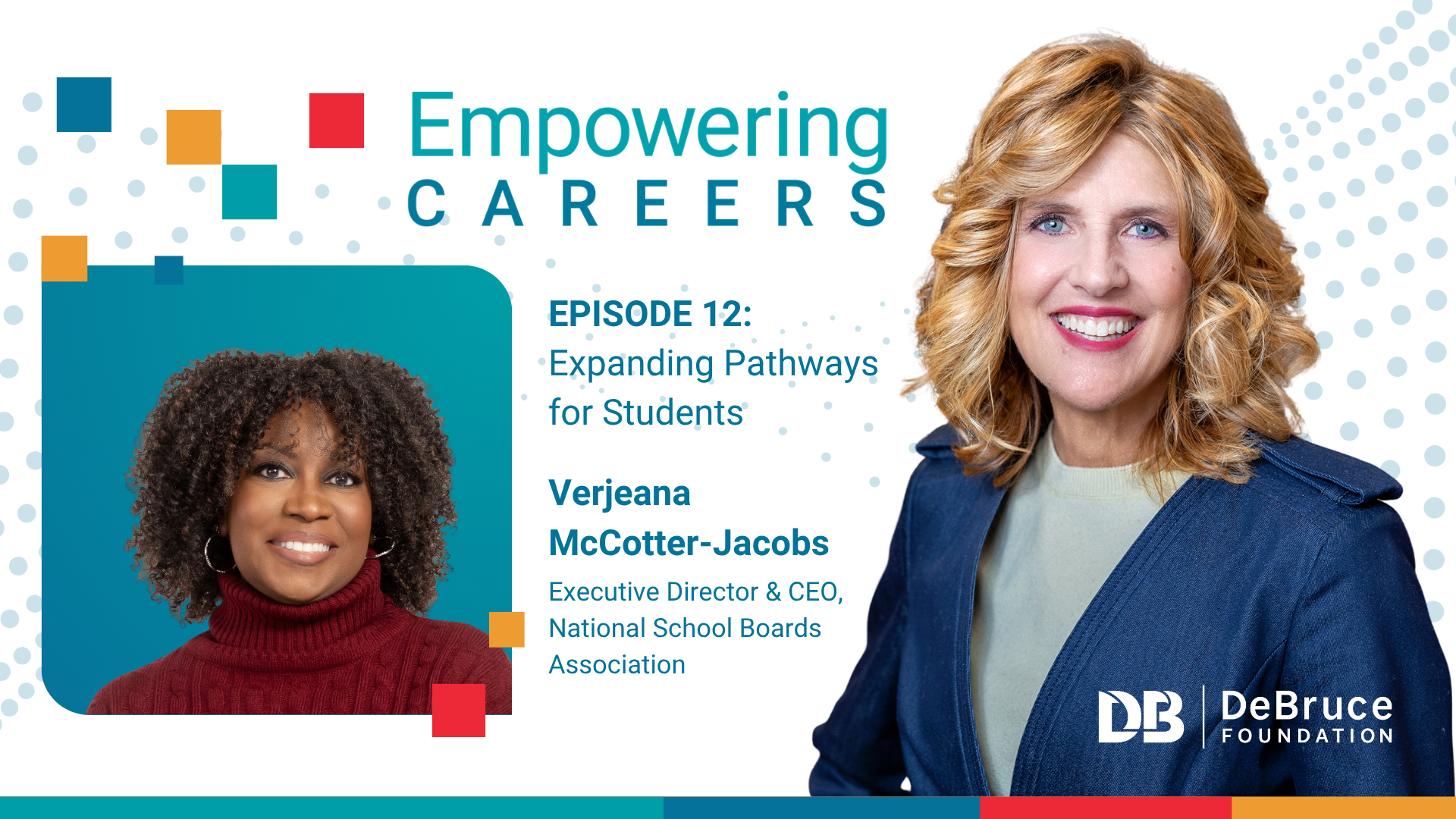
Episode 12 - Expanding Pathways for Students


Takeaways
Transcript
Dr. Leigh Anne Taylor Knight
Welcome to the DeBruce Foundation’s Empowering Careers Podcast, where we explore insights and strategies for building empowered careers. Hello everyone. My name is Leigh Anne Taylor Knight, Executive Director and Chief Operating Officer at the DeBruce Foundation. And I am thrilled today to welcome to our studios, Verjeana McCotter Jacobs. She is the Executive Director and CEO of the National School Boards Association. She’s got more than 30 years of experience in education, public safety, and law. She demonstrates an unwavering commitment to education and equity and enhancing the educational outcomes of students. So you guys know she’s going to be one of my favorite people in this world. Welcome, Verjeana.
Verjeana McCotter-Jacobs
Thank you so much, Leigh Anne. I’m honored to be here. Thank you so much.
Dr. Leigh Anne Taylor Knight
We have a lot of folks who like to hear about the career journeys of our guests. So we’re just going to start today with maybe you talking a little bit about your own career and even before we were on, you’re saying, OK, I have to talk about myself here. But really, Verjeana, you’ve had a remarkable career across education and law and public service before even leading NSBA. So looking back, what experiences most shaped you as a leader today?
Verjeana McCotter-Jacobs
All of them. So, you know, when I first started working in— I went to the University of Maryland. When I started working at the Department of Corrections in Prince George’s County, I didn’t know that it was actually a jail, okay? Naive, 21 years old, just graduated college, and I— my degree was in behavioral social sciences, so when I read this description, it sounded like I could save the world, right?
Dr. Leigh Anne Taylor Knight
Yes.
Verjeana McCotter-Jacobs
But in reality, I show up and I see the barbed wire fence, but what happened there in the little time that we have I started to see children charged as adults, and it just, it just did something to me. So seeing that happen, and then our community had the opportunity to go from an appointed to elected board. So I ran for the Board of Education while I was working at the Department of Corrections. In my career, I worked in every area you possibly work. I never forget when they said, hey, you got to go get fitted for your uniform before I actually got the job. And I thought, What’s wrong with the clothes I’m wearing? Anyway, so I actually— so I ran for the school board. I won. But while I was working at the jail, long before school board, I worked the midnight shift so that I could go to law school full-time during the day.
Dr. Leigh Anne Taylor Knight
Mm-hmm.
Verjeana McCotter-Jacobs
So I did both the full-time job and law school at the same time. And those experiences just shape you. You’re seeing, you know, for lack of a better way to characterize it, like the bowels of society in a way. And then you see the impact that that has on people and children and, you know, especially the young adults. It was an adult facility. And then so from there, I started serving on the board. I did 10 years there and all of that uniqueness of these different careers just kind of shaped who I am and helps me to build some resilience for sure. and some steadfastness. So I think that’s— it’s a combination of all those things that really kind of shaped who I am today, not to mention family and all those things.
Dr. Leigh Anne Taylor Knight
Yes, thank you for sharing that. And so let’s talk a little bit about today. Some of our audience members may not be familiar with the National School Boards Association. Before we got on, we were talking about what great learning opportunities and professional development you all provide for educators and our elected officials who are serving on school boards. Would you share a little bit about the Can you tell us a little bit about the mission of the National School Boards Association, Verjeana?
Verjeana McCotter-Jacobs
Absolutely. 86 years as of last year, 86 years young, has been through a lot as an organization. I would say that we have transitioned over time, even back to Brown v. Board of Education to where we are now. Essentially, you know, we work really hard to ensure that school board members are able to transform education, if you will. Oftentimes we don’t think of school board members in that way because they sit in this sort of governance role. But, you know, our focus is on a number of things. So we file more amicus briefs in the courts than any other education organization. We have an advocacy agenda for the Hill. And ultimately, we provide training as well and professional development for school board members. We have a lawyer’s arm. called the Council of School Attorneys. And so our mission is really about how we best serve school boards in their role to better serve students. And that’s been the focus of our work.
Dr. Leigh Anne Taylor Knight
Oh, thank you. Thank you for that work that you do today. Also, thank you for your service publicly, for having been an elected official on a school board. You know, those are volunteer jobs that are very, very busy and hold such an important position in our communities and for our future, right? So as we think about National School Boards Association serving those school boards and those leaders, what do you think the role of school boards is in preparing our students not just to graduate but to thrive across their careers and their lifetimes, Verjeana?
Verjeana McCotter-Jacobs
That’s a great question. Oftentimes people are saying, and I kind of started talking about that earlier, school boards are so quote unquote far removed from the classroom that they don’t have impact on the classroom, and that couldn’t be farther from the truth. The fact is school boards have to hire that superintendent, they have to create the policies that drive the district, and ultimately they have to approve the budget. And we all know that our budget is a policy document, right? So it tells us whether or not what our priorities are. So school board members’ role, and I’ll say this real quick too. So there’s so much conversation often about stay in your lane, you know, let superintendent do the day-to-day work. That’s true. But boards need to know what their role is. And so we created these 8 characteristics of effective boards so that board members can self-evaluate, are we falling in this realm? They have to care about students’ ability to learn. You’re right, I served 10 years on the board. I often say that it was harder than working 23 years in the jail because it’s so complex and it’s so— it’s such a big, big issue.
Verjeana McCotter-Jacobs
You know, you’re making decisions about children’s lives. So, and we often say too, internally, people woke up during COVID and said, who are these people and what decisions are they making? So, people started to pay more attention to school boards, I think, as well. So their job in a nutshell is to govern the district, not manage it, but to govern the district, make sure that the district is held accountable for the outcomes that we expect for students and staff for that matter. And so that’s kind of— we have the key work of school boards and becoming a better board member. We have resources to help boards across the country do this great work. And then finally, I would say we spend— part of my role has been around equity, of course. So We spend a lot of time talking about what those factors look like, which applies to any board, not just, you know, urban boards. It applies to any board across the country. And so we try to support them in that way as well.
Dr. Leigh Anne Taylor Knight
Well, and earlier you also mentioned the word transformation. And so, you know, school boards do, based on what you just said, do have a role as we think about where is it that districts can really be the beacons of truly preparing students for tomorrow’s workforce? So when you look across the country and you see that happening, what do you think distinguishes those districts and those school boards that are supporting that kind of transformation? You know, like, is it a mindset? Is it a willingness to innovate? Is it strong community partnerships? Really, just what patterns do you see where you see some of this best work coming to prepare tomorrow’s workforce?
Verjeana McCotter-Jacobs
So I’ll start by saying, and we share this with board members, oftentimes they get elected and then they forget their advocacy role. And the reason I say it that way is because it comes from all of what you said. It’s definitely a mindset, but I’m thinking about a school in my own district where this particular high school struggles. The community was like, People would— I don’t want to go there. They didn’t want to send their kids there. And so they created— and they were having a difficult time getting the educators in the school, so they turned it into an aerospace and aviation school. And so it created an opportunity for students to see what career path did I take if I really care about this. And of course, it was dear to my heart.
Dr. Leigh Anne Taylor Knight
He’s—
Verjeana McCotter-Jacobs
my son’s 15 now, and he’s not as concerned about it. But at the time, I had to take him to— we have a local airport. I had to take him to the airport every day. And it got to the point where the owners of the airport would just let them get in the planes and things like that. So I’m saying that to say that kids just need opportunity. They need choices. And so that’s one where right here at home that touches my heart. We have others as well. And then I know there’s a school, and it’s escaping my mind right now, but there’s in Oklahoma, there’s, I think it’s Life Ready. where they create the same opportunities for students to be able to make decisions about their careers. Where’s the board in that, school boards in that? Well, again, they have the responsibility to make sure those opportunities are available, and they can only do that through— from the dais and through setting goals, mission, vision, and making sure that that’s— that it’s a priority.
Dr. Leigh Anne Taylor Knight
Definitely. Yeah. And like you said, they are integral to that. And we know that that funding has to go with that. So it’s important for those school board members to see that vision and to see this is how we level the playing field and give access to all of our students and create these kinds of opportunities. You know, you mentioned that people had a changed perspective around school boards as we went across the pandemic. You’ve led organizations through periods of significant change. Would you give us some leadership principles that really helped guide you through times of uncertainty and keeping people focused on the mission, please?
Verjeana McCotter-Jacobs
I’m going to start with humility. Sometimes you’re in such a tough position and it’s easy to kind of lose sight of, of where you are and keeping your eye on the North Star. And so I’ll start with that. I think, you know, you have to learn that when you’re trying to make change in organizations. And I’m going all the way back to even my time at corrections. They would— while I was there, I also worked with a nonprofit Chinese organization, and they would say, hey, when it’s messy, call Verjeana because she’s going to come in and try to make things work, right? But that’s kind of been my career. Tough things and tough times. you know, when there’s time for turnover, it’s almost as if that’s when I’m at my best at times, because you got to really have some critical thinking going on. But what I would also say, so humility for sure, but I think it’s also a question of where are your own values, you know, not compromising your own values. And then, you know, at the end of the day, you have to, you know, ensure that Change management is part of your work as well, because sometimes change is so hard.
Verjeana McCotter-Jacobs
And what I found, unfortunately, in some of my experiences is that when change is necessary, sometimes leaders just shy away from it, which means you’re leaving a problem for someone else to deal with down the road because it’s going to get worse. So it’s really having an understanding of being humble yourself, Supporting your people, you know, it’s— I never forget I was in an organization when I was leaving and the employee said, the way you treated us, you could have asked us for anything, we were going to do it. And so building that kind of rapport where you, again, make tough decisions at times, but respect people. You know, people just want to be respected. They want to know that— Um, That’s their value. And so I think all those things, because it’s just who I am as a person, I think they just naturally flow from a management perspective or trying to change organizations.
Dr. Leigh Anne Taylor Knight
Thank you. Those are enlightening. I appreciate especially the pieces about humility and values, but also change management. That just has to be a part of it. And it goes back to how do you treat those people? across that and everybody giving everybody else just a little bit of grace because it’s hard to, it’s hard to change, you know. So we’re going to shift gears just a little bit. And you mentioned your son a little bit earlier. So one of the things that probably someone your son’s age has been hearing for a long time is this question that we all ask kids, hey, what do you want to be when you grow up? Right? And oftentimes, that kind of a question can steer kids into just thinking about careers as a single narrow pathway rather than what we know the reality is. They’re going to experience probably 6 careers, 18 different jobs. I mean, you yourself, we’ve talked about the different careers that you’ve been in that have been a part of your journey, right?
Verjeana McCotter-Jacobs
Right.
Dr. Leigh Anne Taylor Knight
So it’s like from the vantage point of school governance, Verjeana, talk to us about how board members can help districts move from this, like, one-path readiness model to something that prepares young people for multiple futures, multiple possibilities in their careers?
Verjeana McCotter-Jacobs
So we often talk about college and career readiness, right? That’s just kind of the thing we talk about in education. I think the biggest thing we don’t spend enough time on is that they’re the same thing. It’s not one or the other. It’s options. It’s choices. It’s What path will a child choose to go? And we have to prepare them for all those paths.
Dr. Leigh Anne Taylor Knight
Yes.
Verjeana McCotter-Jacobs
And that’s where I think we struggle in the country in general. We need more. And let me be clear though, we’ve had stigmas attached sometimes. And so we— everybody started pushing, you got to go to college, you have to go to college because the stigma is attached to if you don’t go to college. But the reality is we owe it to children to provide the options and the resources so that they can make choices that may be career pathway, or they may go to college. They may do both. You know what I mean? So—
Dr. Leigh Anne Taylor Knight
Well, I mean, even kids who go to college are going to have a career someday.
Verjeana McCotter-Jacobs
Exactly.
Dr. Leigh Anne Taylor Knight
And most of us have to work while we’re in college. So they are not mutually exclusive. Thank you for sharing that.
Verjeana McCotter-Jacobs
Yeah, absolutely. And that’s the point. And board’s role in doing that is to ensure, again, You’re talking about vision, you know, where do you see the district? What do you want to be known as? That’s the board’s job to make sure that those things are readily available.
Dr. Leigh Anne Taylor Knight
So when you think about those boards, what challenges do you see kind of consistently rising to the top across the country? And where do you see the greatest opportunities for innovation coming from those challenges, Verjeana?
Verjeana McCotter-Jacobs
So, you know, I would say this, in any circumstance where you have Politics, unfortunately. The political piece is always tough for boards. Everybody says, you know, education should not have politics involved in it, and that’s true, except that it just does because of the nature of how education is funded, et cetera. So I think those are impediments. You know, what did— however, we also tell our boards, what does your community want? Listen to your community. I think when we get lost in making decisions without including the community, that’s where boards run into trouble. And then making the best use of your funding. You can’t essentially say your priorities are one thing, and then you get a budget that is totally opposite and you still approve it. So I think it’s that balance that board members go through to meet the needs of the community and to also meet the demands of their challenging budgets.
Dr. Leigh Anne Taylor Knight
Thank you.
Verjeana McCotter-Jacobs
Yeah.
Dr. Leigh Anne Taylor Knight
And so when we think about that balance of meeting those demands, but also recognizing there are limitations, let’s turn to the topic of educational equity. You have spent a career, you’ve spent a lifetime committed to that, right? And you have an interesting seat from which to be able to help advance educational equity in our country right now. If you could make one transformational change in education that would expand opportunity to students, what would it be and why?
Verjeana McCotter-Jacobs
Well, I’m going to start saying this. I think education is the one industry and field that is least— not completely, but At least open to change. And what I mean by that, I’ll give you an example, and this definitely answers your question. COVID told us that we had to sit home and we had to create spaces like this in our meetings, Zoom, et cetera. And as soon as it was done and everybody’s back to normal, we have snow days where I live and kids are still not in school. Like, Yeah.
Dr. Leigh Anne Taylor Knight
you know what I mean?
Verjeana McCotter-Jacobs
Like, we need to be more innovative. So what I would do, I think, and I know it’s so hard to answer this question in one thing, but I would say, number one, we have to define it. Everybody’s not on the same page of what equity is. And if I had to put it in a nutshell, it is giving kids what they need. It’s that pure and simple. Every kid, not all, I mean, it is all children, but all is not equal. So we have to make sure that’s the case. If I could, if I had a brush and I could just run that brush across and make things, make things different, it would be that. It would be, I would give every child an IEP of sorts and drive, let that drive how we serve them, how we take care of them, etc., in schools. And I think we need to get away from some of the traditional notions of how we educate children. I mean, You know, some of my staff have kids. If you have a son that’s very active, well, let him be active as long as he’s learning. So it’s those things that we just don’t, we don’t take into account.
Verjeana McCotter-Jacobs
We’re so structured in education that sometimes I think we miss the opportunity to meet every need for kids.
Dr. Leigh Anne Taylor Knight
And that’s really a beautiful walk into this next piece of the conversation, which is really no organization can work alone, right?
Verjeana McCotter-Jacobs
Right.
Dr. Leigh Anne Taylor Knight
To accomplish what is needed in preparing our young people for the future. So, you know, for them to have meaningful careers, it’s going to require educators and families and employers and communities all working together to even get to even that definition of equity, which is making sure every kid gets what they need. So if we, if we kind of stay in that space, You know, again, have you seen any examples of partnerships where you really think, now that’s the kind of career preparation, that’s the kind of education, that’s what it should look like? You’ve given us a couple earlier, but are there others that really kind of lean into that space of making sure every kid has— gets what they need?
Verjeana McCotter-Jacobs
So absolutely, I think it does take all of us to— I always say the success of schools and children in this country is all of our responsibility. Even if you don’t have kids, it’s your responsibility. So when organizations come together and make decisions about collaborating, I think that’s the best way to do it. You have different needs, but you also have different resources, so we all can can join hands and join forces to take care of them. Some that comes to mind, just generally speaking, Gates Foundation works with some school boards. I think they’ve, you know, they’re in the stretch of spending all their money by 2030, 2045. And so there’s a great opportunity there. A lot of foundations and organizations are looking now towards more career paths and more work work readiness. And I think in doing that, it gives all of us the opportunity to be a part of that and create policies that are going to help to move those issues forward. So I think ultimately, if you think about organizations working together, I mean, geez, your organization, for example, is, you know, doing great work as well. And I think that’s really important.
Verjeana McCotter-Jacobs
And sometimes what happens, we don’t We know each other exists, but we don’t necessarily do the work together. And I see so many opportunities to work with you all to do different things that we can do. Now, this doesn’t necessarily jump out at you as equity, but we did a federal grant with the Environmental Protection Agency, EPA, and it was around air quality and not knowing the data, all of the data. The impact of clean air quality or lack thereof on children’s ability to learn is an equity issue. So it’s really how do we take different issues that are impacting communities? We just did some work in Flint, Michigan. I mean, these are equity issues. You have communities that are struggling and you have communities that don’t have voice or communities that have been shoved aside. How do we work together to provide opportunities for students? in those communities. And I think that requires organizations to come together and commit to it.
Dr. Leigh Anne Taylor Knight
Yeah. And you bring up a couple of points. Sometimes we know that we’re out there, but we’re not doing the intentional work to work together. And if we did, we could leverage to much greater things, much better outcomes with that. And also to sometimes just see the things that look like they would be in 2 different places, but how they come back together. Thank you for sharing. That example. Hopefully that’ll open the minds to some of our listeners of how they can think about that in their community.
Verjeana McCotter-Jacobs
That would be awesome. Yeah.
Dr. Leigh Anne Taylor Knight
So we have some students who listen to this podcast, and you have had a career like in public service and nonprofit leadership and education. Do you have any advice for those who might want to think about, well, what is the skill? What are the mindsets that I need to be cultivating now to be able to be like Verjeana when I, at that point?
Verjeana McCotter-Jacobs
Well, I love our baby humans. They are the best. I absolutely, I just love them. They’re just so awesome. What I would say, and this is probably the hardest part, especially depending on their age and how they’re coming through life, Self-affirmations are so important, even when you don’t feel it.
Dr. Leigh Anne Taylor Knight
Yes.
Verjeana McCotter-Jacobs
So I tell them, and I would tell them, you know, on those days when you’re not feeling so confident, spend your day, I am confident. And so it’s kind of like building faith. So that’s part of it. Like, I want them to defy any negative stuff that comes their way. Again, I know that’s easier said, but if they start like journaling, or even take those simple, you know, pick a day and do the self-affirmations. That leads then to what you need in school when you’re trying to pass that math test and reading and those kinds of things. I think what I’ve seen today is a lot of kids tend to lack confidence and peer pressure is so huge. So those mental health issues are different than my son calls me old, but they’re different than when I was, uh, his age.
Dr. Leigh Anne Taylor Knight
Absolutely.
Verjeana McCotter-Jacobs
And so it’s really more self-care. Like, I’m not gonna say go get those A’s and B’s— get them— but to me, the focus is how do you, how do you take care of yourself? Because taking care of yourself is gonna lead to better mental health, better ability to deal with the social media and peer stuff, and that in and of itself is gonna lead to you know, your ability to study and your ability to focus on your work. And then ultimately, I would say, don’t be afraid to switch up when you need to. Who knew I would graduate from college, work at a jail, get elected to the school board, work at the University of Maryland, and do this work? So they don’t necessarily match. Things don’t have to line up all the time.
Dr. Leigh Anne Taylor Knight
That’s right.
Verjeana McCotter-Jacobs
Just take opportunities where they come. and let them build who you are.
Dr. Leigh Anne Taylor Knight
Yeah, those are very wise words. We say around here all the time at the DeBruce Foundation, building confidence is no small thing. It really can be a pivot point for individuals. And early on, and across the way, we continue to say, like, anything that you can do to help someone build their confidence, those ideas of those affirmations. We have a signature tool here called the Agile Work Profiler. We saw early on in our research that when people took it in just 10 to 15 minutes, they already had more confidence. You know, and, you know, educators are in a position to be able to really build that confidence, but so are family members, so are other community members, right?
Verjeana McCotter-Jacobs
That’s right.
Dr. Leigh Anne Taylor Knight
And all of us have, as you said, all of us have a responsibility in doing that. And so finding those ways to build that confidence is really important. And And adults need confidence building too. So it is okay to also, with your employees and with others, that’s a good leadership quality too.
Verjeana McCotter-Jacobs
Yeah, absolutely. Absolutely. And here’s the tricky part. You and I probably walk in rooms and look extremely confident, and we both know we’re like, oh my God, what am I about to do? So it’s a work in progress.
Dr. Leigh Anne Taylor Knight
I 100% agree. Agree. And I like try to share that with individuals. And probably sometimes I’m too authentic about the fact that, you know, I’m not as comfortable being in this room as I think I should be. Or— but I, but I think we need to model that, right?
Verjeana McCotter-Jacobs
I mean, right, exactly right.
Dr. Leigh Anne Taylor Knight
Kids, people, kids and others that are on their curtsy toes, they do. They look at a Verjeana and they go, she has got it all put together. It is always going to be like that for her. And there’s never a room that she can’t go in and feel 100% assured and confident. And yet we all have that moment. And the more that we are authentic about that and share that, then that allows for that true connection and meaningfulness to come and to be able to support each other. The other thing is too, is like, how do you get through that? You get through that because you have others who are willing to say, you’re not alone. We’ve got this.
Verjeana McCotter-Jacobs
You’ve got it.
Dr. Leigh Anne Taylor Knight
We can do this. So, you are so optimistic, and that is just a blessing to have you on and hearing this. Here’s what I think our audience is going to want to know. They’re going to want to know, when Verjeana thinks about education the next 5 to 10 years from now, what gives you the greatest sense of optimism, Verjeana?
Verjeana McCotter-Jacobs
A moment of vulnerability. And I would say sometimes I worry. I worry about it. I think about as a country, where are we going? What are we going to do? And then there’s this African— I’m looking at this picture here in my room where the kids are in a circle and the question is, how are the kids, how are the children doing in the village? What I see as a vision for 5 to 10 years from now, of course, that children are thriving in our education system, but I see us in education really taking that step back from what I talked about a little bit earlier and Embracing innovation, embracing change, embracing non-traditional ways to educate children, meeting them where they are more. I kind of see that as— because I feel like the academics are— they are what they are. So when you think about the workplace, most of the issues that come up aren’t the work itself. It’s how do we work with our coworkers? How do we work with our peers? How do we collaborate with people, right? So in education, I think the academics will take care of itself, but we have to make sure we set the conditions so that children can be who they are and come— they come from different families.
Verjeana McCotter-Jacobs
We have to see them as assets, not problems to solve. And ultimately, education to me becomes this hub, this place that is a safe place for kids. And that’s how they— it’s also like, you know, we have scenarios where, you know, we know this is the— this happens across the country where children aren’t safe in their homes, but we want their best time to be the moments that they spend in education so that we can change their lives.
Dr. Leigh Anne Taylor Knight
Yes. And, you know, a big thank you to you and your leadership, but all of those who serve on school boards, all of those who serve in our communities as volunteers in our schools, and those who are getting paid, that you would show up every single day to set that kind of an environment for our youth in a place where they can thrive. Because also the adults will thrive in that kind of environment. Like, it just, you know, it’s like you’ve got to model that and illustrate that. And so that kind of environment is good for everyone, right?
Verjeana McCotter-Jacobs
It is. Absolutely.
Dr. Leigh Anne Taylor Knight
Okay, we’re going to do a lightning round. I’ve got a few questions here for you to just answer in real short, like what it is, because I know inquiring minds want to know this. What’s one habit that helps students thrive?
Verjeana McCotter-Jacobs
Reading.
Dr. Leigh Anne Taylor Knight
Excellent. What’s one habit that helps school leaders thrive?
Verjeana McCotter-Jacobs
Consistency.
Dr. Leigh Anne Taylor Knight
And where do schools have the greatest opportunity to prepare students for the future?
Verjeana McCotter-Jacobs
Social-emotional learning.
Dr. Leigh Anne Taylor Knight
Excellent. So if there’s one message that you want every school board member— well, and again, we’re just going to say every single community member because we all have a responsibility to these young people to take away from this conversation, what would that message be, Verjeana?
Verjeana McCotter-Jacobs
Know that you have the ability and capacity to make a difference.
Dr. Leigh Anne Taylor Knight
Oh, thank you for that. And you have given us excellent examples today of how we can show up as individuals, as leaders, of how we can show up as educators, as family members, of how we can show up in partnerships, maybe partnerships that we haven’t thought about previously, but bringing those together to do good things and actually to drive back to ensuring that we as a community and as a country get to kids what they need in order to be able to thrive in learning and being able to thrive into their future careers. So it has been—
Verjeana McCotter-Jacobs
Awesome.
Dr. Leigh Anne Taylor Knight
A delight to host you today.
Verjeana McCotter-Jacobs
Thank you for coming and helping us Looking forward to it, and I really appreciate the honor of being here with you today.
Dr. Leigh Anne Taylor Knight
Well, we appreciate your insights. Have a great rest of your day, Verjeana.
Verjeana McCotter-Jacobs
You too. Take care.
Dr. Leigh Anne Taylor Knight
Thanks for tuning in to Empowering Careers from The DeBruce Foundation. Be sure to visit debruce.org for more career-building resources and subscribe to the podcast so you never miss a conversation. Together, we can build empowered careers. See you next time.