Link copied to clipboard
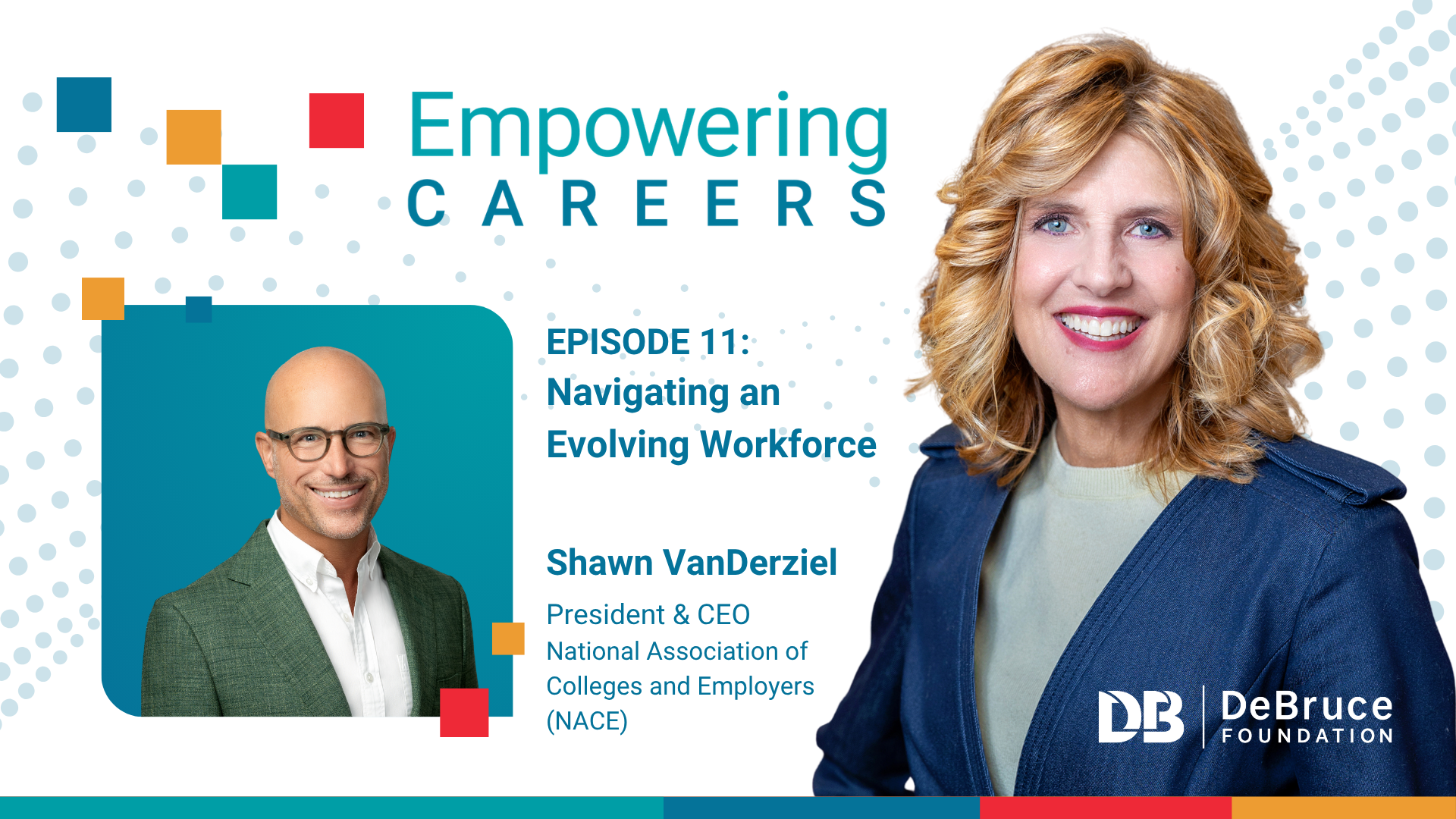
Episode 11 - Navigating an Evolving Workforce


Takeaways
Transcript
Dr. Leigh Anne Taylor Knight
Welcome to the DeBruce Foundation’s Empowering Careers podcast, where we explore insights and strategies for building empowered careers. Hello, my name is Dr. Leigh Anne Taylor Knight, and I serve as the Executive Director and Chief Operating Officer of the DeBruce Foundation. Thank you for joining us today. I am thrilled to welcome Shawn VanDerziel, the President and Chief Executive Officer of the National Association of Colleges and Employers (NACE), to our podcast. He’s got more than 25 years of experience in human resources, higher education, and leadership. Shawn brings great insight into the transition from college to career, internships, career readiness, and the future of work. Shawn, welcome today.
Shawn VanDerziel
Hi, Leigh Ann. It’s great to be here. Boy, you made me sound really good. Okay. Let’s get this going.
Dr. Leigh Anne Taylor Knight
I know. Let’s see if you can live up to it. We’ll start with a softball question here. Okay. It’s an easy one. Just thinking about your career journey, I mean, Shawn, You’ve literally lived across different career lives with lots of different opportunities. Can you tell us, looking back on that career, are there experiences that shape the way you think about helping people launch meaningful careers?
Shawn VanDerziel
Well, I think it goes back to myself and thinking about my own career journey and how I got to where I am and what it took to get here. But also thinking empathetically to— around others that also go through similar experiences, whether they be friends, family, close acquaintances, and hearing struggles that folks have in entering the workforce or figuring out their careers or going to college and not knowing what they’re going to do or going to college and having a dream, thinking about what they— want it to do and something gets in the way of that or, or things change course. And so those stories and looking at them holistically really have inspired my career to the point where I am today and wanting to make the journey that much less painful for others into the future and making it enjoyable.
Dr. Leigh Anne Taylor Knight
Well, and that leads us perfectly into, maybe sharing with our audience the mission of National Association of Colleges and Employers— of Employees. Like, probably people maybe aren’t that familiar with NACE, so I think that’s a nice transition. What’s the mission of NACE?
Shawn VanDerziel
Sure. So the National Association of Colleges and Employers, otherwise known as NACE, is a membership organization, and what we what we do is to bring together folks who work on college campuses, who mostly work in career services, but those who are also interested in career readiness, and then the employers, the recruiters who go into college campuses to actually hire new college talent. So about two-thirds of our members work on those college campuses helping to prepare college students for the world of work, and then the other third are those recruiters who are looking to fill their talent pipeline in their companies. The colleges and Universities really range the whole gambit from 2-year, 4-year, public, private, large, small. And our employers, uh, have the same spectrum. They’re small to large. The average size tends to be around 8,000 employees. So many of the name brands that you can think of or know are likely members of NACE. And these two communities are interested in the future of work and molding the future of work through talent. And so coming together to bridge that is vitally important so that we have a thriving workforce, and that’s really the goal.
Dr. Leigh Anne Taylor Knight
And you mentioned career readiness, and I know NACE was ahead of the curve by actually establishing the career readiness competencies. Could you talk a little bit about that definition of career readiness and how having a shared language can be so important for the students you’re serving, the educators, the employers, just all of those stakeholders, Shawn?
Shawn VanDerziel
Yeah, so higher education can be a tricky place for many people because they go to school and they take lots of classes to obtain all kinds of knowledge that they’re hopefully going to use one day and to make them better people and better citizens. But they’re also there to get a leg up on their future, particularly for careers. And oftentimes, because we’re going through all of this coursework, we lose sight of how that coursework actually plays into our careers in the end. And so if I’m a— let’s say I’m a biology student, but I have to take an English course, and the question is, is what does that English literature course have to do with my career? Uh, and so the idea is, is that no matter what course you’re taking and no matter how you’re, you’re going about your education, that every class can be connected and is connected to career. And therefore, what we wanna do is through your educational experiences to ensure that there is a connection between your experiences and your coursework to your eventual career, therefore career readiness. So do you know how to conduct the basics of a job search?
Shawn VanDerziel
Do you know what the skills and the knowledge that you’re obtaining and how that applies to the world of work? Or your career eventually. So we did create something called the comp— our competency model. So it’s the NACE competency model, and it’s the most widely adopted competency model on campuses today. And the idea is that there are these 8 main competencies or skills that employers universally want from employees, and they serve as a foundation for being a great employee who can work through lots of different kinds of scenarios and problems. And we test these, so we regularly survey employers about them and what they’re looking for, and these really stand the test of time. So what we want to do with those and what the tools are that we’ve put in place around them are to ensure that when you’re taking a class or you’re going through an extracurricular activity, a leadership experience, whatever it may be, that you are able to evaluate what you’re doing there and to articulate back all of the things that you’ve learned, but to do so in a way that future employers will understand how that can apply to them.
Shawn VanDerziel
So if I am doing a project in a class and I’m working with 3 other students, Well, you may have some project management skills as an example.
Dr. Leigh Anne Taylor Knight
Mm-hmm.
Shawn VanDerziel
Uh, you probably have gained some communication skills cuz inevitably there was some conflict within the group around how to get to where you’re gonna go. There had to be collaboration and who’s gonna take which parts of the project and how that would happen. Uh, at the end, there’s probably communication that needed to happen, whether a written report and you’ve gained writing skills or a verbal report where you’ve had to speak. And so while the course may have been about something in the humanities, as an example, all of those skills were gained directly apply to the workplace. And so we’re on a mission to help students to articulate all of the things that they are learning in the classroom and outside the classroom so that employers can understand it in plain language and so that students are taking full accountability for the things that they’re learning and that they too can articulate it.
Dr. Leigh Anne Taylor Knight
I, I appreciate and want to amplify that you started in the place of establishing relevance for students, and that is so very important. And you ended in the place of accountability and students being accountable for their learning, but also being able to communicate that in their next settings. And I think that’s a part— we talk a lot about career literacy here at the DeBruce Foundation. And that ability to be able to communicate that set of skills into and translate that into how you bring value into the career marketplace is so important. But it starts back with that, the relevance and helping students see that across, you know, every single setting and building into that. Also, those skills that you’re talking about, as I think about the future of work, and you’ve shared about the future of work and technology and AI and what’s coming, those skills that you shared will be— are important today, will continue to be important. Maybe you want to talk a little bit about that, or maybe what you guys are looking at, even in terms of you do a job outlook report every single year. I love reading that. So are there some big takeaways from this year’s report that connect the dots in some of those spaces?
Shawn VanDerziel
Yeah, sure. So it’s been a tough labor market overall for the last 3 years, and it’s not just for new college graduates, it’s the entire labor market. And but it’s been particularly hard for new college graduates. And the reason being— there are a number of reasons, but one of the primary reasons is that there’s more experienced talent in the marketplace looking for jobs at the same time that new college graduates are coming out because it’s such a tight labor market. And but there are jobs available and employers are doing their best to create new jobs. So we saw a little uptick this last job outlook for graduates who are just now coming out, which is great news, but it’s still not getting us back to where we were several years ago. And so we’re hoping that that’s going to increase. There’s hope there. We’ve got to continue to monitor those economic indicators that are out there. There isn’t one industry or industries that are on the decline in terms of, of graduates being hired or students being hired. There are companies within every industry that are hiring, and there are companies within some industries that aren’t hiring at all.
Shawn VanDerziel
And so it, it becomes that much more complex when you’re doing your job search, uh, to really dig deep for those jobs. Now, having talked about the economy, uh, and as you mentioned, you, you can’t talk about jobs these days without talking about AI. And what we found is, is that there probably are some instances in the workplace, uh, in terms of job creation where employers are holding back a little bit on job creation because they’re waiting to see how AI may help them in their company to potentially save on cost and reduce the overhead of having employees.
Dr. Leigh Anne Taylor Knight
Mm-hmm.
Shawn VanDerziel
However, We are not finding whole scale that employers aren’t hiring because of AI. So meaning replacing jobs yet with AI. That could come. There’s been a lot of scare in the marketplace about it. But the reality is that it’s not happening. There are jobs available, and companies are all still trying to figure it out how to apply AI to jobs, helping to supplement and make jobs more efficient and more effective. So long term, there could be some dramatic impacts, but we don’t see it anytime in the immediate future. Very few companies have actually eliminated jobs.
Dr. Leigh Anne Taylor Knight
I think that’s really helpful for our audience to, to hear. And it makes me think about too, as you talk about the competitive market that the students, the graduates are going into, how much more important it is for them to have a very compelling story about their experiences. And we know that when they’re in college, they have really valuable experiences. Many of them have internships, they’ve led organizations, they’ve volunteered in their communities. I mean, college students do a lot more of that, I feel like, today than we have in generations past. But if they struggle to connect those experiences to, like, who they are and can be as a professional, What advice would you give them? I know we’ve got some students listening and we have a lot of people who help students navigate that. What advice would you give for telling that compelling story in this competitive market and knowing that people are still going to get hired? How do you tell that, your story?
Shawn VanDerziel
Yeah, and you really hit on it, which is take a full accounting of all of your experiences. And how those experiences may apply to the workplace.
Dr. Leigh Anne Taylor Knight
Mm-hmm.
Shawn VanDerziel
Some of them you may have discounted and may have thought, “Mm, an employer isn’t gonna be interested in that,” or, “What does that have to do with a job?” But when you lack experience, you need to show experience because there are lots of folks out there who probably do have more experience than you in terms of a job if you’re a new college graduate, jobs that they’ve held in the past, and you’re competing against them. So how do you stand out? Well, you stand out by celebrating all of the things that you have done, the responsibilities that you’ve held in those activities, and the skills that you learned in those activities. So it could be at your church, serving as a leader in your church, or volunteering at your church. What did you actually do? Guess what? That applies to the workplace.
Dr. Leigh Anne Taylor Knight
Yes.
Shawn VanDerziel
Uh, in your experiences serving on a, uh, student activity, maybe that activity was a sport and you were on a volleyball team. Well, being on that team is important to show that you served on a team, and that shows how you have drive and initiative and you’re competitive and things that employers actually value. So how can you account for that for yourself? Think through what skills you learned and the responsibilities you had. Maybe you were the captain of that team. Well, you were a leader. Mm-hmm. Employers want to see that. They want to see that you have leadership ability and that you were the communicator for the team.
Dr. Leigh Anne Taylor Knight
Yeah.
Shawn VanDerziel
Now, same thing could happen with those internships. Summer jobs. What were those? Okay, I worked in an office just as an office assistant for, for $10 an hour. Well, great. Put that down. Those are experiences worth telling. And so it’s super important before entering into a job search that you think through all of your skills. And with those skills that you’ve learned broadly, as I’ve just described them, What is it that you enjoy doing and what is it that you don’t enjoy doing?
Dr. Leigh Anne Taylor Knight
Yes.
Shawn VanDerziel
And start tailoring your job search, looking for jobs that are about those skills, uh, so that you can have a good match. Because I will tell you what, there are thousands of jobs out there that you never even knew existed.
Dr. Leigh Anne Taylor Knight
Yes.
Shawn VanDerziel
And so if you are distinguish yourself for the skills that you have, you may actually then open yourself up to a world of possibilities that you never knew even existed to begin with.
Dr. Leigh Anne Taylor Knight
Oh, Shawn, I promise audience, I did not pay him to say this, but I am right now going to say that that’s exactly our mission here at the DeBruce Foundation is to expand career pathways. And your piece about opening yourself up, being open to sectors and industries and jobs that you’ve never ever heard of. That actually is a really key component to career literacy and navigating this future of work, and which I say it’s no longer the future. We are here today. And those skills that you’re talking about, understanding that cross-section of like, what do you like to do and what do you do well? Those skills are— those are work activities. Those are work activities used in every single job in the economy. We call them agilities. Here. But as you were saying, you are developing your skill set and understanding what you like to do, or those agilities, in volunteer experiences, in paid experiences. And when you can say, I actually developed my ability to manage others when I was the captain of this co-curricular volleyball team, or when I was at this receptionist job, I actually learned about how to organize and you can give some more specific work activity language to that, you really can then stack up in this competitive market because you’re applying what you have experienced that may not have a job title with it, but you will help translate that for those who are thinking about hiring you or have you in that candidate pool.
Shawn VanDerziel
So, yeah, ultimately it’s about selling yourself. And you can’t— don’t sell yourself short, right? You hear that about selling short, and that’s what it is, is when you don’t take enough, um, how do you say, credit. You don’t take enough credit for who you are and what you’ve done. And it may seem small to you at the moment, something that you did, But it could make a significant difference in the story that you tell to others. Yes. And ultimately, that’s what an employer wants is someone who they know is going to be able to communicate about the things that they do. Yes. And that’s what happens in the workplace. And hey, let’s face it, careers are not linear. Careers change. Do not happen overnight, right? And we often start in one place and we end in a very different place because a career is a winding path. And so that the ideas that you just exclaimed around being open to possibilities is so important because that first job may not be your dream job. Because you thought maybe you would be someplace else. But perhaps that job just isn’t available right now.
Dr. Leigh Anne Taylor Knight
Mm-hmm.
Shawn VanDerziel
But you really need a job. Or perhaps there, um, that job you don’t have the real experience for, and there are so many more experienced candidates that are getting it. So where do you start? How can you keep honing those skills to get to where you want? And what are the jobs that could help you to do that? You know, even in my own experience, my career has been a winding road from one thing to the other. And what I’ve been able to do is to— I’ve had 4 professional jobs in my lifetime, and in each of those jobs, what I’ve been able to do— and they’ve been very different jobs, but they have all connected in some way. But to an outsider, may look very different. But what I was able to do was to tell my story from one to the other and to convince that next person to take a chance on me because of those previous experiences.
Dr. Leigh Anne Taylor Knight
Yeah. Yes. No, you are an excellent role model for that. And I think our young people and, and adults, like all of us, need to have that growth mindset, right? That and to, to be open to, yeah, that looks like a really different job from what I’m doing now, but I can transfer those skills into that opportunity. Telling that story is very important. There’s a story also that’s out there. We do a lot of research with young people and talking with folks who are across the country. You’ve seen this also in other research pieces that young people are thinking differently about education than previous generations, right? They’re They’re really asking some very practical questions about cost, about return on investment, the value, the career outcomes that, that go with this. You work with colleges and employers every day. What role does college play in preparing people for meaningful careers today, Shawn?
Shawn VanDerziel
Yeah, they play a really important role. Employers have not given up on the college degree. —despite what the media may make it out to sound, or other sources. We have found in all of our research that employers still are relying on the college degree as a real signal for the future that you hold within a company and filling a pipeline for them for the future. They want to grow leaders. And they want to grow their talent. And college education provides a very efficient way of gaining lots of knowledge and lots of skills in a very short period of time, where it may take others, uh, who maybe didn’t have those same coursework experiences and extracurricular activities much longer to get to the same place. And so it’s a great way to build that foundation, and employers see that. Now, having said that, you brought up an interesting question, which is accountability of colleges and thinking about when you’re going into that journey. Are— should colleges be accountable? They should. And we should all be very deliberate in the schools and the programs that we choose to make sure that they’re going to deliver on, one, their own promise, but two, what it is we want to get out of our education.
Shawn VanDerziel
And again, taking responsibility for that. So what that means is asking lots of tough questions and looking for lots of information before even choosing the programs and the colleges that we go to. Are they being transparent about where their graduates are going? Do they have a good employer base that they’re working with? What are the connections they’re going to help me to make? Will I be able to get an internship through my career with that college? These are important questions to ask, uh, when entering into any program and when going through a program, because those are the things that could make a difference. Once you get towards that graduation date.
Dr. Leigh Anne Taylor Knight
Yeah, well, and we know that those connections, those internships, they really build those strongest bridges, right, between our education and our employment. So what advice would you give both to employers and to students to make internships more meaningful than just, you know, something that checks a box? Shawn?
Shawn VanDerziel
Yeah, you mentioned this a little bit earlier, but it’s about exploration. Right. So for an employer, it’s exploring you to be an employee, potentially. Yes. It’s also about potentially doing a project that maybe that employer has been trying to get off the ground, but they have an intern to help them to actually get it off the ground. They have a new resource so the intern can do real work. And while they’re doing that real work, evaluating that intern to say, hmm, could they be a future employee of ours? On the flip side, it’s an experience for those students to just gain some experience to see what real work life is about or what a particular industry is about or a type of job is about or whether or not the kinds of tasks that they’re assigned to are things that they like to do or that they’re good at doing. And so it’s an ability to evaluate for yourself your own skills, your own ability, your own knowledge, and to determine what you want to do with that next. And perhaps that employer is exactly where you want to be next, but you may learn that it’s not.
Shawn VanDerziel
So it’s a great exploratory activity that works for both parties in the end. It is, and it’s, it’s so important.
Dr. Leigh Anne Taylor Knight
It is it is for both parties. You know, the interns are trying this on to see just as much like, do I want to be here as do I not want to be here? That is, that is 100% of a person’s job when they’re interviewing for a job or interning. And, you know, the same with the employers. You learn so much about yourself. You learn so much about yourself within the workplace. Just the other day, Ava, one of our current interns, had mentioned that as she’s learning across an internship, a desire to be in the office rather than hybrid. And I thought, now that’s interesting because sometimes we’re hearing that, oh, nope, nobody wants to go to the office anymore, none of the young people. But there is some really strong research out there to say that there’s value in being in that. So I thought it was interesting to hear from one of our own interns that that’s one of the things that she’s learning across her internship is how her level of accountability and what that might be in an in-office situation versus a remote situation and just the, the gains that she could have in the office that she wants her first job to be in the office.
Shawn VanDerziel
Yeah, there’s so much to it. I mean, these experiences, both from the employer perspective and the student perspective, are— it’s what you make of it. It’s what you put into it is what you are going to get out of it. And there are lots of learnings to be had on the virtual piece of it. That’s sometimes an interesting— for me, it’s an interesting lesson that I hear lots of employers having that is a little bit of something I tried to myth bust around, which is this notion that these young kids today don’t want to go into the office, and it’s not true. So in fact, Gen Z, we have learned about 3/4 of Gen Z actually They do want to be in the office for their first job. They want to be in the office for their internship. They want to be in office for their first job because they understand the value of being in the office. You also have to understand that this is a generation that spent 2 years of their lives virtually because of COVID and they understand the value of human connection when they didn’t have the human connection. And so they understand what they don’t know.
Shawn VanDerziel
And so they’re trying to achieve what they don’t know. Again, it’s what you put into it, right? But you better believe this group also eventually wants to work hybrid. So as much as they want to be in person, they do want the ability to work flexibly. And so my, my bet is that Gen Z will shape the future of work in terms of how we’re working, and it will likely be hybrid. Moving forward when they’re the leaders.
Dr. Leigh Anne Taylor Knight
Okay, that we like. I love that prediction. We’ll put that on a Post-it note. We’ll see how that, how much that comes true as everybody’s trying to figure it out. You started to lead us into a little bit too of the misconceptions, right? So maybe you could give us another example of a misconception that employers have about today’s graduates, and then maybe what’s one misconception that graduates have about employers? Can you help us see that from both Yeah, sure.
Shawn VanDerziel
I hear often from employers initiative-taking or about how this generation, they don’t really want to work and they don’t take a lot of initiative. And I find this generation to be the reverse. The issue is that employers don’t provide enough feedback or set the expectations in such a way that allow the generation to succeed in a way that is positive for both parties. So this generation does have a deference to their leaders. Uh, they see you as a leader when they come in. Their supervisor is their supervisor, their manager is their manager, and they’re willing to do whatever it takes to get the job done, but they need clear expectations to do that. So they can be very simple things, uh, from, um, what they should wear to work, uh, what you mean when you say take a lunch break. Does that mean 1 hour? Does that mean 30 minutes? That— what does that mean? I have to eat here in the building? What does that mean? What does it mean when I— if I finish a project early, should I be asking you for my next project or should I just be waiting for you to bring me the next project?
Shawn VanDerziel
So we always say, you hear this in the world often, kind is clear, clear is kind. And it’s so true because this generation needs that. They need the instruction and the expectations. They’re new to the workplace. They’re not being lazy. They’re not lacking initiative. They’re lacking direction. And so if you need them to take initiative, it’s explaining what initiative means in your specific scenario or in your workplace. Yeah. Probably a myth. I would give you a myth on the other side around employers, which today I hear a lot in conversations. Which is around the job selection and recruitment, which is nobody’s getting a job because of AI, because AI is running the recruitment process. And I just have to laugh because I think, okay, even if AI is involved in the hiring process, somebody’s getting the job. So AI isn’t preventing a candidate from getting a job. The issue is, is that there may only be one job And there are so many more candidates right now in the selection pool that it’s making it more difficult for all candidates to feel seen and heard through the process. And so if you have one job and you’re getting 1,000 applicants, you still only have one job.
Shawn VanDerziel
And, and so it is hard to get through those processes. But in many cases, it’s, it’s not an AI issue. It’s a volume issue.
Dr. Leigh Anne Taylor Knight
Thank you for both of those misconceptions or myths so that our listeners can, can really be curious about those and look at where they’re seeing those kinds of things happen and sharing in that. Let’s talk a little bit about the connection between employers and higher education. You have this national leadership viewpoint, right, of being able to see probably some of the strongest partnerships that are out there today. So when we look at employers and higher education and how they can partner, are there some trends that you’re seeing? Are there really strong partnerships that we can learn from those, Shawn?
Shawn VanDerziel
Yeah, the— what I love about some of the newest things that are happening are, are experiences that employers are creating that can be brought into the classroom so that the students can actually learn about work in their coursework. Uh, again, the coursework could be broad and general. Maybe it’s marketing and communications. Uh, and rather than just learning about the concepts of marketing, that you actually are able to work on a project that is a real-life scenario in a marketing situation at a company. And so there are a number of ways that employers are doing this by partnering with third parties that are bringing those into the classroom, or they’re working directly with universities and faculty to make that happen. And it’s also happening with student groups as an example. So where an employer will come in and work with a student group to— maybe it’s a business student group and they’re working with that business group, student group, to do a project related to that company. It’s a win-win for everybody because then that student can put that on their resume that they did a project with this company. They actually learned a whole bunch of new stuff and the employer was able to gain exposure to those students who could be future employees.
Shawn VanDerziel
And they’re also giving exposure to their company in general. And so the ambassadorship around that company becomes even more heightened.
Dr. Leigh Anne Taylor Knight
And I think our students are going to continue to up the standards that they have for these experiences because so many of these work-based learning experiences, project-based learning experiences, career-connected learning experiences, whatever you want to call them, are happening at younger and younger ages, right? So they’re having these experiences. And they will expect an even next-level standard at the college level when they get to that. So, and I love the idea of student groups actually driving some of this too, right? I mean, the opportunity to bring student voice into this work, we’re just starting to scratch the surface of that, right? And how much stronger we will all be for the future of the workforce and in the future as we bring that student voice into rooms and it’s amplified. And so student organizations leading some of that effort, I think, is one of the most promising things for, you know, the future of our workforce and the hope that I see. Are there, are there places of hope that you really see, Shawn, for students preparing to launch their careers?
Shawn VanDerziel
Yeah, there are, there are all kinds of hopeful things that are happening in the world. I would agree with you, using your voice is so important, and how you use your voice is, is vital. And so that can happen in many ways. You know, a simple example of that would be You don’t know until you ask. So using your voice to just ask questions of things that you really don’t know the answer to, or maybe you know the answer to because you heard one person say it, but you want verification of it. And that includes the job process. So you are at a picnic. With extended family, and there are friends there, and you are just graduating and you’re looking for a job. Well, use your voice. That’s the hope. The hope is, is letting everyone there know you’re looking for a job. Yes. And maybe you meet a small business owner while you’re there. Maybe you, uh, start talking to someone and you all of a sudden you hear they have a cousin who works someplace that you’d like to work too. Yes, you can ask a question. Would you be able to make an introduction for me?
Shawn VanDerziel
Yeah, it’s as easy as that. Sometimes the worst thing that could happen would be they say, oh, I don’t really feel comfortable doing that. Okay, there’s no loss. But it could happen the reverse, which is, right, sure, I’ll make it. I’ll make an introduction for you. That’s easy. Let me text right now. And then you just have a conversation about that company with that person, and who knows where that might lead.
Dr. Leigh Anne Taylor Knight
Yeah, strengthening that network. And even if it’s then that person leads you to another person, right? And it’s really about that network being both wide and deep. And so in that family example, or in a place where, like, you’ve got some people there who they’re going to spend their social capital on you, you know, and really careers Jobs aren’t built alone and they certainly aren’t built like in isolation from networks. Usually, you get a job because somebody says, “Oh, I know Shawn would be great for that. Let’s get him in here.” But that does take you using your voice, asking those questions, being curious, and listening. And then I would also say, and always go ahead and follow up. Then after you’ve met somebody like that, Reach out on LinkedIn. You don’t have to ask them to have coffee. You can just say, it was so nice to meet you at X place, and I enjoyed our conversation about Y, and let’s be connected here on LinkedIn. Because you, you don’t know when those kinds of strong network pieces are going to come, come back around. And, and research shows that that strong network combined with career literacy will be a game changer in empowering individuals in careers and how much money they can make, the opportunities that they have, and even their believing in themselves to be able to take risk and go after some of those jobs where we’re talking about expanding what you will consider.
Dr. Leigh Anne Taylor Knight
So I love that that’s one of the places that you’re bringing us back to. Okay, I have a lightning round of questions that are just like, like 4 questions here that you can just probably answer in one sentence. Okay, let’s do it. All right. One thing every employer should do better?
Shawn VanDerziel
Communicate with their candidates. Love it.
Dr. Leigh Anne Taylor Knight
One thing every student should do before graduating.
Shawn VanDerziel
Oh, every student should do before graduating would be take that full inventory of all of your skills and all of your experiences so that you can plug and play it with it as you see new jobs posted for specific jobs.
Dr. Leigh Anne Taylor Knight
Okay. You’ve also brought us misconceptions and myths today. Is there one career myth that you would just love to retire? Get off the table right now.
Shawn VanDerziel
Well, most people don’t spend their life in one career or at one job. And so it’s— you’re going to do more than one.
Dr. Leigh Anne Taylor Knight
Yeah, I think some of the estimations are 6 careers, 18 jobs. I’ve got a 30— I’ve got a son right now that’s on career number 4, and he’s not been out of college for 10 years yet. So it’s going to happen. It’ll be real. Um, and one piece of advice that you would give to your 22-year-old self?
Shawn VanDerziel
Just keep at it. Don’t get discouraged. Just keep at it. Uh, that opportunities come at the least likely moment, but you do have to work at it. Uh, and so keep at it.
Dr. Leigh Anne Taylor Knight
Yeah. Shawn, thank you so much for joining us today. Thank you for the work that you and your team do at NACE and really for all of those you serve, your college and your employers. They are key to us having this prepared workforce and for those connections, those bridges to be built from education to employment. So I appreciate the work that you do. I love that you amplified today the importance of relevance when we’re working with young people and how colleges and educators can really connect the dots for them to have the relevance of what they’re developing today will be meaningful for tomorrow, for young people to be accountable and to be curious and to ask the right questions, build their networks, understand the skills and how they’re transferable into a variety of opportunities, because that’s really what is going to help them pivot across their entire lifetime, Shawn. So thank you for sharing that wisdom today. And also, I loved that you gave our employers kudos for bringing the projects into the classrooms, for being present with our students, but also that advice about we need to have clear expectations with folks when they start with us and job places.
Dr. Leigh Anne Taylor Knight
And our graduates want to show up, they, they want to be prepared, and they want to do the very best job that they can. So it’s our responsibility as employers to really set those expectations and be Clear. Clear is kind. Kind is clear. So that’s a great note to end on today. Shawn, thank you so much for being here with us.
Shawn VanDerziel
Leigh Anne, it’s been a real pleasure. Thanks for having me.
Dr. Leigh Anne Taylor Knight
Yes. For everyone who tuned in, if you enjoyed this conversation, be sure to check out our website at DeBruce.org and follow the DeBruce Foundation on our social media for more career-building resources. Together, together we can build more empowered careers. We’ll see you next time.