Link copied to clipboard
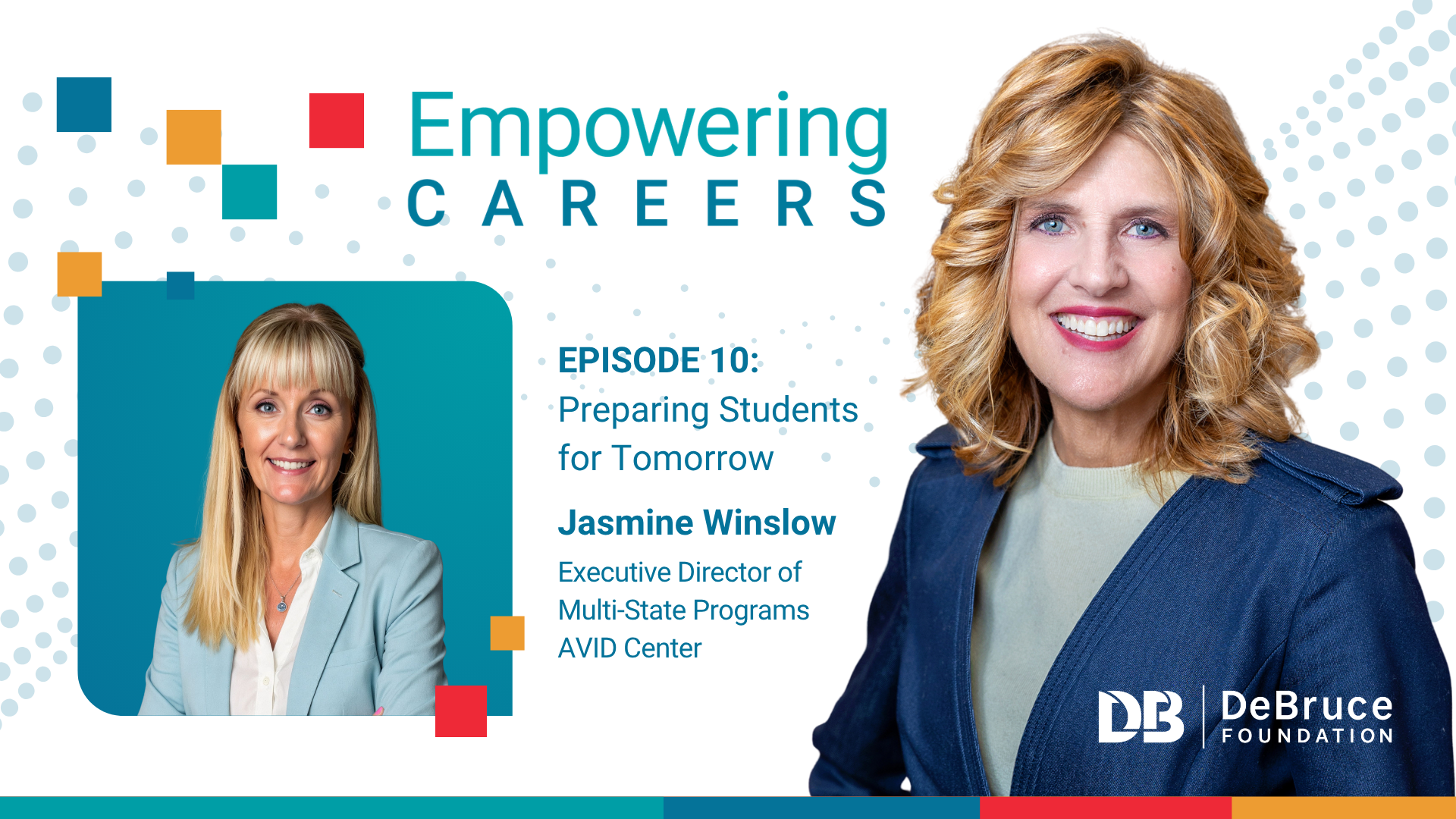
Episode 10 - Preparing Students for Tomorrow


Takeaways
Transcript
Dr. Leigh Anne Taylor Knight
Welcome to the DeBruce Foundation’s Empowering Careers podcast, where we explore strategies and insights into building empowered careers for individuals. I’m Dr. Leigh Anne Taylor Knight, and I serve as the executive director and chief operating officer of The Foundation. Today, I’m really excited to have with us an individual by the name of Jasmine Winslow, who is with AVID. I have long been an admirer of AVID’s work, and so I’m thrilled that she was willing to bring her 23 years of experience in public education as a teacher, as a teacher leader, and as a principal, along with a really deep understanding of the realities and the possibilities for our youth in today’s context. Jasmine, welcome to our podcast.
Jasmine Winslow
Thank you so much. I’m very excited to be here.
Dr. Leigh Anne Taylor Knight
Let’s start with your career journey, right? Your impact spans now multiple states and education systems, but what first drew you to working on expanding opportunities students, Jasmine, and like, was there a defining moment that really shaped your passion for educational equity?
Jasmine Winslow
Thank you. You know, when I think about it, I think that my own journey to college acceptance was sort of the start to this passion because I grew up in a small community in northeastern Oregon, very rural, 2,000 people in the town. So, you know, super tiny town. I can relate, 3,000 in my hometown. There you go. So, um, you know, my family had not attended college before. Um, I was very good in school, uh, but I didn’t really know— as I got closer to the end of high school, I truly didn’t know like all the steps, you know, to get there. And I happened to honestly talk with the school counselor one day in the hallway, and he was like, are you planning to go to college? And I said, well, if I can pay for it, I’d love to. And so that sort of started like through a happenstance conversation in the hallway. You know, I was able to, to kind of open that door and start the conversation about how to make that possible and those steps. And so when I, as I went to college and then decided to become an educator, I knew that I wanted to make sure that I was advocating for students, right?
Jasmine Winslow
Because I had someone who helped advocate for me. I ended up teaching in another small town, but on the other side of the the state of Oregon. And what I experienced there was very interesting because again, lots of low-income, you know, rural students with less access perhaps. But also there were families that were where students were learning English for the first time, right? And so that added another layer to it where I just, I saw in real time that sometimes Families don’t even know how to advocate for their students, and that was a disparity that I was able to see. So, you know, I think that sometimes kids have parent advocates and they will continue to advocate, and they maybe know the right questions to ask, and there’s others that don’t. So as an educator, I knew it was my job to make sure that my students and families were as educated as possible about the pathways that were possible for their students.
Dr. Leigh Anne Taylor Knight
Yeah, I love that. Well, and you even mentioned a happenstance conversation, right? And so some of our listeners may not be familiar with AVID, but when I think about AVID, I think about the mission is to make sure we don’t just rely on happenstance conversations. So could you talk with us a little bit about the approach of AVID to career readiness? Jasmine, and the work that you do in that relationship.
Jasmine Winslow
Absolutely. No, as you said, like, our mission is to close that opportunity gap, right? And so if we’re going to do that, it has to be a systemic piece of the puzzle, not just that one nice teacher or that, you know, like those— we, we always have those teachers that are just those brightest lights and that do that work, and we love them. But, but what if you’re not with that teacher, right? We want to ensure that our system is set up in a better way. So We have a framework where we focus in on first what all students need to be college and career ready, and then also what educators have to do in order to make sure that that happens. And so we know that all of this work has to be grounded in relationships, right? We have to be able to build those relationships where our students trust us, where they are seeing that we’re demonstrating respect to them and they’re demonstrating respect to us. And that they’re just authentic, right? We get to know them in a way that, um, where we can really see what their, you know, not only what their potential is, but what their hopes and wishes are.
Jasmine Winslow
Um, and then I think after that, we have to ensure that we are providing them with rigorous academic experiences. Um, it can’t just be for those classes, again, like those happenstance, like as you get older classes, like, oh, I took this one class and it told me this. We’ve got to make sure we have rigor throughout the day and throughout our K-12 system. We also have to make sure that we provide that opportunity knowledge that, again, I didn’t have as a student growing up and many, you know, don’t have. And that also we train students in how to advocate for themselves, right? Like they, they have the skills and they take it and they can advocate for what they want and where they’re hoping to go. So I think building those skills in the students is so, so important. And if we’re going to do that, there are things that the educators have to do. Yes, right? We all have to be on the same page. And I think for educators, we have to insist on that rigor, right? We can’t just love them to the next grade level like we want to, and we’re so compassionate, but we have to be those warm demanders, right?
Jasmine Winslow
We can be warm and we can ensure that we’re, we’re setting the bar with higher expectations and providing the support that they need to be able to achieve those.
Dr. Leigh Anne Taylor Knight
Yeah, that’s so true. And it is that combination of the relationship and the rigor that goes together so that those students will respond in that situation. One of the things we talk about here with the Foundation too is the importance of instilling that confidence in them. So when you talk about sharing and showing them the opportunities are there, they do have to have the confidence of which you’re speaking to be able to advocate, you know, for themselves. So as you all think about this from AVID’s perspective and just what we’re seeing nationally, are there factors that you think are contributing to those kinds of gaps today that you’re, you’re trying to close? And, you know, you’re giving us some of the solutions that schools and organizations and communities can have. Could you talk a little bit about maybe more about those factors and anything else anything else that you think we all as a community can help to contribute to that?
Jasmine Winslow
Absolutely. So, you know, I think even within our mission statement over the last several years, we’ve evolved from talking about the achievement gap into really that opportunity gap, as we, you know, talked about earlier, because we’re finding that it really is about that unequal access. Right? How are we making sure that all students have the access to be able to pursue those opportunities that are ahead of them? So, um, you know, that is certainly a factor. We know that there are some system-level inequities, right? Maybe funding is different in a, you know, in one state or in certain parts of the state. Um, maybe, um, the, the zip code that you live in, right, it might determine what your school system looks like. So we know that that’s that’s a situation that is present. We know poverty and language and early childhood experiences truly shape the readiness for students, which is why we actually— our program actually starts in kindergarten because we know that that elementary zone is so, so important for getting kids just that— those early academic behaviors that again, they probably didn’t get at home. So we’ve got a program— never too early to start that.
Jasmine Winslow
No, Absolutely not. And then I think, you know, beyond those, some factors, just that, that inconsistent high-quality instruction and high expectations. We have to have those. And, and like I said, you know, we think of it as that warm demander. We’ve got to have both. We’ve got to have the rigor with support. And so, you know, I think that those, those factors really play a role in the outcomes that we’re seeing currently. And so For that to not be the reality, right, for us to, to create a different reality as we move forward, like I said, we’ve got to be more systemic. We have to not be isolated in the changes that we’re creating in our systems. We have to align the instruction, the systems, the leadership, and the culture of districts and schools so that all of those pieces are working together. And then I think, you know, ensuring that our systems are embedding support for every student regardless of, you know, what that looks like, I think is just such a, a key piece to the work that we do. And we’re not trying to fix students, right? Every student is different, we know that.
Jasmine Winslow
We’re always going to have students with different skills and strengths, but really transforming the system so that the system is producing a more replicable outcome, right? We want to have more consistent positive outcomes in our, in our systems. And so that really is the work that, that we are passionate about and that we get to do every day.
Dr. Leigh Anne Taylor Knight
So, you’re working with schools all across the nation and helping implement, and I’m thinking some other schools are probably thinking, hey, we’re trying to do that too. Where, where do you schools, where do you see schools tending to struggle the most when they’re implementing these AVID approaches and how do you support them them through that.
Jasmine Winslow
Absolutely. So without getting into like every detail about, you know, the, the program itself, in our secondary schools there is something that really our program is built upon, which is the AVID elective class. You know, AVID started with one teacher in one classroom in 1980, so we’ve— we’re actually in our 46th year and she had students who were being bused in from a more urban area into her school and in her classes, and she felt like the expectations for those students were not the same. And so creating that elective class and designing that support and what they needed to be able to be sick as successful, um, really helped us design that focus class. And so The AVID elective is actually a course where students are, are recruited into it and they have to apply to get into it because we want to make sure that we have the students that are a right fit for the model, right? There’s lots of different types of supports in school districts, but for the AVID elective, we want students that are in kind of that middle of the road range. You know, maybe they’re your like B or C students, like they’re doing OK, but we know with some targeted support that they could do even better, and we want them to want to be in it, right?
Jasmine Winslow
This is not a course to like fix all students and give them all the exact same, you know, outcomes, though school-wide we do it a little differently. But in this course, we want to make sure that we have the students that are the right fit. So I think that is sometimes where, again, those big-hearted educators, right, we just like, oh, maybe if we put this child there, you know, It just doesn’t always work. So that’s something that we help schools work through. And then the AVID, like, instructional strategies that really are used beyond the elective and like school-wide, they’re all research-based strategies. There’s, there’s so much research to say that these are best practices. Sometimes schools will sort of take this collection, right, of strategies, like, I went to a training and now I’m ready. Yeah, they just sort of sprinkle them throughout their day. Right? Which is lovely, and yes, better than not doing it. But we also know certain strategies are intended to build certain skills in students. And so our focus is on what are the skills your students are needing, right, in this course. And now let’s be really intentional about the strategies that you’re selecting to help build those skills.
Jasmine Winslow
So I’d say those are probably two of the, the most common things that we help support.
Dr. Leigh Anne Taylor Knight
Thank you for sharing those, Jasmine. Let’s, let’s turn— you have this view, you, I mean, your title in and of itself, you work with multiple states as it relates to AVID. So sometimes our audience members are really interested in hearing some of your favorite ways that you see a state or certain states implementing college and career readiness in their schools or in their communities. I mean, what’s something that really stands out for you as this works, this is effective, this is something, or this is something new or innovating that I’m seeing and I’m excited about it.
Jasmine Winslow
Absolutely. So I think, you know, I, I live in Oregon, so I, I definitely am excited about the work that Oregon is doing. So in 2023, they adopted Senate Bill 3, which was Oregon’s higher education and career path path skills course that is now part— starting next year is required for all students who are graduating. So it’s part of the diploma process now. So I think just that in and of itself, that ensuring that there is a course that all students will take to explore their career paths and what higher education opportunities are out there, I think is huge. So what we were able to do as we learned about this requirement was we were able to work with the, the Department of Education and local school district leaders and help them kind of align the resources that we have in place in order to meet the standards that they had created for that course. What was really exciting was we were able to— for the students actually that are already in the AVID elective course, they automatically met those requirements because it’s really like a mini version of what we do. So we were able to help them figure out how do they code it, how do they get it approved.
Jasmine Winslow
And so being a resource for the State Department was, and the schools, was a really great partnership. So I, I’m excited to see how this starts to transform the outcomes that we’re seeing in students and perhaps what they choose to do after high school.
Dr. Leigh Anne Taylor Knight
Well, thank you to AVID and you for performing that role of partnering and, and helping that. And, and we see that too at the DeBruce Foundation. We’re always looking like We want to help every single state in the nation do the best that they can do to expand career pathways for students. And really, those kinds of partnerships where you already have the research, the proof of concept that something is working, and it just ties in and weaves perfectly with what the state expectations are. I mean, I am excited that we see more states taking very seriously how to systematize this effort. So it has to be systemic, it has to be systematic. You kind of mentioned that in the earlier part of the, of the podcast too. So we know that AVID, I mean, it has impacted millions of students, and I love that we got to hear the origin story today with that. So is there, is there a specific story of a student whose journey really captures the, the power of AVID’s approach? I loved hearing that story of the educator that started this, how about a story of a student?
Jasmine Winslow
Jasmine, absolutely. So, you know, we’re really fortunate in that sometimes we get to bring back alumni to be able to talk with at our conferences or even with just our internal staff. And we recently had put together a book of stories of our AVID alumni, and it’s, it’s just great. You know, you have days that where you get get frustrated or whatever and things, things are hard, it’s like, how can I just go back and grab a story and remind myself like, this is why we do this work. And I think all educators need that in their lives. So there’s a story that I heard from a student that was able to present to us last year, and her name was JJ, and her story just captured my heart. So, you know, as many students, she had some pretty traumatizing events happen at a young age. And she was sent to live with her father. She had lived out of the country and was now coming into the U.S., living with her father. So we know that’s a, that’s a very challenging situation. She was starting out in middle school. She didn’t know how to speak English.
Jasmine Winslow
She really remained pretty silent for about 6 months, but at home was like teaching herself English because she was so determined to be successful. Her mother had just told her like, you are going to get us out of this situation, you are going to be successful, right? So those expectations were there, but just not the know-how. So by the time she was in high school, she really had that solid determination, but she didn’t have a vision for what was possible. She kind of assumed she would just go straight to work like her family did, work, you know, several jobs just to make ends meet, and And her freshman year she was in a class and she overheard a teacher come into the class speaking with one of the students there, and it was an AVID teacher, and she was reminding that student that they were going— remember, you’re going to apply for AVID next year, so make sure you get your application in. So JJ actually tracked her down in the hallway, like left the class and tracked her down.
Dr. Leigh Anne Taylor Knight
The initiative, I love that, right?
Jasmine Winslow
As a freshman, I would have done that, but she, she tracked her down. And she started to ask her questions, and she ended up applying and joining AVID her sophomore year in high school, and she just really excelled with that support. And so I think what was so impressive, like the things that she said, was that she found a mentor, right? Like she needed that. She found a mentor and she felt like they saw the potential in her before she saw it in herself.
Dr. Leigh Anne Taylor Knight
Yes. Yes.
Jasmine Winslow
Which is just like, we all need that, right? We all need that. Um, she found like a family and a community where that said she belonged, right? Even though she had been feeling a little bit on the outside and she just was encouraged to imagine a future that had seemed so impossible just, you know, a few years before. So she ends up being a class president her junior and senior years. She ends up with enough scholarship and, you know, money gathered that it’s essentially like a full ride to Florida State University. That avid teacher actually even arranged a ride for her to get driven the 8 hours to be able to be dropped off at college the first time, which is just like, right, these are those teachers we were talking about that just go above and beyond. Yes. But she ended up with a bachelor’s degree in international affairs. She now builds leadership programs, coordinates student housing, and creates community for students. And her message is just reminding students that their circumstances don’t define their potential. And I think that is just a lesson that we all need to hear and that all students need to be, you know, reminded of.
Jasmine Winslow
And so her story among thousands, right? We, we could talk about thousands, but Her story reminds me on those days that are a little bit harder, like, this is why we do what we do, because there are just such amazing kids out there that need, need those advocates and they need us to do this work.
Dr. Leigh Anne Taylor Knight
Yes, and a round of applause for all those teachers and advocates and coaches and career navigators and people in the community that, that step up to mentor and champion our young people. This, as you you shared that story, I was reminded of the research that we have around— the reason this is called the Empowered Careers Podcast is that those who are empowered in their careers have two things: they have career literacy and they have network strength. And that was this student, JJ, was building that network strength. And again, it’s never too early to start and to have that. And are the things that open those opportunities and that access of which you’re speaking and of which AVID is known for, again, opening those doors and those access. So, you know, it’s a really interesting time when our students today, Jasmine, are having to prepare for careers that may not even exist yet. So AVID, the schools, everybody with whom you are working, we’re all trying to figure out how do we prepare students in this world where we don’t even know what’s what some of their careers will be, right? So what shifts do you think are needed in career preparation to help our students navigate this future of work?
Jasmine Winslow
Absolutely, such a great question. You know, I think often when we get into, you know, we think, OK, well, I’ve gone into trade or I’ve gone into a college. I’m going to get trained in how to do the things that that job requires of me.
Dr. Leigh Anne Taylor Knight
Right?
Jasmine Winslow
And there’s certain skills that every job has, and yes, we need to learn those. Those are absolutely vital. And we need to learn critical thinking, right? We have to learn how to think critically. We have to learn to be leaders, because if— what happens when you’re the leader of the group? Like, you’re right, it’s like those school projects that you were, you know, you had when you were in school. Like, somebody’s got to step up and kind of like figure out how to make this work. Well, The same thing happens in our careers, right? We need those people who are going to be leaders and take on those roles. You know, we’ve got to be critical readers, right? Digest information. Just be able to, to see what’s not maybe being explicitly said, right? Like read between the lines, that kind of thing. We’ve got to have growth mindsets because the world is changing. We have to know, like we all have skills that are maybe strengths and weaknesses, and how are we continuing to grow as we move forward. And I think one of the most important skills is just how to be a great collaborator.
Jasmine Winslow
Yes, because if we can collaborate around problems of practice or innovation, we can, we can do whatever is necessary and whatever is going to come next, because we do know like things are changing quickly. So how can we make sure that we’re training students to be those leaders and to be those critical thinkers of tomorrow so that they can tackle, you know, whatever is coming down.
Dr. Leigh Anne Taylor Knight
Yeah, and I’m so glad you mentioned in there both the collaboration piece as well as the growth mindset, right? So if you don’t know what skills you’re gonna need in the future, you do have to have the mindset. And that goes back to earlier, you’re talking about the ability to advocate for yourself, the ability to have the confidence to do that And I love that you mentioned the skills and the interests that individuals have. We call those agilities at the DeBruce Foundation and that crossover of work activities of what you like to do and what you do well. The more that you know that about yourself, but enter that with a growth mindset of a new and different experience can actually improve how well I do something. And I think AVID does give practice for students across the way with that. And again, this is where I feel like there’s hope yet for us to help these students at this time. So when I say that word hope, when you look ahead, what gives you hope, Jasmine, about the future of education and workforce development?
Jasmine Winslow
Absolutely. You know, I think most important is that we are all working together on this, you know, this process. Sometimes the career people and the college-focused people You know, they get into these like bickering situations where, you know, it’s like, no, this is better, this is better. Like, really, it depends exactly like what you’re saying. Like, what am— what skills do I have and what am I interested in? It can go a variety of directions, right? So both are so, so important and play such a critical role. And so ensuring that students have the opportunity knowledge across the board, right? From, from the youngest grades. Like, they need to be able to understand, like, oh, I just read a story about this, what kind of career would that, you know, would that entail? And just starting those conversations early, right? What are some of those careers out there? Um, you know, I know that when I’m in schools right now, sometimes I hear, you know, oh, I’m gonna be a YouTuber, or I’m gonna be, you know, a rocket scientist. It’s still that. And And as these schools are implementing AVID and exploring careers more and more with younger students, we’ll get some like really specific answers from students who are even at the elementary level.
Jasmine Winslow
Like, I’m going to be a, like, an underwater welding specialist. Like, I, I, that’s news to me. I didn’t even know that was a thing. But you know, there’s so many creative things out there that are really, really foundational. So I think for, in addition to opportunity knowledge, that rigorous academic preparedness, right? Having those high expectations and high levels of support for students to be able to be successful from an early age, it’s just going to help students be able to achieve their dreams. And that’s our hope, of course, right? We want them to be able to tackle that with purpose and determination. And, you know, really achieve whatever their hopes are for the future.
Dr. Leigh Anne Taylor Knight
Absolutely. And I think probably all of our listeners care about those very same things. So I’m glad that you’re bringing it home with, with that. And that’s inspirational to all of us.
Jasmine Winslow
Okay.
Dr. Leigh Anne Taylor Knight
Are you ready for a little lightning round of one-sentence answers?
Jasmine Winslow
Can you do that? Absolutely. I’ll do my best.
Dr. Leigh Anne Taylor Knight
Okay, here we go. What’s one thing you hope every learner understands about their own potential?
Jasmine Winslow
That they have it inside them, right? Whatever they, whatever they want, they can put their minds to and achieve.
Dr. Leigh Anne Taylor Knight
What advice would you give students who are figuring out their path?
Jasmine Winslow
You really have to consider what are, what do you enjoy, right? And what are your strengths? And what are you interested in or curious about? Because there’s so much to, to explore there.
Dr. Leigh Anne Taylor Knight
And what’s one thing our audience can do to help students build brighter futures, Jasmine?
Jasmine Winslow
Oh, you know, I think for— I mean, each of us, we can just talk with kids more. Kids are so insightful, you know. Ask them, what are you interested in? You know, what have you learned recently? Be curious, because sometimes I think our students don’t know that like adults really do care about us, and, and kids have great insight. So I talk to kids more, like ask, ask them questions. They’re, they’re deeper than we realize.
Dr. Leigh Anne Taylor Knight
That is, that’s excellent advice. And you know, for me, that winds us back to some of the things that you said were really, really important to help students early on, and that AVID does. Is it’s about that building relationships, right? And so when we’re listening to students, when we’re asking them questions, when we’re being curious, like you just said, that’s some of the best advice for building those initial relationships and inspiring them to even want to do the rigorous work that it takes to prepare for their future. So it is that combination, and you called it being a warm, Warm demander. Warm demander. Okay. If we take away nothing else today, we’re going to be warm demanders. So the demand is about the rigor, the elevated rigor, and the warmth is about that relationship and focusing on how we listen to students and develop those. I mean, we’ve covered those as great insights today. I also want to hearken us back to your other push about about the importance of students be— being collaborators and having a growth mindset. And we as community members, right, educators and career navigators, civic leaders, business leaders who are also getting into this game of education workforce development, we need to collaborate, right?
Dr. Leigh Anne Taylor Knight
I mean, it’s together that we’re going to be able to build these empowered careers. And you’ve really helped drive us home that with that today. Jasmine. So I appreciate your being with us. Thank you for the work you do every day. And thank you for sharing lessons with us today.
Jasmine Winslow
Absolutely. Thank you for having me.
Dr. Leigh Anne Taylor Knight
For everyone who tuned in today and enjoyed the conversation, be sure to follow the DeBruce Foundation at DeBruce.org and us on social media for more career-building resources. Together, as Jasmine reminded us today, we can build empowered careers. We’ll see you next time.